Index
'Property' | Diggers |
Gift | Oppressed |
Fairfax
Land and Freedom
Injustice and the Privatisation of Land in Britain
Charles I: The Commoners' King - halting then reversing
enclosure
Yes... King Charles I was 're-nationalising' newly enclosed land, just before
the English Civil War broke out.
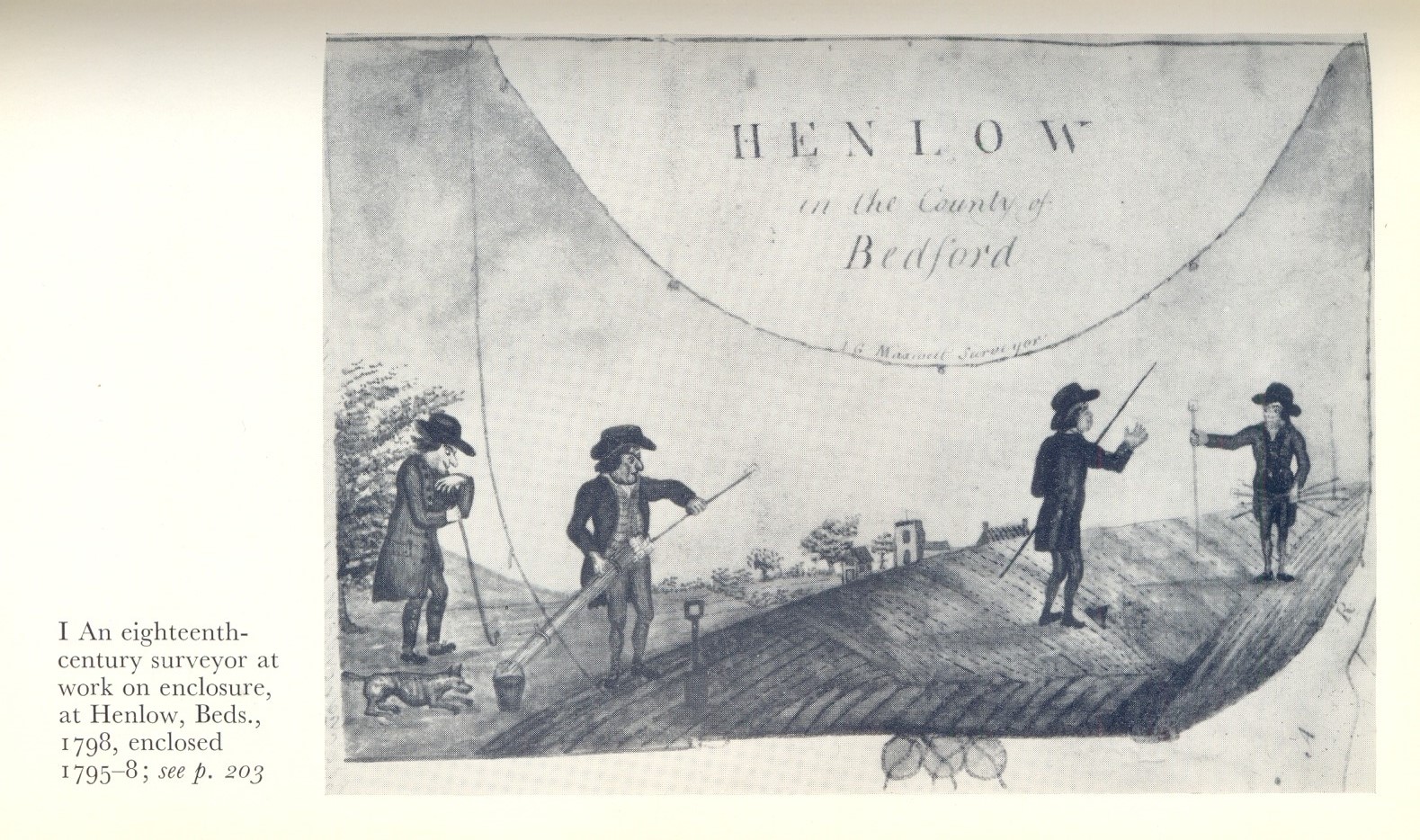 I present here three accounts, from two different books, of pre-Civil War
actions by King Charles I to penalise lords of manors, merchants and other
enclosers. I suggest resentment caused by these retrospective
compositions, or fines, may have been the true reason for acrimony, and
eventually civil war, between England's feudal and merchant classes. It certainly
speaks very well for Charles' record and was largely a result of his good
relationship with Archbishop Laud, who was championing the needs of the new
landless classes within the English government.
I present here three accounts, from two different books, of pre-Civil War
actions by King Charles I to penalise lords of manors, merchants and other
enclosers. I suggest resentment caused by these retrospective
compositions, or fines, may have been the true reason for acrimony, and
eventually civil war, between England's feudal and merchant classes. It certainly
speaks very well for Charles' record and was largely a result of his good
relationship with Archbishop Laud, who was championing the needs of the new
landless classes within the English government.
After the civil war enclosure was greatly accellerated by a landowners
parliament, to blight the entire population to the present day. If the
'compositions' had not been retrospective the merchant class may have put
up with them... but this aspect of Charles' new anti-depopulation and
anti-enclosure fines/laws made the merchant class very angry.
Extract 2 - The English Village Community and the Enclosure
Movements by W. E. Tate, Victor Gollancz, London, 1967 - 'If the reign
in its social and agrarian policy may be judged solely from the number of
anti-enclosure commissions set up, then undoubtedly King Charles I is the
one English monarch of outstanding importance as an agrarian reformer.'
Extract 3 - Common Land and Inclosure, by E. C. K. Gonner.
Macmillan and Co., Limited. St. Martin's Street, London. 1912. - 'In
1633-4 we find a proposal that all inclosures made since James I. should
be thrown back into arable on pain of forfeiture, save such as be compounded
for. The suggestion was not lost sight of, and from 1635 to 1638 compositions
were levied in respect of depopulations in several counties of which an account
is fortunately preserved.' - download
this as a printable Word document with table and footnotes
The Battle of the Braes. Heroic Crofters fight back
against the privatisation of Scottish land in 1882 and bring an end to the
Highland Clearances
English Civil War and the Diggers' Intuition
The Campfire Revolution
by Tony Gosling - June 2009
Squatters are going up market. As liars loans are called in and gangster
capitalists, outside the inner circle, are ejected from their Kitsch mansions,
Mayfair squats are becoming regular news.
In Birmingham 'Justice Not Crisis' are organising waves of group squats matching
homeless people with empty homes and public buildings. From their squatted
Dalston headquarters, Passing Clouds have a minimal overhead business model
for us all … and one of the funkiest clubs in North London. Anticipating
the need for a "money free economy" the squatting group in Bristol have opened
a Free Shop, a High Street version of the internet Free Cycle system. Everywhere
the disposessed and the unsung are refusing to be ruled by a casino elite's
money system.
The twin conundrums of the War of Terror and the Financial Meltdown are making
headlines daily but the real story is how we are responding to the folly
of our ever more secretive, distant and reclusive 'betters'.
This is by no means a NATO zone phenomenon. Churches in Mumbai, India have
been buying tracts of arable land outside the city, handing it to unemployed
urban families, and creating egalitarian villages from the ground up. They
have called the latest Muktapur, 'Salvation Village'.
Even the vision of what kind of Ecological new build we need to downshift
our post industrial nation is being hotly challenged. Is it to be Prince
Charles' £250k stone cladding Poundbury? A Persimmion EcoVillage? An
elitist pseudo revolution is being prepared for us, signed off by 'The Borg'.
An epic struggle is unfolding between ruddy-faced peasant activists and elitist
accountants. Between profit margins and common sense. Between whether the
land is a commodity to be traded like barrels of oil on the open market or
a fundamental human right. It's unlikely to be pretty.
With justice, peace and with peace, beauty. Visions for a just future are
being hotly contested around the campfire. Can ecological justice accommodate
private banking? Or the soulless legal 'person' of the Corporation? Can there
be any hint of justice with war criminals in government? How utterly sunk
is the media? How best to organise?
The G20s greatest financial confidence trick in history looks sure to bring
all these issues to a head, to our doors. A new generation of Levellers,
Ranters and Diggers are rising to the challenge.
Meanwhile new light is being thrown on the true origins, in the 1630s, of
England's first Civil War. Historian W. E. Tate points out that Charles I
acted decisively to make enclosure 'depopulation' a criminal offence.
'From 1635-8 enclosure compositions [fines] were levied in thirteen counties,
some six hundred persons in all being fined, and the total fines levied amounting
to almost £50,000. Enclosers were being prosecuted in the Star Chamber
as late as 1639.'
Though he may not have had the detail, it seems Gerrard Winstanley and his
Diggers were right, recklessly lucrative land privatisation of Cromwell's
merchant class was at the heart of the seven year struggle. Revolution it
was not.
Quite whether our present struggle pans out to such extremes of the BBC's
1975 series 'Survivors' God only knows, but it will be the severest test
yet of our ability to work together. To open meetings and pause before big
decisions in silence or prayer will ensure we don't lose sight of the spiritual.
We all have a part to play on the way to the first Quaker George Fox's vision
of 'a thousand points of light'. "Whether England shall be the first Land,
or some others, wherein Truth shall sit down in triumph."
* The English Village Community and the Enclosure Movements by W. E. Tate,
Victor Gollancz, London, 1967. p. Chapter 11, Enclosure and the State: (A)
In Tudor and Early Stuart Times.
[nb. this article was commissioned by Simon Fairlie for 'The Land' magazine
in May 2009 but he subsequently turned it down]
 Manors, Fields and Flocks: Farming in Medieval England
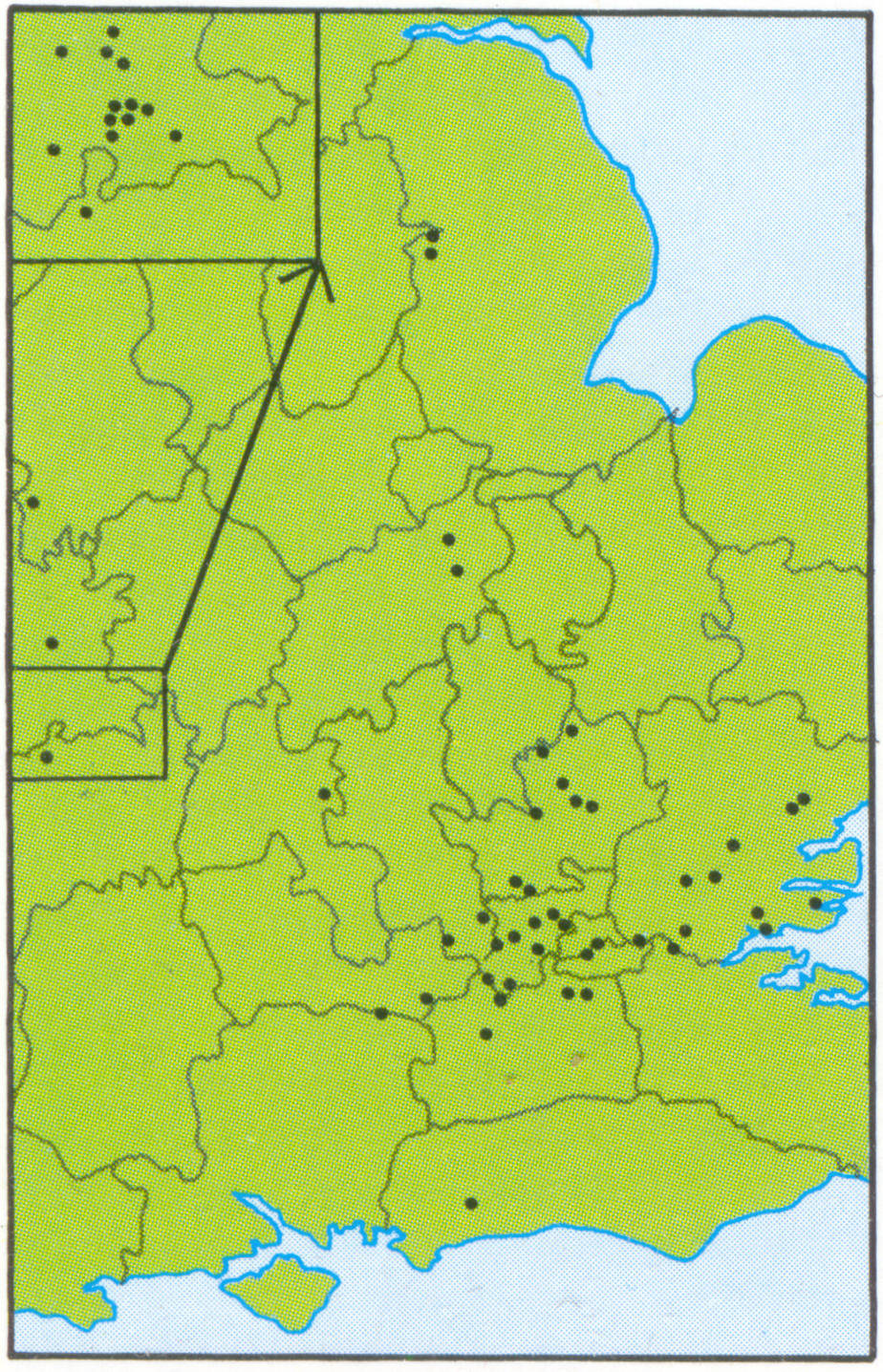
Manors belonging to Westminster Abbey in 1086.
The map shows how widespread the distribution of a
great ecclesiastical estate's possession could be.
Extracted from:-
The Historical Atlas of Britain
by Malcolm Falkus and John Gillingham
Published in 1981 by Granada
ISBN 0 246 11614 5
Manors, Fields and Flocks: Farming in Medieval England
The estate or fief was the unit of large-scale exploitation supporting the
ruling class, and the manor was the constituent cell of which the fiefs and
estates were composed. Each manor in turn consisted of land called the demesne,
which could be managed and cultivated directly by the lord, and land in the
hands of rent-paying tenants, predominantly in small plots.
 Two types of manorial settlement
and cultivation. At Wigston Magna in Leicestershire, good-quality land was
farmed on the three-field system from a central settlement.
Two types of manorial settlement
and cultivation. At Wigston Magna in Leicestershire, good-quality land was
farmed on the three-field system from a central settlement.
If we examine the manor in detail we soon find that it displayed an almost
infinite variety of structures, each one dependent upon a wide range of
jurisdictional, topographical and agricultural variables.. Yet there were
a number of common features which assist the grouping of manors into broad
categories. Most notably we have manors with nuclear or with scattered
settlement, and this distinction went hand in hand with either strip farming
in open fields or with the cultivation of small enclosures. Two examples
illustrate these two main forms of manorial and farming structure. Wigston
Magna in Leicestershire was an open-field village of the classic type, and
its three great fields remained virtually unchanged until 1776. The bulk
of the 70 or more families in medieval Wigs ton lived in cottages lining
the two main streets, close to the village green and between the two churches.
The lands held by each family would be scattered in small strips, often of
an acre or less, in the three fields. By contrast, the upland terrain of
Cornwall was ill-suited to open-field farming and tightly clustered villages.
At Stoke Climsland in the east of the county we find the 100 or more families
on the manor living in scattered hamlets and cultivating compact enclosed
pieces of land. There were over 40 different settlements, and they were
interspersed with expanses of rough pasture and unimproved downland.
In open-field villages the freedom of the individual farmer was limited by
the need to conform to communal routine, for his lands were intermingled
and interlocked with those of other tenements. Under an orthodox, three-field
system, each field would experience a three-year rotation consisting of
winter-sown crops (wheat and rye), spring-sown crops (oats or barley) and
fallow.
 The cultivation of small enclosed
fields by individual families could by contrast be very flexible. Generally
enclosures were prominent in hilly terrain and where land was being taken
in small parcels from moorlands, woodlands, and marshlands. Often convertible
husbandry was pursued, in which the plots were subjected to rotation of crops
followed by a number of years under grass. The length of the grain and grass
cycles could be altered to suit the needs of the farmer and the quality of
the soil; moreover, the rotation helped to improve both crop yields and the
quality of pasture.
The cultivation of small enclosed
fields by individual families could by contrast be very flexible. Generally
enclosures were prominent in hilly terrain and where land was being taken
in small parcels from moorlands, woodlands, and marshlands. Often convertible
husbandry was pursued, in which the plots were subjected to rotation of crops
followed by a number of years under grass. The length of the grain and grass
cycles could be altered to suit the needs of the farmer and the quality of
the soil; moreover, the rotation helped to improve both crop yields and the
quality of pasture.
Two types of manorial settlement and cultivation. At Stoke Climsland in
Cornwall more marginal land led to a pattern of scattered settlements.
Although there were some places, especially in the remote colonizing frontiers,
where fields were of minor importance and enterprise was primarily pastoral,
mixed farming predominated throughout most of England. Consequently, the
right to pasture animals on village fields and wastes was highly prized.
Even in those regions particularly suitable for arable, beasts had to be
reared to draw ploughs and carry produce and people and, of course, livestock
was essential to arable farming as the prime source of fertilizer. Most peasants
aspired to possess plough-beasts, and a few cows, pigs, sheep and poultry,
though their limited resources usually meant that they attained far less.
Landlords, however, frequently built up large herds and vast flocks. During
the wool-production boom of the 13th century a large number of estates kept
flocks of many thousands of animals. In Edward 1's reign the export trade
alone absorbed the fleeces of eight million sheep a year.
English wool was among the finest in Europe. The diagram provides a guide
to the relative quality of the wool produced throughout the country in the
first half of the 14th century. Altogether the prices fixed in 1343 relate
to over 50 different grades of wool, varying in price from £9. 7s. 6d.
a sack down to £2. 10s. 0d. At one end of the spectrum we have the very
best wool from the Shropshire and Herefordshire borderlands, followed by
fine fleeces of Lindsey and the Cotswolds, and at the other end we have Cornish
wool, described contemptuously by contemporaries as 'Cornish hair'.
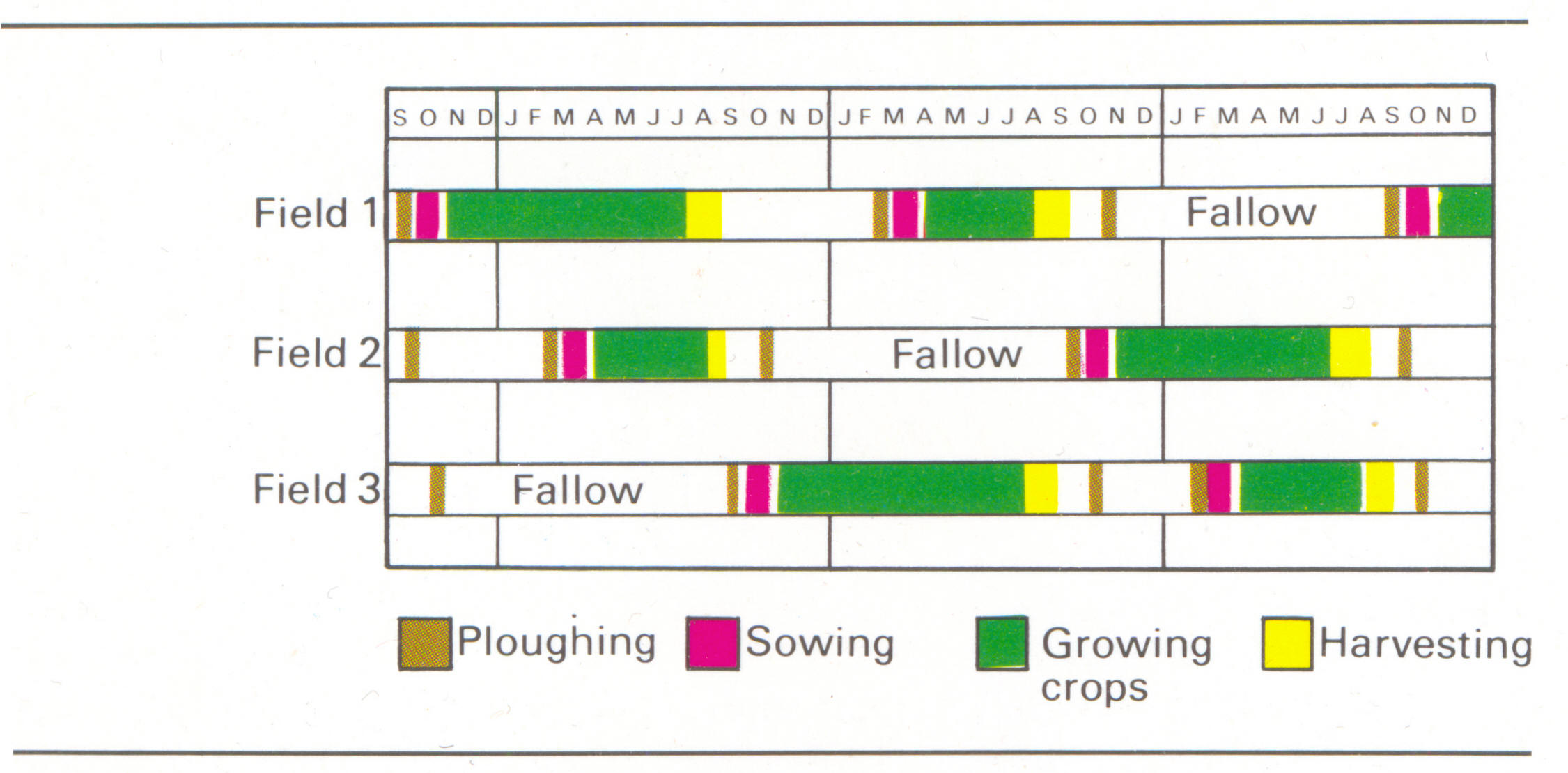 The
operation of the classic open field system.
The
operation of the classic open field system.
Landlords untroubled by the stark struggle for subsistence which characterized
peasant farming, had much greater freedom of choice as to how to manage the
land which they controlled directly, their demesnes. While one choice was
the balance between arable and pastoral, a more fundamental choice was between
direct exploitation and leasing. The 13th century, with its strongly rising
prices for agrarian produce and cheap labour, was the age of direct management,
the age, as it is called, of 'high farming', when landlords marketed increasing
quantities of grain, dairy produce and wool. The 14th century, with its famines
and plague, was a far more difficult period for the large-scale farmer. But
it was not until the last quarter of that century that prices turned decisively
downwards. Thereafter, falling prices for both grain and wool, combined with
rising wages and associated labour problems, undermined demesne profits and
encouraged leasing.
 By modern standards, yields in the
Middle Ages of both arable and livestock husbandry were low. Even the rather
optimistic estimates of contemporary farming treatises put the return of
oats at around only four-fold the seed sown, wheat five-fold, and barley
eight-fold. The average yields actually achieved on the extensive demesne
farms of the Bishops of Winchester never approached even these modest targets.
At these levels wheat and barley would have yielded less than one-third of
today's crops, and oats less than one-fifth. A variety of measures were taken
to improve returns, including in many places the digging in of marl and seaweed.
Many villages also switched from a two-field regime, in which half the land
lay fallow each year, to a three-field system, but the adoption of legumes,
which improved fertility by fixing nitrogen in the soil, was not rapid. It
is possible that, in comparison with modern standards, livestock farming
was relatively more efficient than arable.
By modern standards, yields in the
Middle Ages of both arable and livestock husbandry were low. Even the rather
optimistic estimates of contemporary farming treatises put the return of
oats at around only four-fold the seed sown, wheat five-fold, and barley
eight-fold. The average yields actually achieved on the extensive demesne
farms of the Bishops of Winchester never approached even these modest targets.
At these levels wheat and barley would have yielded less than one-third of
today's crops, and oats less than one-fifth. A variety of measures were taken
to improve returns, including in many places the digging in of marl and seaweed.
Many villages also switched from a two-field regime, in which half the land
lay fallow each year, to a three-field system, but the adoption of legumes,
which improved fertility by fixing nitrogen in the soil, was not rapid. It
is possible that, in comparison with modern standards, livestock farming
was relatively more efficient than arable.
Agricultural prosperity: wool prices in England in 1343, shortly
before the first outbreak of the Black Death. Contemporaries were well aware
of the value of English wool: 'half the wealth of the kingdom' was. how one
of them described it in the late 13th century.
Land Enclosure
The adoption of enclosure, associated with improved crop rotations, was perhaps
the single most important development in agriculture. Whatever advantages
the open fields may have had for the communities which farmed them in earlier
centuries, the greater efficiency and productivity of enclosed land ensured
a progressive abandonment of the open-field system. Nonetheless, looked at
over the centuries, progress was relatively slow. Open fields seem always
to have been less in evidence in the Highland Zone of the North and in the
South-West, in Wales, in Kent, and parts of Essex and in those areas where
land had been reclaimed from forest, waste and marsh. In later medieval and
early modern times enclosure of fields and commons for both pasture and arable
progressed even further in these regions, as well as in others where open
fields had predominated. The later 15th century was a period of widespread
enclosure for pasture, and in the following two centuries we can discern
that the progress of enclosures was most rapid in the North-West, the Welsh
borders, the Vales of Gloucester and Glamorgan, the north-west Midlands,
west Yorkshire, and parts of Norfolk, with each region adopting the type
of enclosure best suited to its needs (see p. 185). By the later 17th century
the greater part of land was enclosed in northern and western regions, and
in the South East; but open fields were still dominant in a broad swathe
of central England. Attention must also be drawn to the other major agricultural
'improvement', engrossment. The concentration of land into larger farms and
the decline of the smallholder were to be powerful forces in raising agricultural
efficiency.
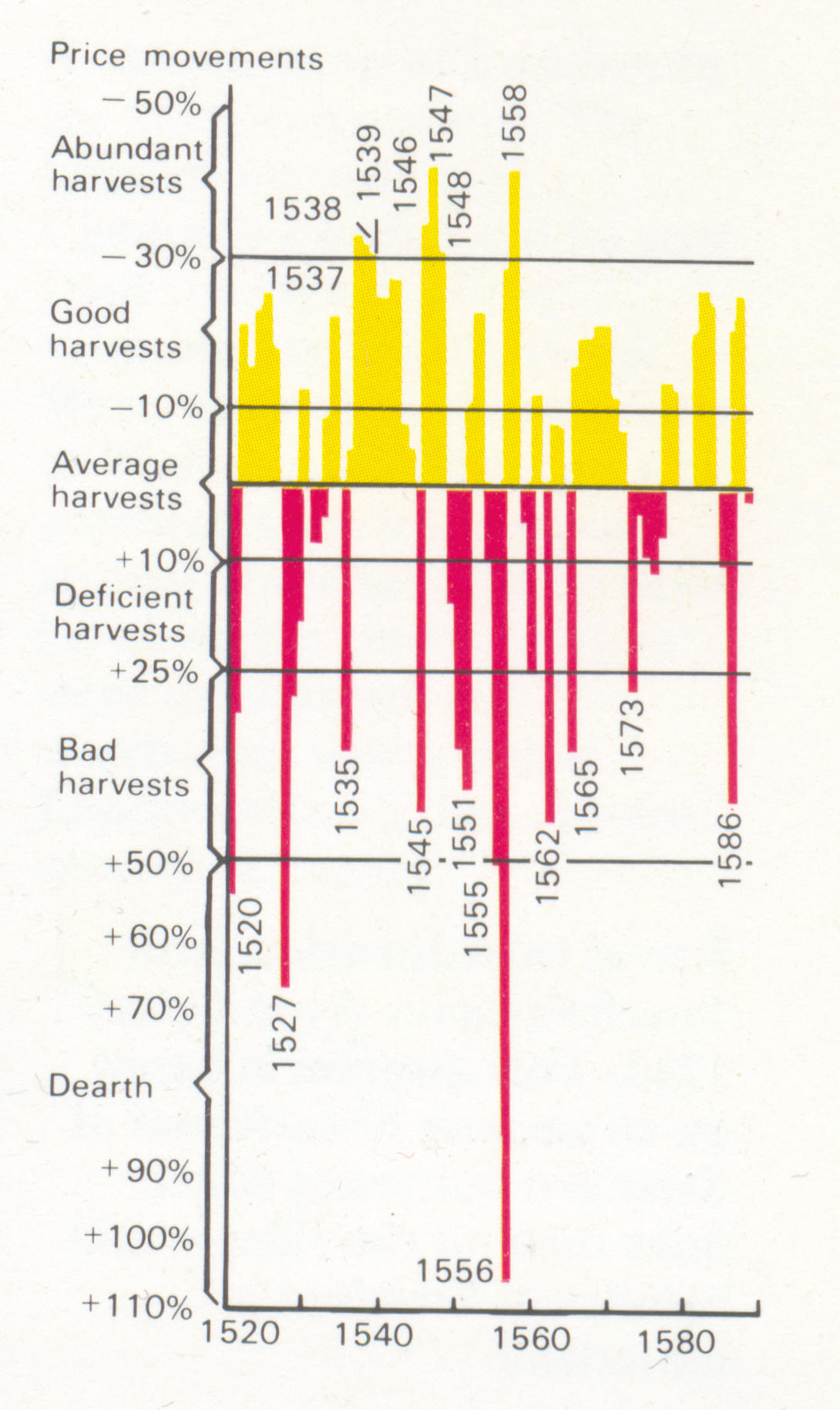 Grain price movements, 1520-90. Prices
oscillated wildly as yields fluctuated. Until the great agrarian improvements
of later centuries, and the development of an international trade in foodstuffs,
all sectors of the economy were deeply affected by the quality of the
harvest.
Grain price movements, 1520-90. Prices
oscillated wildly as yields fluctuated. Until the great agrarian improvements
of later centuries, and the development of an international trade in foodstuffs,
all sectors of the economy were deeply affected by the quality of the
harvest.
It was only after long centuries of agrarian improvement and the opening
up of international trades in foodstuffs on an unprecedented scale, that
the dependence of Englishmen and women upon the state of the harvest was
substantially lessened. During the medieval and early modern centuries the
quality and quantity of the harvest was of paramount importance to the whole
population and to all sectors of the economy. A poor harvest meant that
smallholders had less to eat; a bad harvest forced them to purchase food
in order to survive, and might also entail the sale or slaughter of essential
livestock. Poor yields also meant high prices, so that all those who had
to buy food were left with less money to spend on manufactures and non-essential
items. Thus harvest failures not only struck rural communities; they adversely
affected craftsmen and merchants. The harvest was at the very heart of the
economy and its health was determined by the vagaries of the weather. Prices
oscillated wildly as yields fluctuated. Such instability severely limited
the potential for development and progress in the nation's economy.
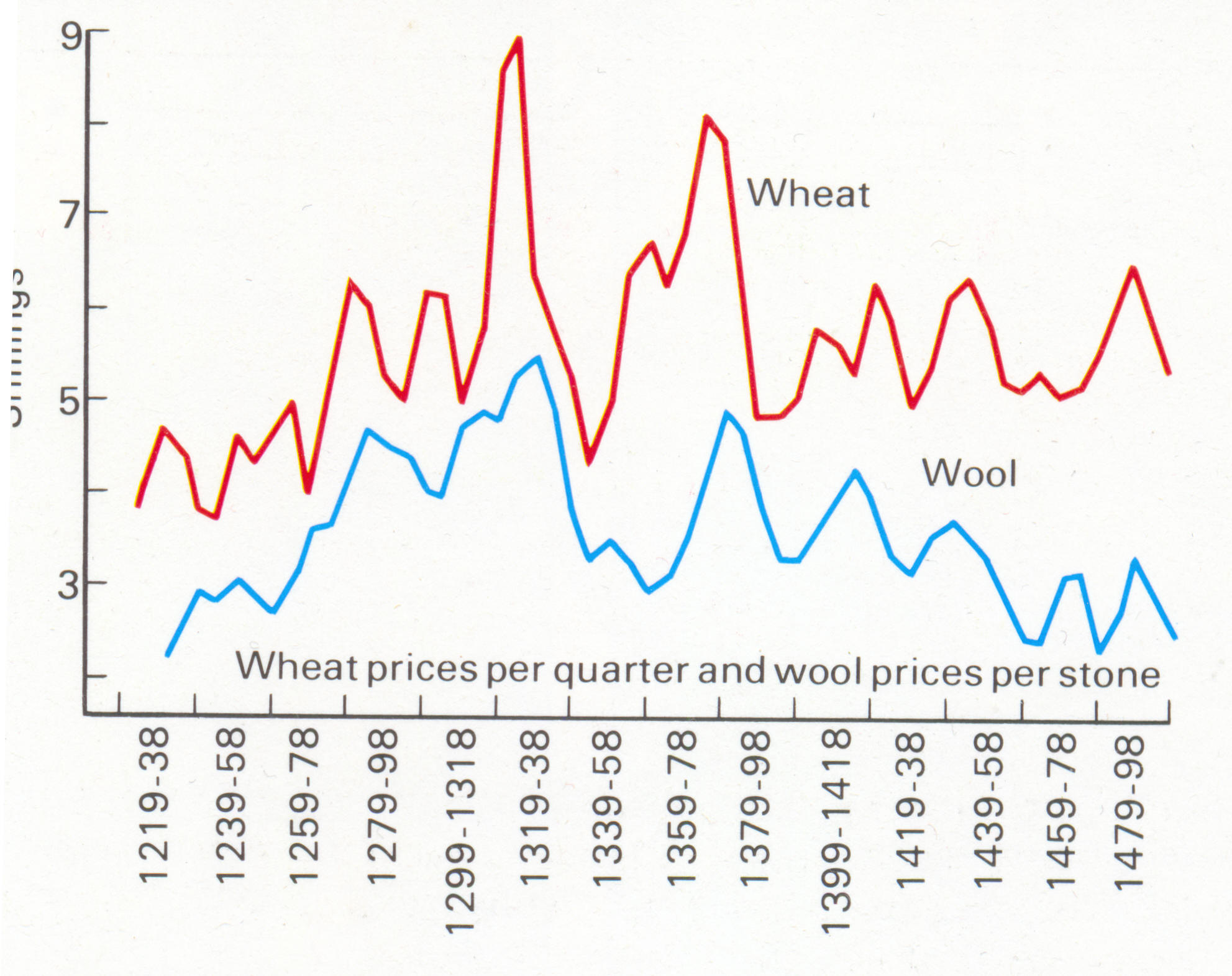
The underlying trends revealed by this graph show steadily rising prices
both for wheat and wool during the 13th century followed by a period of stable
or declining prices in the following two centuries.
Extracted from:-
The Historical Atlas of Britain
by Malcolm Falkus and John Gillingham
Published in 1981 by Granada
ISBN 0 246 11614 5
Manors, Fields and Flocks: Farming in Medieval England
Living on the wasteland
C18 Encyclopedia Brittania definition of the English word 'dole':
'A part or portion, most commonly of a meadow, where several persons have
shares.'
Tony Gosling - April 1999
We're not talking about living on managed nature reserves - the fact is that
high-impact land use (intensive housing and chemical farming)- combined with
a lack of public access (scrutiny) leads to practices far more detrimental
to biodiversity.
You have to be very careful using arguments about exclusivity of access to
land - eg. this piece of land is for plants only. I remember seeing
an Englishman in Scotland getting a cool reception in 1997 when he unveiled
plans for a people-free wildlife area in the Cairngorms, "I'd say ye have
nae spoken wi' many local people. Have ye never heard of the clearances,"
was the frosty reply.
The point we're trying to make is that responsible people manage land for
the benefit of all species - not to the exclusive benefit of man. I believe
Simon's criteria has a section where biodiversity is mentioned as having
to form part of any management plan. That is to say "if you ain't gonna improve
biodiversity you can't have your planning permission"!
I think it's really important to get away from the idea that man is incompatible
with other species. It doesn't have to be like that! The problem is the current
attitude to land which so many farmers have which is that they see it as
their factory floor and don't look at WHY it is necessary or lucrative for
them to use chemicals and force land into monoculture.
The reasons for this have a lot to do with EEC subsidies and modern distribution
networks. But many farmers, and others, are guilty of this partitioned thinking
where they have a 'resigned' attitude to the structure which is forcing tenant
and landowning farmers to intensify their activities to destructive proportions.
The other problem comes from the private ownership of land. This means if
there is any dispute about what should happen or not be allowed on the land
there is no reason to talk to your neighbours. You just do what you want.
It is also a very important concept that the earth is a free gift to mankind.
Not to one class of mankind and not another.
Sharing land forces us to justify our plans in front of the local community
and forces us into a much-needed participatory approach to land use/management.
If a modern day village was to be told the inhabitants were collectivising
the land there would be nothing less than the screaming ab-dabs!!
People get very territorial especially when they have been able to wangle
more than their fair share. But eventually agreement would be reached...
see Ken Loach's film 'Land and Freedom' for an example of this happening
in the Spanish Civil War.
But look at a pre-inclosure village. It would look something like the New
Forest where the land is managed by local agreement and by local consensus.
No wonder the rich and powerful sought fit to inclose it because the local
wouldn't agree to their wishes to ruin it!!!
There is now only one wholly unenclosed village in the country, Laxton in
Nottinghamshire.
Try visiting Laxton or the New forest and tell me if unenclosed land and
wasteland is incompatible with people. You'll find in both these places
the people are a positive benefit to the area.
Charles I: The Commoners' King
"From about 1607 to 1636, the Government pursued an active anti- enclosure
policy" - W.E. Tate
Charles' anti-enclosure policies may have been the spark that ignited the
English Civil War
Extract 1
Historians are inconclusive about the origin and cause of the war. Whatever
brought the merchant classes, or bourgeoisie, to armed conflict with the
landed feudal gentry, personified by the king, must have had a mighty incentive.
Driven by the new capitalist class the move from collective to private ownership
of land was extremely lucrative. To halt it, unforgivable. In the eyes
of the avaricious merchants the king had to go!
Extract from: 'The English Village Community and the Enclosure
Movements'
W. E. Tate, Victor Gollancz, London, 1967. (longer extract
below)
Chapter 11
Enclosure and the State in Tudor and Early Stuart times.
The Policy of the Early Stuart Governments
Probably in Stuart times baser motives weighed more heavily with the governmental
authorities. The Stuart policies, especially that of Charles I, were as Tawney
says, 'smeared with the trail of finance'.,' Enclosure, at any rate enclosure
leading to depopulation, was an offence against the common law."* Commissions
inquired into it, and in many cases the statesmen and divines who composed
these were inspired by the loftiest motives. The general action of the
government, however, was to use the Privy Council and the courts, especially
the prerogative courts, the Court of Requests and the Star Chamber, the Councils
of Wales and the North, as means of extortion. The offenders were 'compounded
with', i.e. huge fines were levied so that the culprits might continue their
malpractices.¹
In 1601 a proposal to repeal the depopulation acts was crushed upon the ground
that the majority of the militia levies were ploughmen.² In 1603 the
Council of the North were ordered to check the 'wrongful taking in of commons'
and the consequent 'decay of houses of husbandry . . .'. From about 1607
to 1636, the Government pursued an active anti- enclosure policy.³ In
1607 the agrarian changes in the Midlands had produced an armed revolt of
the peasantry, beginning in Northamptonshire, where there had been stirrings
of unrest at any rate since 1604. The counties mainly affected were
Northamptonshire, Bedfordshire, Buckinghamshire, Huntingdonshire, Leicestershire,
the three divisions of Lincolnshire, and Warwickshire.
The leader was a certain John Reynolds, nick- named Captain Pouch, 'because
of a great leather pouch which he wore by his side, in which purse he affirmed
to his company there was sufficient matter to defend them against all commers,
but afterwards when he was apprehended, his Pouch was searched, and therein
was only a peece of greene cheese'. John was soon dealt with after a skirmish
at Newton, where a body of mounted gentlemen with their servants dispersed
a body of a thousand rebels, killing some forty or fifty of the poorly-armed
rustics. Some of his followers were hanged and quartered.
Promises of redress made by various proclamations were fulfilled only to
the extent of the appointment of still another royal commission to inquire
into agrarian grievances in the counties named. After it had made its return,
however, it was discovered that on legal technicalities the commission was
invalid, and little action seems to have been taken upon its laboriously
compiled returns. The local gentry were soon busily at work again in enclosing
their own land and that of others, though in 1620 Sir Edward Coke, the greatest
of English judges, who had already shown himself a keen opponent of enclosure,
declared depopulation to be against the laws of the realm, asserting that
the encloser who kept a shepherd and his dog in the place of a flourishing
village community was hateful to God and man.
A reaction set in when in 1619 there were good harvests, and the Privy Council
was concerned to relieve farmers and landlords who were suffering through
the low price of corn. This is why commissions were appointed to grant pardons
for breaches of the depopulation acts, and why in 1624 all save the two acts
of 1597 were repealed. The county justices still, however, attempted to check
the change, and in this received more or less spasmodic pressure from the
Council. In the 1630's corn prices rose again, and in 1630 the justices of
five Midland counties were ordered to remove all enclosures made in the last
two years. In 1632, 1635, and 1636 more commissions were appointed, and the
justices of assize were instructed to enforce the tillage acts. In 1633 they
were cited before the Board to give an account of their proceedings. From
1635-8 enclosure compositions were levied in thirteen counties, some six
hundred persons in all being fined, and the total fines levied amounting
to almost £50,000. Enclosers were being prosecuted in the Star Chamber
as late as 1639. However, the Star Chamber was to vanish in 1641, and the
Stuart administrative policy disappeared with the engines by which it had
been - somewhat ineffectively and spasmodically - put in force.
If the reign in its social and agrarian policy may be judged solely from
the number of anti-enclosure commissions set up, then undoubtedly King Charles
I is the one English monarch of outstanding importance as an agrarian reformer.
How far his policy was due to genuine disinterested love of the poor, and
how far it followed from the more sordid motive of a desire to extort fines
from offenders, it is difficult to say. But even the most unsympathetic critic
must allow a good deal of honest benevolence to his minister Laud, Archbishop
of Canterbury, and some measure of it to his master. On the whole it is perhaps
not too much to say that for a short time after the commissions issued in
1632, 1635, and 1636, Star Chamber dealt fairly effectively with offenders.
The lack of ultimate success of this last governmental attempt to stem the
tide of enclosure was due, no doubt, partly to the mixture of motives on
the part of its proponents. Still more its failure is to be attributed to
the fact that again the local administrators, upon whom the Crown depended
to implement its policy, were of the very [landed] class which included the
worst offenders. A (practising) poacher does not make a very good gamekeeper!
The Commonwealth
During the Commonwealth there was little legal or administrative attempt
to check enclosure of open fields. It is not clear how far this was taking
place, though there was great activity in the enclosure and drainage of
commonable waste. Some of the Major-Generals, especially Edward Whalley,
held strong views upon agrarian matters, and attempted to use their very
extensive powers to carry their ideals into operation. Petitions were prepared
and presented, a committee of the Council of State was appointed and numerous
pamphlets were written.
In 1653 the mayor and aldermen of Leicester complained of local enclosures
and sent a petition to London, very sensibly choosing their neighbour, John
Moore, as its bearer. Appar- ently it was because of this that the same year
the Committee for the Poor were ordered 'to consider of the business where
Enclosures have been made'. The question arose again in 1656 when Whalley,
the Major-General in charge of the Midlands, set on foot local inquiries,
and took fairly drastic action in response to petitions adopted by the grand
juries in his area. He hoped that as a result of his action 'God will not
be provoked, the poor not wronged, depopulation prevented, and the State
not dampnified'. The same year he brought in a Bill 'touching the dividing
of commons', but it failed through the opposition of William Lenthall, the
Master of the Rolls, and indeed was not even given a second reading. This
was the last bill to regulate enclosure. Ten years later, in 1666, another
bill was read in the Lords, to confirm all enclosures made by court decree
in the preceding sixty years. It also was unsuccessful, but the fact that
it was introduced is indicative of a great change in the general attitude
towards enclosure displayed by those in authority.
Footnotes:
* Coke (Chief justice of the King's Bench, 1613-16), was very emphatic on
this, Institutes III, 1644 edn., p. 205. Ellesmere, his great rival (Lord
Chancellor 1603-16), was more favourably disposed to enclosure, and himself
authorised some enclosures by Chancery Decree. The point is of interest,
since it may well have been Ellesmere's attitude which emboldened his kinsmen,
Arthur Mainwaring, to embark on the enclosure of Welcombe, near Stratford,
in 1614. In the story of this, Shakespeare plays a (very minor) part. Tothill,
W., Transactions of the Court of Chancery etc., 1649, edn. 1827, P. 109,
and Ingleby, G. M., Shakespeare and the Welcombe Inclosure, 1885.
¹ There is a tabular statement of the proceeds in Gonner, p. 167 [and
presented below!].
² See D'Ewes, op. cit., p. 674, for Cecil's speech on this.
³ The activity was mainly 1607-18 and 1636, the first spasm being due
presumably to the Midland riots, the second to a period of high corn prices.
Extract 2 - 'If the reign in its social and agrarian policy
may be judged solely from the number of anti-enclosure commissions set up,
then undoubtedly King Charles I is the one English monarch of outstanding
importance as an agrarian reformer.'
Extracted from
The English Village Community and the Enclosure Movements by W. E. Tate,
Victor Gollancz, London, 1967
Chapter 11, Enclosure and the State: (A) In Tudor and Early Stuart Times
The Tudor Governments
From the social and political points of view too the Tudor governments disliked
such enclosures as led or threatened to lead to depopulation. Several of
the Tudor rulers, certainly Henry VIII and the Lord Protector Somerset, had
a quite genuine desire to be fair to the small proprietor, who was usually,
with good reason, bitterly opposed to enclosure. All had a lively apprehension
of the danger of dynastic or religious rebellion, and all were unwilling
that malcontents should be presented with the opportunities afforded by the
existence of a dispossessed and starving peasantry. Even before Henry VIII's
time anti-enclosure measures had been placed on the statute book, and throughout
Tudor times there was a long stream of statutes, proclamations and commissions,
all designed to check a process felt to be utterly destructive of the common
weal. Thus in 1517 there was the commission already referred to. Thirty-two
years later a main count in the indictment against Somerset, under which
at last he lost his head, was that he had been so slack in suppressing Kett's
Rebellion in 1549 as to give the rebellious peasantry an idea that he was
in sympathy with their feelings on the agrarian grievances which had led
to the disturbance.
The first landmarks in the story of enclosure in Tudor times are the Depopulation
Act of 1489 'agaynst pullying doun of Tounes', a proclamation of 1515 against
engrossing of farms, and certain inquiries by the justices, etc., made the
same year. A temporary act of early 1516 was virtually made permanent later
in the year, and the next year was the commission of 1517, addressed to the
nobles and gentry of all save the four most northerly counties of England,
with other anti-enclosure commissions in 1518 and 1519. In 1519 Wolsey, as
Chancellor, ordered that those claiming the royal pardon for enclosure should
destroy the hedges and ditches made since 1488. A proclamation of 1526 made
a similar order. There was an act for restraining sheep farming in 1534,
and two further depopu-lation acts in 1536. At the same time proceedings
were taken in the Chancery and the Court of Exchequer against enclosers,
sometimes those of lofty station. Evidently the acts and pro-clamations were
little observed, and in 1548 the Protector Somerset issued yet another
proclamation. A movement in the reverse direction was made in 1550, when
as part of the policy of the nobility and gentry who had triumphed over him,
the Statutes of Merton and Westminster 112 were confirmed and re-enacted,
and measures were taken to check hedge and fence-breaking. However, only
two years later another depopulation act was passed, in 1552.
There was still another in Philip and Mary's time, 1555, and one five years
after Elizabeth I's accession, in 1563. This repealed as ineffectual the
three latest depopulation acts, of 1536, 1552, 1555 but re-enacted the earlier
one of 1489. It was repealed in part in 1593. Most of these acts endeavoured
to re-establish the status quo, to forbid under penalty of forfeiture the
conversion of arable to pasture, and to compel the rebuilding of decayed
houses, with the reconversion to arable of pasture which had lately been
put down to grass. Probably the multiplicity of acts is an indication of
their ineffectiveness. The reason was that the administration alike of acts
and commissions was largely in the hands of the landed classes profiting
by agrarian change. In 1589 was passed Elizabeth's famous act prohibiting
the erection of any cottage without four acres of arable land [? and of course,
proportionate pasture rights]. This remained in force, theoretically at any
rate, until 1775. The difficulty with which the government was faced is well
illustrated by two acts of 1593, which passed through Parliament together,
and which in fact stand next to one another on the statute book, but which
adopt markedly contrasting points of view towards enclosures of different
kinds. The first of them, as noted above, repeals much. of the 1563 act,
that part forbidding the conversion of arable to pasture. The second of them
anticipates legislation of the nineteenth century. It orders that no persons
shall enclose commons within three miles of the City of London, 'to the hindrance
of the training or mustering of soldiers, or of walking for recreation, comfort
and health of Her Majesty's people, or of the laudable exercise of shooting.
. .' etc.
The last Depopulation and Tillage Acts
The more complacent attitude towards enclosure evidenced by the first of
the 1593 acts did not last very long. In 1597 were passed two acts, again
neighbours on the statute book, the first for the re-erection (though with
some qualifications) of houses of husbandry which had been decayed. At the
same time the government clearly recognized that if it merely tried by
legislation to maintain or to restore the status quo, its efforts would be
in vain. So the same act specifically authorizes lords of manors, or tenants
with their lord's consent, to exchange intermixed open-field holdings in
order to facilitate improved husbandry. The preamble of the second act sets
out that since 1593 [and the partial repeal of the tillage acts then] 'there
have growen many more Depopulacions by turning Tillage into Pasture', and
the first act orders that decayed houses were to be re-erected, and lands
reconverted to tillage under a penalty of 20s. per acre per annum. The second
act relates to twenty- three counties only, generally those of the Midlands,
with one or two southern counties, and Pembrokeshire in South Wales. These
were the last of the depopulation and tillage acts, and they escaped the
general repeal of such acts in 1624, and remained in force (in theory) until
1863.
The Policy of the Early Stuart Governments
Probably in Stuart times baser motives weighed more heavily with the governmental
authorities. The Stuart policies, especially that of Charles I, were as Tawney
says, 'smeared with the trail of finance'. Enclosure, at any rate enclosure
leading to depopulation, was an offence against the common law. Commissions
inquired into it, and in many cases the statesmen and divines who composed
these were inspired by the loftiest motives. The general action of the
government, however, was to use the Privy Council and the courts, especially
the prerogative courts, the Court of Requests and the Star Chamber, the Councils
of Wales and the North, as means of extortion. The offenders were 'compounded
with', i.e. huge fines were levied so that the culprits might continue their
malpractices.
In 1601 a proposal to repeal the depopulation acts was crushed upon the ground
that the majority of the militia levies were ploughmen. In 1603 the Council
of the Nortt were ordered to check the 'wrongful taking in of commons and
the consequent 'decay of houses of husbandry. . .'. From about 1607 to 1636,
the Government pursued an active anti-enclosure policy. In 1607 the agrarian
changes in the Midland had produced an armed revolt of the peasantry, beginning
ii Northamptonshire, where there had been stirrings of unrest at any rate
since 1604. The counties mainly affected were Northamptonshire, Bedfordshire,
Buckinghamshire, Huntingdonshire, Leicestershire, the three divisions of
Lincolnshire, and Warwickshire. The leader was a certain John Reynolds, nick
named Captain Pouch, 'because of a great leather pouch which he wore by his
side, in which purse he affirmed to his company there was sufficient matter
to defend them against all comers, but afterwards when he was apprehended,
his Pouch was searched, and therein was only a peece of greene cheese'. John
was soon dealt with after a skirmish at Newton, where a body of mounted gentlemen
with their servants dispersed a body of a thousand rebels, killing some forty
or fifty of the poorly-armed rustics. Some of his followers were hanged and
quartered. Promises of redress made by various proclamations were fulfilled
only to the extent of the appointment of still another royal commission to
inquire into agrarian grievances in the counties named. After it had made
its return, however, it was discovered that on legal technicalities the
commission was invalid, and little action seems to have been taken upon its
laboriously compiled returns. The local gentry were soon busily at work again
in enclosing their own land and that of others, though in 1620 Sir Edward
Coke, the greatest of English judges, who had already shown himself a keen
opponent of enclosure, declared depopulation to be against the laws of the
realm, asserting that the encloser who kept a shepherd and his dog in the
place of a flourishing village community was hateful to God and man.
A reaction set in when in 1619 there were good harvests, and the Privy Council
was concerned to relieve farmers and landlords who were suffering through
the low price of corn. This is why commissions were appointed to grant pardons
for breaches of the depopulation acts, and why in 1624 all save the two acts
of 1597 were repealed. The county justices still, however, attempted to check
the change, and in this received more or less spasmodic pressure from the
Council. In the 1630's corn prices rose again, and in 1630 the justices of
five Midland counties were ordered to remove all enclosures made in the last
two years. In 1632, 1635, and 1636 more commissions were appointed, and the
justices of assize were instructed to enforce the tillage acts. In 1633 they
were cited before the Board to give an account of their proceedings. From
1635-8 enclosure com-positions were levied in thirteen counties, some six
hundred persons in all being fined, and the total fines levied amounting
to almost £50,000. Enclosers were being prosecuted in the Star Chamber
as late as 1639. However, the Star Chamber was to vanish in 1641, and the
Stuart administrative policy disappeared with the engines by which it had
been-somewhat ineffectively and spasmodically - put in force.
If the reign in its social and agrarian policy may be judged solely from
the number of anti-enclosure commissions set up, then undoubtedly King Charles
I is the one English monarch of outstanding importance as an agrarian reformer.
How far his policy was due to genuine disinterested love of the poor, and
how far it followed from the more sordid motive of a desire to extort fines
from offenders, it is difficult to say. But even the most unsympathetic critic
must allow a good deal of honest benevolence to his minister Laud, Archbishop
of Canterbury, and some measure of it to his master. On the whole it is perhaps
not too much to say that for a short time after the commissions issued in
1632, 1635, and 1636, Star Chamber dealt fairly effectively with offenders.
The lack of ultimate success of this last governmental attempt to stem the
tide of enclosure was due, no doubt, partly to the mixture of motives on
the part of its proponents. Still more its failure is to be attributed to
the fact that again the local administrators, upon whom the Crown depended
to implement its policy, were of the very [landed] class which included the
worst offenders. A (practising) poacher does not make a very good gamekeeper!
The Commonwealth
During the Commonwealth there was little legal or admin-istrative attempt
to check enclosure of open fields. It is not clear how far this was taking
place, though there was great activity in the enclosure and drainage of
commonable waste. Some of the Major-Generals, especially Edward Whalley,
held strong views upon agrarian matters, and attempted to use their very
extensive powers to carry their ideals into operation. Petitions were prepared
and presented, a committee of the Council of State was appointed and numerous
pamphlets were written.
In 1653 the mayor and aldermen of Leicester complained of local enclosures
and sent a petition to London, very sensibly choosing their neighbour, John
Moore, as its bearer. Appar-ently it was because of this that the same year
the Committee for the Poor were ordered 'to consider of the business where
Enclosures have been made'. The question arose again in 1656 when Whalley,
the Major-General in charge of the Midlands, set on foot local inquiries,
and took fairly drastic action in response to petitions adopted by the grand
juries in his area. He hoped that as a result of his action 'God will not
be pro-voked, the poor not wronged, depopulation prevented, and the State
not dampnified'. The same year he brought in a Bill 'touching the dividing
of commons', but it failed through the opposition of William Lenthall, the
Master of the Rolls, and indeed was not even given a second reading. This
was the last bill to regulate enclosure. Ten years later, in 1666, another
bill was read in the Lords, to confirm all enclosures made by court decree
in the preceding sixty years. It also was -unsuccessful, but the fact that
it was introduced is indicative of a great change in the general attitude
towards enclosure displayed by those in authority.
Extent of Charles' penalties on inclosers
1) Introduction of tillage acts
2) Introduction of depopulation acts
3) A total of 600 individual fines on enclosing landowners as follows
[from p. 167, Gonner, E.C.K., 'Common Land and Inclosure', 1912]:
King Charles I - fines on enclosing landowners - (££)
| Year -> |
1635 |
1636 |
1637 |
1638 |
Total 1635-8 |
| Lincolnshire |
3,130 |
8,023 |
4,990 |
2,703 |
18,846 |
| Leicestershire |
1,700 |
3,560 |
4,080 |
85 |
9,425 |
| Northamptonshire |
3,200 |
2,340 |
2,875 |
263 |
8,678 |
| Huntingdonshire |
|
680 |
1,837 |
230 |
2,747 |
| Rutland |
|
150 |
1,000 |
|
1,150 |
| Nottinghamshire |
|
|
2,010 |
78 |
2,088 |
| Hertfordshire |
|
2,000 |
|
|
2,000 |
| Gloucestershire |
|
|
|
50 |
50 |
| Cambridgeshire |
|
|
170 |
340 |
510 |
| Oxfordshire |
|
|
580 |
153 |
733 |
| Bedfordshire |
|
|
|
412 |
412 |
| Buckinghamshire |
|
|
|
71 |
71 |
| Kent |
|
|
|
100 |
100 |
| Grand Total |
|
|
|
|
£46,810 |
If anyone has the equivalent amount in today's money please
contact me here and I
will include it on this page
Extract 3 - Common Land and Inclosure
By E. C. K. Gonner
Brunner Professor of Economic Science in the University of Liverpool
Macmillan and Co., Limited. St. Martin's Street, London. 1912
Extracted using a scanner so there may be minor errors. Please note the use
of the spelling "inclosure" as compared to the more common "enclosure".
'Cope writes of "the poor who, being driven out of their habitations, are
forced into the great towns, where, being very burdensome, they shut their
doors against them, suffering them to die in the streets and highways,"'
II - INCLOSURE DURING THE SEVENTEENTH CENTURY
THOUGH the view which regards inclosure of common and common right land as
taking place mainly at two epochs, in the sixteenth and eighteenth centuries
respectively, and as due to causes peculiar to these particular times, is
certainly less firmly held than was formerly the case, it is nevertheless
not yet realised that thus stated it gives an almost entirely false presentation
of what occurred. No doubt it is true that particular circumstances or
combinations of circumstances at certain times accelerated the movement or
invested it with some special character, but inclosure was continuous, and
a very considerable mass of evidence as to its reality and extent exists,
spread over the long intervening period of a century and a half. Some part
of this evidence has been indicated by different writers, and particularly
by Professor Gay and Miss Leonard, but as yet its mass and continuity, and
so the extent of the progress to which it testifies, have not been fully
stated. When that is done it will be seen not so much that the earlier view
was inadequate as that it was actually the very reverse of the true state
of the case, that inclosure continued steadily throughout the seventeenth
century, and that the inclosures of the eighteenth and nineteenth centuries
were no new phenomena but the natural completion of a great continuous movement.
In dealing with this movement throughout the seventeenth century attention
must be directed to certain matters besides continuity and extent. The districts,
the character, and the mode of inclosure require to be dealt with.
If we turn to the later years of the sixteenth century the frequent statutes
dealing with tillage and houses of husbandry afford considerable evidence
of the efforts of the government to secure adequate attention to arable
cultivation, and to prevent land suited to corn being used for pasturage.
To some extent these acts were directed to remedy conversions to pasture
which had taken place in earlier years, and, taken by themselves, they do
not, despite their stringency and frequent re-enactment, prove much more
than the difficulty of reversing by state action a movement which, whatever
its consequences, had at its base great economic causes. But this would be
a very imperfect view of the condition which prevailed at the time. Economic
causes were still at work, and inclosure was the natural response. No doubt
they were somewhat changed in character. Even if the demand for pasture was
still effective, the increased population, with its growing need of corn,
and the new possibilities of improved methods of cultivation added new reasons
for inclosure, though obviously for inclosure with different results, against
which the old reproaches of depopulation and the diminution of the food supply
could not be alleged. In respect of this tendency the evidence of writers
like Tusser and FitzHerbert seems conclusive, and it is probable that it
was due to a like perception that, despite the very obvious anxiety about
inclosure, the statute was enacted which so specifically repeated the power
of approvement enacted in the Statute of Merton.
That inclosure from which such detrimental results as those mentioned above
might be and were apprehended was, however, steadily progressing is obvious
from circumstances attending the later statutes of tillage, as from other
evidence. The words of the statutes are very significant. Thus the preamble
to 39 Eliz. c. 2 runs:-
"Whereas from the XXVII year of King Henry the Eighth of famous memory until
the five-and-thirtieth year of her majesty's most happy reign there was always
in force some law which did ordain a conversion and continuance of a certain
quantity and proportion of land in tillage not to be altered; and that in
the last parliament held in the said five-and-thirtieth year of her majesty's
reign, partly by reason of the great plenty and cheapness of grain at that
time within this realm, and partly by reason of the imperfection and obscurity
of the law made in that case, the same was discontinued, since which time
there have grown many more depopulations by turning tillage into pasture
than at any time for the like number of years heretofore."
Like language is to be found in 39 Eliz. c. I, which states, "where of late
years more than in time past there have sundry towns, parishes, and houses
of husbandry been destroyed and become desolate." A like condition of things
is stated in the tract Certain Causes gathered together, wherein is shown
the Decay of England, if it may be assumed that this was written in the
later part of the century. It relates to inclosures in Oxfordshire,
Buckinghamshire, and Northamptonshire, and complains that there has been
a change for the worse since the days of Henry VII.
Additional light on the time and on the aims of Elizabeth's ministers is
thrown by a letter from Sir Anthony Cope to Lord Burleigh concerning the
framing of the new bill against the ill effects of depopulation, written
with the draft of the bill before him. In this criticism the writer says,
"Where every house is to be allotted twenty acres within two miles of the
town I dislike the limitation of the place, fearing the poor man shall be
cast into the most barren and fruitless coyle, and that so remote as altogether
unnecessary for the present necessities of the husband mane's trade." He
then proceeds with other grounds of objection, very pertinent to the working
of the act, and important as showing the difficulties obviously experienced
in certain places. The 'very definiteness of statement is sufficient to show
that inclosures were taking place, and that they were attended in some places
at least with bad results. He specifically urges that recent titles ought
not to hinder the immediate application of the statute.
The foregoing evidence, which bears directly on the conversion to pasture
and the existence of inclosure at the time, and also on the remedy of the
former by law, can be supplemented by that of the writer of 1607, whose careful
comparison of inclosed and open lands, especially as illustrated by the counties
of Somerset and Northampton, has often been quoted. He deals not only with
the two systems but with the remedy for inclosing when that results in
depopulation. Here he considers the expediency of offering a remedy at a
time when, as he says, the mere offer or attempt may serve as an encouragement
to violent attempts at redress. Inclosure, he writes, was made the pretended
cause for the late tumults. However he over rules this scruple and suggests
that, so far as in closure is harmful, which in general he may be taken as
denying or doubting, action must be taken not only with regard to that which
has been but also in prevention of that to come. To prevent or to stay harmful
inclosure he recommends that existing laws should be maintained and that
new measures should be taken against ingrossing of lands. Briefly stated,
no one is to hold more than one-fourth of the land -of any manor, the remaining
three-fourths to remain in tenantries none of which is to exceed one hundred
acres. Side by side with this as testimony to the real existence of the movement
is the inquisition of 1607.
Though it is not intended to deal at this point with the nature of the
inclosures, it should be added that further testimony as to inclosure of
wastes is afforded by a memorial addressed in 1576 to Lord Burleigh by Alderman
Box. This memorial is interesting by reason of the information it gives as
to the condition of the land, and its general breadth of treatment. The writer
urges the necessity of increasing the tillage lands, a necessity arising
from, firstly, the large amount of good and fruitful land "lying waste and
overgrown with bushes, brambles, ling, heath, furze, and such other weeds";
secondly, the amount converted from arable to pasture, which he states has
been estimated at one-fourth of that at one time agreeable to maintain the
plough. That there has been decay of arable is assumed, and equally he has
no doubt in stating that laws made in redress have been inefficacious. The
decay and putting down of ploughs have not been stayed, "but are rather
increased, and nothing amended." His own remedy is to leave the land in pasture
alone and devote all efforts to the cultivation of the wastes. But here he
points out a difficulty, which evidently was a real one. While the wastes
existed the herbage and other profits belonged to the tenants; when divided
and. separated their division was at the lord's pleasure. Hence he advocates
the introduction, of a regular system of inclosure of wastes, the lord of
the manor, together with four or five of the gravest tenants, appointed and
chosen by their fellows, to be empowered to proceed to a division and allotment,
each allotment to be according to the rent paid and to be granted on condition
of clearing and cultivating in two years. His object was not only to supply
the lack of tillage land but to prevent division taking place under conditions
which placed the land at the pleasure of the lord; it became his and the
tenant lost the free profit which he formerly possessed in herbage, etc.
Here, however, the memorial is instanced as evidence that inclosure of waste
to the lord's advantage was taking place, at any rate to some extent. Of
course the writer's recommendation; had it been enforced by law, would have
increased the amount inclosed, though it would have removed or modified the
objection felt by the tenants and people in general and evinced in the discords
referred to, as also later at the time of the Diggers.
On turning to what occurred during the seventeenth century it will be convenient
to examine the evidence as it presents itself under three headings-general
references in tracts, pamphlets, and the like, official records, and lastly
the evidence afforded by comparisons between the state of the country in
the sixteenth and towards the end of the seventeenth century. So far as the
first two bodies of evidence are concerned the century may be divided into
periods of twenty-five years. One thing, however, must be remembered. Literary
references frequently are to movements which have been in progress for some
little time and have grown to sufficient dimensions to impress themselves
as a general grievance in a district and within the knowledge of the writer,
and yet not so long-standing as to have lost their aggressive character.
A tract on inclosure does not merely deal with the events of the last year
or so, but covers a much wider range.
So far as the first quarter of the century is concerned reference has already
been made to the analysis of the relative advantages of inclosure and open
which distinctly favours inclosure as conducing to (1) security from foreign
invasion and domestic commotion, (2) increase of wealth and population, (3)
better cultivation through land being put to its best use. In the
Geographical Description of England and Wales (1615) complaint is
made in respect of Northamptonshire that "the simple and gentle sheep, of
all creatures the most harmless, are now become so ravenous that they begin
to devour men, waste fields, and depopulate houses, if not whole townships,
as one hath written." The passage is of course copied from the Utopia.
The Commons' Complaint (1612) and New Directions of Experience to
the Commons' Complaint (1613), both by Arthur Standish, advocate inclosure
in every county of the kingdom. In the preface to the earlier tract he refers
to "a grievance of late taken only for the dearth of corn in Warwickshire,
Northamptonshire, and other places." Since this as well as the other tract
is largely a defence, or rather advocacy, of inclosing there can be no doubt
that the suggested cause was the in closing. Of Cornwall Carew writes in
1602," They fall everywhere from commons to inclosure." Again, Trigge in
The Humble Petition of Two Sisters (1604) condemns inclosure.
In the second quarter the literary treatment of the subject is not very full.
Depopulation Arraigned (1636), by R. P. (Powell), of Wells, was occasioned
by the issue of the royal commission to inquire into inclosures, and deals
in a hostile spirit with the subject. The author specially condemns what
he describes as "a growing evil of late years "-namely, grazing butchers
taking up land,-and gives some details of inclosure accompanied by depopulation.
In the third quarter and at the very beginning there is much more to be referred
to under this heading. Inclosure Thrown Open; or, Depopulation Depopulated,
by H. Halhead (1650), is a vigorous attack on those desirous of inclosing,
who are accused of resorting to any means to secure their object. As to the
district referred to, the authorship of the preface by Joshua Sprigge, of
Banbury, affords some slender ground for the conjecture that it refers to
the South Midlands. That the Midlands formed a conspicuous area is clearly
shown by other writings. In these a definite controversy centres round the
in closures of Leicestershire, Northamptonshire, and the adjacent Midlands,
while it comprises also references to other parts of the country. The first
publication in this series was The Crying Sin of England of not Caring
for the Poor, wherein Inclosure, viz. such as doth Unpeople Towns and Uncorn
Fields, is Arraigned, Convicted, and Condemned by the Word of God, by
John Moore, minister of Knaptoft, in Leicestershire (1653). To this there
appeared an answer, Considerations Concerning Common Fields and Inclosures
(1653). Moore replied in a printed sheet which apparently is lost. To
this the author of the Considerations published a Rejoinder,
written in 1653, but not printed till 1656. In this latter year Joseph
Lee, the minister of Cotesbatch, published A Vindication of Regulated
Inclosure. A final retort to both the foregoing by Moore in A Scripture
Word against Inclosure (1656) concludes the controversy. By its side
must be placed The Society of the Saints and The Christian Conflict,
both by Joseph Bentham, of Kettering. With regard to all these some few
points require notice. The controversy begins with the inclosures in
Leicestershire, Northamptonshire, and the counties adjacent, and then extends
somewhat to other inland counties in general, one writer alluding to the
inland counties" where inclosure is now so much inveighed against." References
in particular are made to inclosure in Warwickshire, and to the existence
of in closed districts in Essex, Kent, Herefordshire, Devon, Shropshire,
Worcestershire, and even Cornwall, though it cannot be concluded that the
allusion is to recent inclosures in these latter counties. In the second
place even Moore is careful to distinguish between inclosure which depopulates
and that which has no such effect. When hard pushed he goes further, writing,
" I complain not of inclosure in Kent or Essex, where they have other callings
and trades to maintain their country by, or of places near the sea or city."
Thirdly, a very important consideration as to the ultimate effect of the
movement is raised by those in its favour in the assertion that very often
in closure is laid to pasture and then after a rest returned to arable use
greatly enriched. This assertion is accompanied by a consider able number
of instances. Probably the references to the large inclosures in North Wiltshire
by John Aubrey in the Natural History of Wiltshire were written during
this period, for his studies began in 1656, though his preface was not written
until 1685. The same period saw the publication of what was one of the most
important seventeenth century works dealing with the subject, Blith's
English Improver (1652). In 1664 Forster in England's Happiness
Increased prognosticates a rise in the price of corn from inclosure which
he deplores, stating, " more and more land inclosed every year."
During the last quarter of the century we have the many definite assertions
by Houghton in his valuable Collections. In 1681 he writes of the
many inclosures which" have of late been made, and that people daily are
on gog on making, and the more, I dare say, would follow would they that
are concerned and understand it daily persuade their neighbours." He instances
the sands of Norfolk as an example of what they may effect and urges the
need of a bill of in closure. In 1692, in arguing against the common notion
that inclosure always leads to grass, he adduces instances to the contrary
from Surrey, Middlesex, and Hertfordshire. In 1693 he gives some account
of inclosed land in Staffordshire, and adds, " I cannot but admire that people
should be so backward to in close, which would be more worth to us than the
mines of Potosi to the king of Spain." In 1700 he argues again in favour
of a general act which should be permissive. Equally significant testimony
is borne in 1698 by The Law of Commons and Commoners, which devotes
a special section to the matter of legal inclosure. Campania Felix, by
Timothy Nourse (1700), deals with the advantages of inclosure, as also does
Worledge in the Systema Agriculturae (third edition, 1681). General
references of this kind during the latter part of this century multiply as
literature dealing with agricultural systems increases.
But to illustrate the condition of things during the last quarter of the
seventeenth century, or even during the latter half, we must turn also to
books and tracts published shortly after its termination. In The Whole
Art of Husbandry; or, the Way of Managing and Improving of Land, by J.
M., F.R.S. (John Mortimer), published in 1707, inclosure is treated as obviously
beneficial, as with reference to it the writer adds, " I shall only propose
two things that are matters of fact, that, I think, are sufficient to prove
the advantages of inclosure, which is, first, the great quantities of ground
daily in closed, and, secondly, the increase of rent that is everywhere made
by those who do inclose their lands." Again, the editor of Tusser in Tusser
Redivivus (1710), commenting on a reference by Tusser, says, "In our
author's time inclosures were not as frequent as now." John Lawrence in A
New System of Agriculture (1726) contrasts the inclosed and open fields
in Staffordshire and Northamptonshire to the advantage of the former, and
says as to the north that the example of Durham, the richest agricultural
county, where nine parts in ten are already inclosed, is being followed by
the more northern parts. He expresses surprise that so much of the kingdom
is still open. Edward Lawrence in The Duty of a Steward to his Lord
(1727) gives a form of agreement which he recommends to proprietors anxious
to inclose. Equal testimony to the reality of the movement is offered by
J. Cowper in An Essay Proving that Inclosing Commons and Common Fields
is Contrary to the Interests of the Nation, in which he seeks to controvert
the opinions of the Lawrences. Writing in 1732 he says: " I have been informed
by an ancient surveyor that one third of all the land of England has been
inclosed within these eighty years." Within his own experience of thirty
years he has seen about twenty lordships or parishes in closed. An Old
Almanac, which was written and printed in 1710, though it has a postscript
bearing date 1734, urges the need of a general act and expresses the opinion
that the consent of the lord with two-thirds of the tenants should bind the
minority in any inclosure. Again, in the Dictionarium Urbanicum (1704)
we read of "the great quantities of lands which in our own time have laid
open, in common and of little value, yet when in closed . . . have proved
excellent good," etc.
Turning from this kind of evidence to that of an official and legal character,
it is fortunate that the comparative weakness of the testimony of tracts
and pamphlets during the first half-century can be otherwise strengthened.
The inquisition into inclosures in 1607 refers obviously to what had taken
place in the latter period of the preceding century, but during the reigns
of the first two Stuarts the anxiety as to depopulation and scarcity which
are apprehended as a probable if not a necessary result displays itself in
almost undiminished force, as it may be seen from the Register of the Privy
Council. In the reign of James I. there are some few references to cases
of inclosure, the most interesting of which deals with the case of Wickham
and Colthorpe, in Oxfordshire, in respect of which a bill in chancery for
inclosure had been exhibited by Sir Thomas Chamberlain. Lord Say, however,
had pulled the hedges down with considerable disturbance, and thus the matter
came to the attention of the council. In a letter to the lord-lieutenant
from the council it was pointed out that, owing to Lord Say's action being
known, "there is very great doubt, as we are informed, of further mischief
in that kind, the general speech being in the country that now Lord Say had
begun to dig and level down hedges and ditches on behalf of commons there
would be more down shortly, forasmuch as it is very expedient that all due
care be taken for the preventing of any further disorder of this kind, which,
as your lordship knoweth by that which happened heretofore in the county
of Northampton and is yet fresh in memory, may easily spread itself into
mischief and inconvenience." There are, however, but isolated instances of
intervention.
More systematic attention to inclosure is shown during the second quarter
of the century. The great administrative activity of the council in the fourth
decade found a sphere here. On 26th November, 1630, a letter was directed
to be sent to the sheriffs and justices of the peace for the counties of
Derby, Huntingdon, Nottingham, Leicester, and Northampton, calling for an
account of inclosure or conversion during the past two years or at that time
in progress. In the replies from Leicestershire and Nottinghamshire many
great inclosures were reported, and directions were accordingly despatched
as to the course to be taken; some, as tending to depopulation or the undue
diminution of arable, were to be thrown open. That this was deemed unnecessary
in other cases is evident from a subsequent letter of 25th May, 1631, whereby
inclosures begun might proceed on due undertakings that the houses of husbandry
be not restricted injuriously or the highways interfered with. That considerable
care was exercised in the matter is evident from further references in the
proceedings of the council. On 9th October, 1633, the judges of assize were
ordered to attend the board on the 18th to give an account of their doings
and proceedings in the matter of inclosures. Unfortunately in the account
of the meeting on this date and of the interview with the judges no definite
reference is made in the Register to what transpired in the case of inclosures.
In general it is said that the justices of the peace do not meet often enough
to carry out the Book of Orders and that the returns of the sheriffs are
defective. Among the State Papers is a copy of a warrant to the attorney-general
to prepare commissions touching depopulation and conversion of arable in
the counties of Lincoln, Leicester, Northampton, Somerset, Wilts, and Gloucester.
While it is doubtful if much was done directly to stay inclosure, and while
with the approach of the Civil War the time of the council was necessarily
devoted to other matters, the existence of an inclosure movement is certain.
It is equally clear that information was obtained of which some use was made,
though possibly for other ends than the benefit of the agricultural interest
and the people. In 1633-4 we find a proposal that all inclosures made since
16 James I. should be thrown back into arable on pain of forfeiture, save
such as be compounded for. The suggestion was not lost sight of, and from
1635 to 1638 compositions were levied in respect of depopulations in several
counties of which an account is fortunately preserved. Some 600 persons were
fined during this period, the amounts in some cases being considerable. The
following is a summary of the sums obtained from compositions in the several
counties affected during these years:
|
County |
1635
£ |
1636
£ |
1637
£ |
1638
£ |
Total
£ |
|
Lincolnshire |
3,130 |
8,023 |
4,990 |
2,703 |
18,846 |
|
Leicestershire |
1,700 |
3,560 |
4,080 |
85 |
9,425 |
|
Northamptonshire |
3,200 |
2,340 |
2,875 |
263 |
8,678 |
|
Huntingdonshire |
|
680 |
1,837 |
230 |
2,747 |
|
Rutland |
|
150 |
1,000 |
|
1,150 |
|
Nottinghamshire |
|
|
2,010 |
78 |
2,088 |
|
Hertfordshire |
|
2,000 |
|
|
2,000 |
|
Gloucestershire |
|
|
|
50 |
50 |
|
Cambridgeshire |
|
|
170 |
340 |
510 |
|
Oxfordshire |
|
|
580 |
153 |
733 |
|
Bedfordshire |
|
|
|
412 |
412 |
|
Buckinghamshire |
|
|
|
71 |
71 |
|
Kent |
|
|
|
100 |
100 |
(apologies but this table doesn't seem to have come out 100% - please see
the section immediately above this article - it will print correctly if you
download the Word document - ed.)
Having regard to the size of the counties and the number of instances in
each, this may be taken as indicating a considerable amount of inclosure
in the case of the first six counties-Lincoln, Leicester, Northampton,
Huntingdon, Rutland, and Nottingham. Only inclosures leading to depopulation
were supposed to be included.
To the evidence thus given in official records as to inclosure during the
first half of the century must be added that of the drainage inclosures.
A large body of evidence as to in closures and their distribution, mainly
affecting the latter part of the century, lies in the Chancery Enrolled Decrees,
where cases of inclosure suits and agreements occur in large numbers. These
are of different kinds. In some instances agreements were enrolled to secure
record and to bind the parties concerned; in other instances the object was
to bind a minority who were not consenting parties to the case. For this
purpose what seems to have been a collusive suit was brought against certain
persons proceeding to in close and a decree obtained giving allotments to
the petitioners. This was used, though obviously illegally, to prevent third
persons not parties to and probably often in ignorance of the action from
disturbing the division of the ground in question. That this was illegal
is clearly stated by the author of the legal text-book on the Law of Commons
and Commoners (1698), but his language leaves no doubt as to its occurrence.
Probably in the then state of the rural districts the method was efficacious.
Not only so, but the threat of a suit at law was used frequently, we are
told by others, to secure assent to a proposed agreement to inclose. The
mere menace would inevitably cause many to assent and others to withdraw
from their rights. But the defect as against those who stubbornly adhered
to their opposition, and who had sufficient means to give expression to their
opposition, doubtless strengthened the growing desire for some parliamentary
action, a full account of which has been given already. By this it will be
seen that no fewer than eight general bills dealing with commons or common
land were introduced into Parliament during the last half of the century.
The allusions to tumults in Northamptonshire at the beginning of the century,
a repetition of which was feared at the time of Lord Say's destruction of
an inclosure, together with the movement of the Diggers, add the testimony
of public disorder to the very considerable array of evidence adduced. A
further supplement is to be found in the references made both by contemporary
writers and by those of the earlier part of the next century to specific
inclosures. Thoroton mentions some in Nottinghamshire. A list of the inclosures
in Leicestershire, drawn up in the eighteenth century, notes some as effected
in the previous century. A few instances in Northamptonshire beginning with
1600 are given by Bridges. The list might be further multiplied. Isolated
instances are chiefly useful as filling up and strengthening the more general
assertions made elsewhere. By themselves, however, they are too few to be
of great value.
On turning to another kind of evidence and attempting some comparison between
the state of the country, or rather of different districts, as described
at approximately the beginning and approximately the end of the century,
very obvious difficulties present themselves, except in one instance. The
terms used are general and not precise, while further the obvious aim of
the writer at any date is to compare the state of any particular district
with that of adjacent districts or of the country at large at the same date.
Hence the meaning of the terms "champion" or "inclosed" varies a good deal.
But this feature, which renders the various descriptions so good for a comparison
of the different parts at the same time, takes away from their value as a
means of comparing the condition of one district at one time with its condition
at another time, save when the change has been so great that the main character
of the district is transformed, or when the change has been very irregular
in its distribution.
In one instance, however, this difficulty does not present itself, and a
good deal as to the progress of inclosure may be learnt from a comparison
of the Itinerary of Leland with the road maps of Ogilby. Out of the
references by Leland to the condition of the land along the road traversed,
counting as one each case where there is a practically continuous account
of a uniform character, about one-half can fairly be identified with a route
described by Ogilby. Of these in twenty-seven cases the land is apparently
in much the same condition. In the case of fourteen the amount of inclosure
however has obviously increased, sometimes very greatly increased. Some two
or three other cases, though indications point in the same direction, have
been put aside on the ground that the evidence is inadequate. I t ought to
be added that in no case does land stated to be inclosed on the earlier tour
appear to have fallen back into an open condition. Taking these fourteen
cases, two occur in Devon and Cornwall, and so the inclosure is of waste
or open common, three in Yorkshire (E. and N. Ridings), one in Hampshire,
one in Worcestershire, while the remaining seven are in the Midlands. Three
of these last seven are in Northamptonshire. The route taken by Leland in
South Leicestershire runs from Stanton (Stoughton) to Leicester, and the
traveller adds "all by champain land." The neighbouring route described by
Ogilby from Glen to Leicester runs through in closed ground, a fact which
suggests that there had been some increase of inclosure in this district.
Turning from the particular instances analysed above, a careful comparison
of the two itineraries, to give a common name to both, certainly leaves an
impression of a general and marked increase in inclosed land, though, except
in the Midlands, it seems that inclosure rather tends to increase in areas
and to extend along lines already affected by the movement than to break
out in wholly new districts.
Turning to the general comparison of descriptions and records at different
times, for reasons already given great care must be exercised. Certain instances
occur, however, where a definite conclusion seems possible. Leicestershire
is described as " champion" in the Geographical Description of England
and Wales (1615), while Burton (1622) specially says that the south-east
is " almost all champion." On the other hand according to Ogilby's road maps
there was a large amount of inclosed ground in the south-east. Again, we
have in Aubrey a definite comparison of North Wilts at an early date and
towards the end of the century, the latter state being confirmed by Ogilby.
Of Durham the east is "most champain," according to the Geographical
Description, a condition apparently continuing in 1673, when, Blome writes
in Britannia, the east is champain. On the other hand, according to
John Lawrence in 1726 nine parts in ten are inclosed. In North Wilts, according
to Leland, the route from Cirencester to Malmesbury was after the first mile
all by champain, which continues to Chippenham. But by the latter part of
the century much in this district was inclosed, a state of things very clearly
shown in the roads passing through Malmesbury by Ogilby. Again, if Norden
is accurate in describing Dorset, Wilts, Hampshire, and Berks as being champion
in 1607, the state of the roads in Ogilby indicates that in Berkshire as
well as in Wiltshire a considerable amount of inclosing had taken place during
the seventeenth century. The same, though probably to a less extent, is true
of Hampshire.
Before summarising the foregoing some account may be attempted of the condition
of the country in respect of inclosure at the time of Ogilby's road book
Britannia, which bears date 1675, supplementing that with references
of the same time or a little later. Such an account requires considerable
additions to make it applicable to the end of the century, since there can
be no doubt that the movement progressed considerably during the last two
decades.
If we follow Ogilby's description of the land lying at the side of the routes
he traversed as fairly illustrating the country, the area in which open land
chiefly continued at that time forms an irregular triangle, the apex of which
lies in South Wilts, somewhat south and midway between Warminster and Salisbury,
and the sides extend in a north-easterly and easterly direction respectively
to the east coast. Of these the north side may be roughly figured as passing
through Warminster and Devizes to Highworth; thence almost direct north to
Stow, whence it makes a detour in a north-westerly direction through Pershore
almost to Worcester, thence by Alcester, Coventry, Kegworth, Mansfield, Blyth,
Doncaster, Pontefract, York, to Gainsborough, and thence to the coast. 'The
more southerly side runs through Salisbury, Hungerford, Oxford, Aylesbury,
Newport Pagnel, thence with a southerly detour through Luton to Biggleswade,
thence by Royston, Linton, Newmarket, to Bury St. Edmunds, and thence
by Thetford, Hingham, Norwich, southerly to Great Yarmouth. The triangular
area thus roughly delineated consists of the following counties: all or very
nearly all of Cambridge, Bedford, Northampton, Huntingdon, Rutland, Lincoln,
and Leicester, also S. and E. Warwick, S. Wilts, W. Norfolk, E. Yorks, a
considerable part of Oxford, Buckingham, Nottingham, some part of Worcester,
and small portions of Berks and Suffolk. There was, of course, open
land outside, in addition to that lying in down, moor, heath, and
hill, but if Ogilby can be taken as indicating the average character of the
land it was in this area that open field and commons constituted a widespread
feature. On the other hand, it is equally clear from Ogilby that there was
a very large amount of in closed land in the area described, a feature
particularly conspicuous in Northamptonshire, S. Leicestershire, W. Norfolk,
S. Nottinghamshire, S. Lincolnshire, and Yorkshire. Elsewhere the inclosed
land presents itself more intermixt and in less continuous amounts, as in
Bedfordshire. There is little doubt that by the end of the century the proportion
of this had increased. The tendency for inclosure to prevail near towns of
any size is marked and important. But this suggests the need of some allowance
in our account for a larger amount of open land more distant from roads and
so less accessible to or more distant from towns.
Summarising the evidence which has been adduced, it is clear that inclosure
had been going on with some activity in the latter part of the sixteenth
century. When the seventeenth century opens inclosure is attracting considerable
attention, some part of which is no doubt due to the menace of disorder,
or even to actual disturbances as in Northamptonshire. Complaint, however,
is not confined to that county, but extends into Warwickshire and elsewhere.
At the same time in Cornwall wastes are being inclosed for the purpose, it
may be assumed, of cultivation. With time the movement in the Midlands, so
far from being stayed, gathers force and extends over the adjacent districts
to such an extent that the fear of depopulation leads to official inquiry
into what was happening in the counties of Northampton, Leicester, Derby,
Huntingdon, Nottingham, Gloucester, Wilts, Somerset, and Lincoln. Redress
in certain cases is attempted, but not, it would seem, often, the most systematic
use of the information obtained by these or other inquiries being the exaction
of compositions from offenders, a course which obviously assisted the king
in his effort to avoid dependence upon parliamentary supplies, though it
might not remedy the evil. The chief counties affected by such compositions
were Lincoln, Leicester, Northampton, Huntingdon, Nottingham, and Rutland.
They certainly do not do much to stay the movement in the Midlands, which
leads to considerable local controversy as to the results occasioned. Whatever
be thought of these there can be no doubt that inclosure in the Midlands
was both continuous and wide 'spread, though it probably was most severe
in the border district between Warwickshire, Leicestershire, and
Northamptonshire. Meantime there are marks of like change elsewhere, as in
North Wilts, where the inclosures extend over a considerable area, and in
other districts where the mentions which survive are of separate instances.
During the latter half of the century there is a great body of evidence as
to the extensive nature of the movement, which evidently increases during
the last two decades. As to this latter period, the evidence goes to show
that very large quantities of land were regularly inclosed. The question
of in closure is now not in any sense local, its advocates going so far as
to seek to obtain parliamentary sanction to remove the difficulties which
seem to have impeded though they could not check its course.
As can be seen from a comparison of this summary with the account drawn from
Ogilby the chief area in which inclosure is mentioned as taking place coincides
roughly with the region in which there still remained a large quantity of
open. But in closure also took place just on the borders, and the inclosures
in Durham and the north must be treated as additional. But it must be remembered
that in closures which created no grievance, public or private, which, that
is, did not threaten the realm with depopulation or dearth, or dispossess
individuals of rights or of all opportunity of earning a living, were little
likely to attract attention. What we know of the north or of Wilts, or of
the sands of Norfolk, is due to rather casual notices. Even Moore, the vehement
censor of the movement, writes, "I complain not of inclosure in Kent or Essex,
where they have other callings and trades to maintain their country, or of
places near the sea or city." By the side of this passage may be put his
remark that" the great manufacture of Leicestershire and many (if not most)
of the inland counties is tillage." Probably this attempt at discrimination
is due to a desire to distinguish between what was occurring in his neighbourhood
and what was taking place elsewhere. The reference may be restricted
intentionally to Essex and Kent, in neither of which is it probable that
there was inclosing during this century, but on the whole a wider application
seems more probable. Towns, it must be remembered, were growing and manufacture
was on the increase, and, to judge from Ogilby and other sources, inclosure
in the neighbourhood of the towns' was of usual occurrence. Some further
evidence to this effect is offered by the complaint that the poor, deprived
of the chance of labour in the field, were driven into towns. The material
conclusion is that additional inclosure, which, far from being complained
of, was regarded with favour, took place round the growing cities and towns.
The growth of industries had undoubted influence in this direction. The weaving
districts both in the east and in the west had been gravely affected in the
early part of the sixteenth century, when the need of local supplies led
to a considerable alteration in the cultivation of the land. It must not
be assumed that the conversion, when it occurred, from arable to grazing
was wholly in view of wool. The increase in the need for food, and especially
animal products for consumption, must be taken into account. In some districts
no doubt both wool and corn were largely imported, as was the case in part
of Devonshire at the end of the sixteenth and the beginning of the seventeenth
centuries, when, as we hear in an account in 1630, the country was so full
of cloth-making that food was imported. The wool used was not only local,
or even from the neighbouring counties of Cornwall and Dorset, but brought
from elsewhere, as from Worcestershire and Warwickshire. Probably this was
true also of Somerset. Though tillage was still the great interest in the
Midlands in the seventeenth century, town growth and the spread of industry
were beginning, and these had a necessary effect upon inclosure.
Again, the inclosures in the north and in Cornwall have been mentioned. But
these were not the only districts where wastes existed. To judge from the
accounts of England towards the end of the sixteenth century there was a
vast quantity of wild, uncultivated ground, of heath, moor, fen, and forest.
To this Leland bears testimony in his Itinerary, while the already
cited memorial by Alderman Box lays stress on its amount, as also on the
desirability of its cultivation. Now any such quantity of waste land, as
may be estimated from these and other sources, is, save in some districts
in the north, quite inadequately accounted for in the inclosures by private
act in the eighteenth and nineteenth centuries, or in the other recorded
inclosures. Considerable ground was brought into cultivation by the drainage
of the fens, and to this, it is contended, must be added the land recovered
as it were from a wild condition. It is probable, indeed, that some portion
was inclosed and cultivated during the earlier years of the eighteenth century.
But, granting this and making allowance for the condition of the country
in the late sixteenth century, the conclusion that a very considerable quantity
of inclosure from a wild condition took place in the seventeenth or early
eighteenth century is necessary. It may be contended that in a large number
of cases such a course did not imply technical inclosure, inasmuch
as the land may not have been under any common right servitude, and further
that in such an event there would be nothing to tell of its inclosure, if
the term be employed, even during the period of private acts. This may be
true or partially true in the more outlying regions, but so far as much wild
land is concerned the testimony of Box is in the opposite direction, since
one object of the particular method suggested by him is to prevent tenants
having rights from being deprived of them, as they evidently were being deprived
on inclosure. But even in the case of land where rights either had not existed
or had fallen into desuetude, from the early middle of the eighteenth century
our knowledge of the movement is sufficiently complete to preclude its inclosure
in large quantities without some notice. The enlargement of the whole region
of or near cultivation after the middle of the sixteenth century seems to
justify the conclusion that much in closure of this kind must have taken
place during the seventeenth century, possibly during the latter years.
During the long period dealt with, extending from the later years of the
sixteenth to the beginning of the eighteenth century, there seems abundant
evidence as to the progress of inclosure in the following counties :
Warwick, Derby, Norfolk, Leicester, Nottingham, Durham, Northampton, Rutland,
Cornwall (early), Hunts, Wilts,
There is also testimony as to some inclosure in certain other counties, though
not of so definite a character or in such great amount
Buckingham, Hampshire, Gloucester, Berkshire, Somerset, Yorkshire (part of)
-to which might possibly be added other counties in the north to which inclosure
had spread from Durham. In addition both from the Decree Rolls as also from
scattered instances occasional inclosure was taking place throughout the
country generally. But as to this it should be remembered that some counties
were in a highly inclosed state when the period opened. Among these were
Suffolk, Essex, Hertford, Kent, Devon, Herefordshire, Shropshire, Cheshire.
Both Cornwall and Somerset, different in character as their inclosures are,
were probably highly inclosed. Whether much inclosure went on during this
period in Bedfordshire is difficult to decide. According to Ogilby a good
deal of inclosure had been achieved by that time. It seems probable that
the northern part of Cambridgeshire was in closed at the end of the century.
Leaving, however, the more special cases on one side the general outlines
of the seventeenth-century inclosure seem clear and sufficiently distinctive
to permit of certain conclusions. Firstly, there is evidence of inclosure
continuing from earlier times through the Thames district. The Norfolk inclosures
probably arose from new causes and at the end of the period. In Durham and
the north the movement rises and develops. Probably much the same may be
said of the whole district round the Wash. In the Midlands we have a movement
which, though not new, since the north of Warwickshire was already inclosed
to a great extent, increases very rapidly. Secondly, the. country in the
regions of early industrial and town growth was already largely inclosed.
Thirdly, a considerable amount of land was reclaimed from an uncultivated
state by fen or draining inclosures, and in some cases from encroachment
by the sea. Fourthly, the development of inclosure in the northern Midlands
attacks a region, little affected hitherto, under very particular conditions.
The soil of a large part of the district under the old common field system
could not be devoted to the use for which it was best adapted-namely, grazing.
Again, during that century a considerable quantity of land was reclaimed,
thus adding to the area of cultivation much new and good corn land. Transport
was developing and security of locomotion was greater. On the other hand
towns were beginning to develop, and to some extent at any rate it would
seem probable that inclosure took place owing to their development, and it
may have been to supply their needs.
The method and nature of the inclosures during this period now call for some
notice. The mode whereby these were effected at once follows in due sequence
on that pursued in earlier times, and prepares. the way for that which was
employed in the next century. In the first place approvement was still in
force, and there is evidence that the powers thus at the disposal of the
lord of the manor were in use. Among the answers to the inquiries set on
foot by the privy council are references to sufficient land being left to
others, in one case the lord alleging that he has left as much "as by law
he ought to do." That this means became of less use as time passed and with
the decrease of the land in waste seems evident both from the nature of the
case and also from the attempts in 1696 and 1697 to revive or even extend
old powers. In the second place, while arbitrary inclosures no doubt took
place, they seem, so far as their direct character is concerned, to have
yielded to the development in the administration of the law. Agreements take
their place, though not necessarily to the prevention of arbitrary action.
That is removed one stage further off, and manifests itself in the kind of
pressure exerted to secure assent to these agreements. Unwilling commoners
are threatened with the risks of long and expensive lawsuits; in other cases
they are subject to persecution by the great proprietors, who ditch in their
own demesne and force them to go a long way round to their own land, or
maliciously breed rabbits and keep geese on adjoining ground, to the detriment
of their crops. In addition, to some extent, though until the records of
the decrees in chancery have been fully examined it will be impossible to
say to what extent, advantage was taken of the ignorance of the small commoners
to make an illegal use of judgments obtained in their absence against their
right of common. Thus agreements real or fictitious were secured. Probably
where but few were concerned it was not difficult to bring people to .a voluntary
assent, and in other cases by mingled cajolery and pressure dissent could
be prevented. But the complexity of rights which existed in the larger number
of open fields and the growing knowledge that decrees obtained in chancery
did not bind a dissentient minority rendered resort to parliamentary sanction
desirable.
Hence arose the movement which began in the promotion of a bill to make such
decrees valid, and ended in the resort to private acts. These must not be
regarded as involving a novel system of inclosure. They became necessary
in order to carry out the system of agreements on a large and uniform scale,
supplying both a means of registering them, where unanimous, more convenient
than that previously employed, and further a legal method of enforcing agreements
arrived at by a large majority upon a small and very often an ignorant minority.
In many cases the early acts do little more than give legal assent and force
to a division and inclosure already agreed upon and apparently in the process
of execution. Nor were they without precedent. In addition to the acts passed
for the inclosure and division of lands under particular conditions, as,
for instance, those reclaimed by drainage or needing protection from
encroachments by the sea, there is at least one early act of this very nature.
The precedent was not, indeed, followed at the time, owing, at any rate in
part, to the other means which presented themselves for the ready accomplishment
of the end in view. At the close of the period matters had changed. These
means had been exhausted or found ineffective for further use. So gradually
recourse was had to the system of private acts. Their use, however, coincides
in an interesting way with the growing assertion of parliamentary methods
as contrasted with the action of the crown by ordinance or decree. A private
act is the answer by the king in parliament to the petition by a subject.
But the decree in chancery is the answer by the king to such a petition in
his court of chancery. In this sense continuity is exhibited in form as well
as in substance.
Though it is not possible here to attempt a discussion of the nature of the
inclosures of this period or of their consequences, one or two remarks may
be added. Taking the century as a whole the grave apprehensions expressed
as to depopulation or diminution of arable were not fulfilled. In large measure
inclosure was promoted in view of agricultural or even arable necessities.
The relief of these inspired the support of the movement by its strongest
advocates, as Standish, Lee, the author of the Considerations, and
Houghton. The. opportunities which were offering for skilful farming made
some alteration imperative. Again, at the very close of the century there
is the positive assertion that less land is devoted to stock than was recently
the case, while the Records of the Privy Council show that these results
were often absent in the very cases selected for inquiry. It will be remembered
that writers like Moore admit that a good deal of inclosure might occur without
such consequences. On the other hand it is clear that at certain times and
in certain districts, particularly in the Midlands, conversion from arable
to pasture took place. Diverse influences were at work. Of these the most
important are the growth of towns, which, while making better farming imperative,
tended towards inclosure in the neighbourhood and the local increase of stock;
the improvement in farming methods, which made the difference greater between
the good and the bad farmer; and, lastly, the growth of locomotion. The skilful
farmer required freedom for the exercise of his skill, and it was to the
benefit of the nation that land should be put to the use for which it was
fitted.
Speaking generally, the notion that the sole aim and result of inclosure
during this period was the conversion of arable to pasture must be abandoned.
No doubt this took place in many cases. No doubt, too, that in the earliest
stage of the movement conversion was an important though possibly an exaggerated
feature. But the description does not apply to the later sixteenth and
seventeenth centuries as a whole. In Leland's Itinerary, as has been
already pointed out, there is mention of inclosed land in some sixty instances.
In twenty-six of these notice is definitely made of corn. Sometimes the land
is termed "goodly corn land" ; sometimes it is said to be fruitful and plentiful
of grass and corn, and at other times fruitful of grass and corn. But in
each case the corn is sufficiently obvious to be noted. Again, in the
Properties of the Shires, printed with the Itinerary, we hear
of Somerset, a much inclosed county, that it is "good for whete." If we turn
to Suffolk, also a very early inclosed county, we learn from Reyce that in
Mid Suffolk there is both pasture and tillage; but mainly the latter, and
this is not the district which he treats as champion. On the contrary, the
greater number of flocks are in the champion district, the west. There is,
of course, much other evidence so far as many cases are concerned. Lee, in
Regulated Inclosure, while claiming that hedges provide shelter for
cattle also argues that they are good for crops, an opinion which, though
probably erroneous, shows that the inclosure movement was definitely viewed
as acting favourably on arable cultivation. Reconversion after a rest is
evidence as to result, if not intention. If at the end of the century we
turn to Celia Fiennes's record of her journeys, despite the sporadic character
of her references, which invalidates her testimony with regard to the condition
of the land, whether open or inclosed, her mention of inclosures makes it
clear that these had not necessarily resulted in the substitution of pasture
for arable. Her distinct references to inclosure are some thirty in number.
In about half these instances there is nothing said to indicate the use made
of the land. Of the remainder in some six instances she specifically mentions
the corn, while in the rest the ground is styled fruitful, or good, or the
like.
I t will not be out of place to conclude with a brief statement of the chief
matters dealt with and the conclusions reached, or at any rate indicated.
In the first place it has been contended that during this century inclosure
proceeded steadily and over a wide area, and that a very large amount of
land from being open passed into several ownership and was in closed. In
the second place, these inclosures form part of a general movement which
during this period of a century and a half extends into and then becomes
very marked in a particular area, while doubtless still continuing, though
to a much less extent, outside that area. In some districts it would appear
that for the time it had reached its limits. In the third place, the movement
was continuous not only in itself but in the means adopted to give it effect.
These means follow each other in natural and explicable sequence. Lastly,
the condition of the Midlands attracted particular attention. This area was
affected for different reasons, and especially because, firstly, towns and
industries were beginning to develop, secondly, in certain districts the
old common field system had kept under grain land peculiarly suited for pasture,
and thirdly, better land for grain had been added by means of drained and
reclaimed or improved land.
Understanding landrights history, some terms
defined
"In the Saxon and British tongue, signified a part or portion, most commonly
of a meadow, where several persons have shares"
Definition of DOLE; Encylopaedia Britannica, 1697, Edinburgh.
Tony Gosling 23rd November 1997
As all indigenous people know everyone needs access
to primary resources, land must be freely available to all, regardless
of social standing. It is an essential right, not a privilege, in any society
that calls itself civilised or free.
Yet this has rarely, if ever, been so. As this is the one step that can move
us out of a world of constant fear, threat and intimidation what is stopping
us getting there? Simply awareness and consciousness of the issue.
The fact that land went into private ownership centuries ago does not mean
that decision is irreversible.
Especially as our economic 'system' seems to be on its last legs; especially
as the only answer the rich and powerful seem to have to poverty and
dispossession is the totalitarianism of their corporations. We need land
reform right now!
In order to help us understand how the land has been stolen, bit-by-bit,
from ordinary people here in the U.K. here is a brief overview of historical
terms related to land use and taxation, many of which have fallen out of
use.
By understanding the progress of land control and theft from
Domesday to the present I hope we can grasp
our position more clearly, and be empowered to change it.
Bailiff Baron
Ceorl Clan
Copyhold Court Baron
Court Leet Crofters' War
Demesne Diggers
Dissolution of the monasteries
Distraint Distress
Domesday book Duke
Ealdorman Earl
Enclosure Fealty
Fee Feudalism
Forest Franchise
Frankalmoign Freehold
Fyrd Gavelkind
Gebur Geneat
Highland Clearances Homage
Irish land acts Irish Land League
Kett's rebellion Knight
Kotsetla Manor
Manumission Man Trap
Marquess Mesne tenure
Norman yoke Peerage
Pilgrimage of Grace Quit claim
Reform acts Rights of Common
Serf Scutage
Sheriff Shire
Socage Thegn
Tithe Vassal
Villein Viscount
Witan
The agent or steward of a landlord or landowner. Also a sheriff's officer
who serves writs and summonses, makes arrests, and ensures that the sentences
of the court are carried out.
Back to the land terms index
The fifth and lowest rank of the peerage. Until the 13th century the term
was applied to all tenants-in-chief - those who held land directly from the
king. A distinction came to be made between those summoned to court by personal
writ (the greater barons) and those summoned by general writ (the lesser
barons), which Magna Carta (1215) confirmed. A new criterion of definition
was introduced in the 14th century, when baronies were created by personal
summons to parliament and had no basis in land tenure. The law life peers
(created since 1876) and other life peers (since 1958) are ranked as barons
and baronesses.
Back to the land terms index
An Anglo-Saxon peasant ranking between serf and noble. He either owned his
land or receive it from a lord to whom he was therefore tied by labour services.
He was liable for military service (in the fyrd) and taxes. In court he was
entitled to have three fellow ceorls to support his oath. By the 11th century
wealthy ceorls could become thegns, but most lost their personal freedom
after the Norman conquest, and 'churl' came to mean an ill-bred person.
Back to the land terms index
(Gælic for: children or offspring) Semi-autonomous political, military
and social units in the Scottish Highlands which emerged at the end of the
14th century. Clans were formed partly to counteract the growing lawlessness
that resulted from the decline of the monarchy, although the clans themselves
were partly to blame for this lawlessness.
In theory a clan consisted of all the descendants of a common ancestor, who
was regarded as the founder of the clan and who gave his name to it (e.g..
MacDonald, son of Donald). In practice many clansmen were tenants, dependants
or followers who had no blood relationship with the chief's family.
In the west many chiefs were descendants of pre-feudal local leaders, either
Celtic or Norse, who had accepted feudal tenure but now reasserted more
traditional kinship claims to authority. In the east the founders of many
clans were alien feudal landlords whose descendants adopted local customs,
accepting the Gælic language, culture and form of "clan chief" leadership.
Thus feudalism could be at leas as important as kinship in creating a clan,
while naked aggression and conquest could be as important as either in extending
a chief's power.
Under the clans, much of the Gaelic speaking Highlands (especially the west
and the Hebrides) remained outside the effective control of central government
until the 18th century.
During the 18th century the social and economic influences of Lowland Scotland
combined with political and military pressure to destroy clanship, especially
after the failure of the 1745 Jacobite rising.
Back to the land terms index
A form of land tenure, so called because the holder had a copy of the record
of his holding in the manorial role. By the 15th century most villeins had
become copyholders as most of the services they owed to their lord were commuted
to money payments. Under the Reform Acts "£10 copyholders" - those with
land worth £10 annually - were given the vote in 1832 and "£5
copyholders" in 1867.
The last copyholds were converted into freeholds by the Property Act (1922)
and the last feudal obligations attached to copyhold were abolished in 1935.
Back to the land terms index
A court held before the freemen of a manor to deal with such services owed
by tenants to the lord and personal actions by tenants for the recovery of
debts or damages worth less than 40 shillings. Neither the lord nor his steward
were permitted to imprison or fine. Although obsolete, courts baron have
not been abolished.
Back to the land terms index
A court of record that the lord of a hundred or manor might be authorized
by royal charter to summon annually. Its chief functions were to inspect
the members of the hundred etc. and to punish misdemeanours. The steward
of the leet was the judge and he might fine or imprison.
Back to the land terms index
Action which culminated around an eviction at The Braes, south of Portree
in Skye in 1882. Crowds, led by the womenfolk, gathered to ambush a large
party of police and bailiffs sent from Glasgow to evict crofters from The
Braes. The eviction party was sucessfully repelled and newspaper reports
on 'The Battle Of The Braes' led to Lord Napier's Royal Commission into the
greivances of the Crofters. This, in turn, led to the unique Crofting Acts
which do a great deal to enshrine in law what had been the customary system
of land tenure before the Highland Clearances began.
Crofters War links:
Top Scottish Site
http://www.hebrides.com/subj/crofting.htm
Crofters
War discussed in the House of Commons
http://www.parliament.the-stationery-office.co.uk/pa/cm199697/cmhansrd/cm961106/debtext/61106-01.htm
Books
available: http://american.prices.com/books/1450/1462midi.html
Back to the land terms index
That part of a manor kept by the lord for himself as distinct from land held
of him by tenants. It was exploited directly for the lord by his villeins,
the amount of work owed to him varying according to region and season. Ancient
demesne was the land that was recorded in Domesday as having been in the
possession of the crown in 1066; it included the boroughs.
Towards the end of the 14th century the combined effects of depopulation
caused by the black death, the flight of the villeins, and the low price
of grain led many lords to lease the demesne.
Back to the land terms index
A small but determined group that practised a form of agrarian communism
at the end of the English Civil War. Seeing the war as a defeat for the
landowning class, 20 Diggers, under the leadership of
Gerrard Winstanley, assembled at St. George's Hill
in Surrey on 1st April 1649 to set up a colony in which land was cultivated
communally. They used liberated printing presses
to get pamphlets about their vision out to ordinary people and to ensure
their ideas survived to inspire future generations.
Believers in passive resistance, the Diggers were harassed by legal action
and mob violence and by April 1650 had been dispersed.
Back to the land terms index
The suppression of the monastic houses of England and Wales and the transfer
of their property to the crown in an effort to boost royal income. It was
organised by Thomas Cromwell between 1536 and 1540. A visitation of all monastic
houses conducted from 1535 to 1536 revealed the hoped for examples of misconduct
that provided some moral justification for the policy. Approximately 800
institutions were affected and although their 9000 inmates received some
compensation the dissolution provoked resentment that contributed to the
Pilgrimage of Grace. For Henry VIII the policy meant an additional income
in excess of £90,000 a year. Most of the property was sold off to the
English gentry through the Court of Augmentations.
Back to the land terms index
1. See Distress. 2. The obligation of persons owning land of a certain value
(originally £20) or holdinga knight's fee, to accept a knighthood. It
was introduced by Henry III to increase revenues from feudal incidents. Charles
I's insistence that all owners of land with an annual value of £40 assume
knighthood provoked the long parliament to abolish compulsory knighthood
(1641).
Back to the land terms index
The seizure of a wrongdoer's movable property by the person wronged. In feudal
law, a lord possessed the right to seize the property, also called distress
and generally comprising livestock, of a tenant who had failed to perform
the services owing to him. The statute of Marlborough (1267) and subsequent
legislation attempted to regulate abuses in distress.
Back to the land terms index
The most comprehensive and detailed record of property compiled anywhere
in Europe during the middle ages. Conceived by William the Conqueror at Christmas
1085 in Gloucester, the survey's primary purpose was to provide maximum yeild
from the land tax. It received its name in the 12th century to signify that,
like the day of judgement, there could be no appeal from its verdict.
The survey was carried out in 1086. Each shire was visited by groups of royal
commissioners, who conducted their investigations from the shire courts.
Every village was expected to reply to a variable list of questions, including
identity of landholders, the size and use of land, the number and status
of its cultivators, and its value, "all threefold: before 1066, when king
William gave it, and now". The truth of the replies was attested by juries
consisting of an equal number of Englishmen and Normans. The information
was then condensed and tabulated, shire by shire, on the basis of feudal
ownership: the king's estates were listed followed by those belonging to
the ecclesiastical and lay tenants-in-chief, women, English thegns, etc..
The survey was eventually recorded in two volumes, one dealing with the counties
of Norfolk, Suffolk and Essex (Little Domesday) and the other with the remainder,
which were held at the treasury in Winchester. The four northernmost counties,
London, and Winchester were not included.
The survey caused considerable resentment and, in some places, riots. Domesday
Book is now in the Public Record Office.
The Village of Groby in Medaeval
times - domesday entry and glossary http://www.grobynet.org.uk/gname.htm
Back to the land terms index
Dole
In the Saxon and British tongue, signified a part or portion, most commonly
of a meadow, where several persons have shares.
Encylopaedia Britannica, 1697, Edinburgh.
The highest rank of the peerage originating in 1337 with the creation as
duke of Cornwall of Edward, the Black Prince. The first nonroyal duke was
Robert de Vere, 9th earl of Oxford, created duke of Ireland in 1386.
Back to the land terms index
A noble of the highest social rank in Anglo-Saxon England, appointed by the
king to govern a shire. Ealdormen were responsible for the shire military
levy and secular law in the shire moot. From the 10th or 11th century ealdormen
became powerful local magnates, with control over more than one shire, and
became known as earls.
Back to the land terms index
The chief royal representative in the shires, replacing the Anglo-Saxon ealdorman
in the Danish areas of England in the 10th century and throughout the country
under king Cnut (reigned 1016-35). Although the office was nominally the
gift of the king, the earls had such political and landed power that the
tendency was towards hereditability. In the shire the earl commanded the
fyrd, presided over the court, and received a third of the profits of justice.
During the 11th century earls ruled over provinces, such as Wessex and
Northumbria, and were replaced in shire administration by the sheriffs. In
the 12th century the title of earl became one of nobility and earls formally
entered the peerage.
Back to the land terms index
[Originally and more correctly spelt 'Inclosure' as the E spelling was thought
by the powerful landowners to be less emotive.]
The conversion of the open field system of farming into that of enclosed
fields, completed by the early 19th century. The enclosure by landlords of
open fields, commons and waste lands occurred in the middle ages. Extensive
enclosure, especially for sheep farming, took place in the 16th century,
causing considerable unrest (e.g.. The Pilgrimage of Grace and Kett's Rebellion).
In spite of legislation against enclosure by 1700 about half the arable land
in England and Wales was enclosed. The farming 'improvements' of the agricultural
revolution were inoperable in open fields and, together with the food demands
of an increasing landless population, brought about a relentless movement
towards enclosure in the 18th century. Implemented mostly by enclosure acts
(private acts of parliament), by 1815 almost all usable farming land was
enclosed.
These enclosures, while essentially for revolutionising farming and food
supply, had unfavourable social effects. Although land reallocation under
an enclosure act theoretically compensated those losing their rights to common
land, in practice most lacked the capital to utilise the land, and many
smallholders could not live adequately from their new plots; further, landless
labourers received no compensation.
Back to the land terms index
The loyalty sworn by a vassal to his lord. It followed the act of homage.
While making the oath the vassal placed his hand on the Scriptures or on
a casket containing relics. The oath still survives in the coronation service.
Back to the land terms index
Land granted to a knight by his lord in return for military service. By the
12th century such land was regarded as inheritable. Its size varied and it
could be let by mesne. The word was later extended to offices of profit similarly
held, and thence to the sums that those who held such offices were authorized
to demand as payment for the exercise of their official functions. It was
later extended to denote the remuneration due to lawyers and physicians,
and in modern times to any professional person for services provided.
Back to the land terms index
A system of land tenure, characteristic of medæval Europe, in which
land is held by a vassal (the feudal inferior) of his lord (the feudal superior)
in return for a pledge of homage, military services, and certain other duties.
In England, land was granted by the king to his tenants in chief, who might
pass on part of their service, in return for grants of land, to tenants,
and these tenants might do likewise.
All land was held directly or indirectly (mesne tenure) of the King, who
was the feudal superior of all tenants.
The question whether feudalism was introduced into England by the Normans
has been much disputed. There are almost no cases of land held for specific
military service in Anglo-Saxon England and the knight often regarded as
an essential component of feudal society, was unknown in England before 1066.
His home, the castle, was also a Norman innovation.
The feudal host provided the nucleus of the Anglo-Norman army but Kings also
relied heavily upon mercenaries and specialist soldiers. Soon after the conquest
money payment (scutage) was being exacted from the holders of fees (lands
held in return for the service of one knight) in place of military service
and the money was used to hire mercenaries. This process was hastened by
increasingly sophisticated warfare and the needs of English kings in the
12th and 13th centuries for almost permanent armies to serve in France, Wales
and Scotland.
The Military Justification for feudal tenure therefore declined at the same
time as the development of Royal Justice contributed to the decline of the
private jurisdictions of feudal Lords.
The
Feudal System
http://socserv2.socsci.mcmaster.ca/~econ/ugcm/3ll3/vinogradoff/feudal
Back to the land terms index
The right of keeping wild beasts or fowls in a specific area, not necessarily
wooded, for the purpose of hunting. The royal forests were protected by forest
laws, enacted mainly between 1066 and 1189. Penalties for infringement of
the laws were severe and included capital punishment and mutilation, both
abolished by the forest charter (1217). The repeal of the forest laws, little
enforced after 1688, was completed by 1817.
Back to the land terms index
The right to elect members of the House of Commons, known as the franchise,
was until the present century only granted to landowners. The term originates
in the setting free (French franchir, to set free) of the unfree by
manumission. The franchise denoted first the body of freemen in a manor,
borough, etc., and then their rights, including the right to vote. This depended
largely on land ownership qualifications. Between 1430 and 1832 the English
county franchise was limited to residents possessing a freehold worth 40
shillings a year. Borough members were elected on a variety of franchises.
the reform act of 1832 unified the borough franchises, that of 1867 enfranchised
all borough householders, and that of 1884 all county householders. In 1918
all men over 21 and women over 30 were enfranchised. Women over 21 have voted
since 1928. Plural voting whereby certain electors might vote in more than
one constituency, did not end until the abolition of the university seats
in 1948.
Back to the land terms index
(Anglo-Norman: free alms) land held by the church fro such services as praying
fro the souls of the lord and his heirs. Originating in Anglo-Saxon times,
it was not abolished until 1925.
Back to the land terms index
A form of land tenure. Under feudalism freeholders were those who held land
by knight service or by socage tenure. The services attached to these tenures
were at an early date commuted to money payments. These rents were fixed
and thus constituted a decreasing burden. Lands held in knight service also
bore the various feudal incidents, but in practice the free tenures had become
hardly distinguishable from absolute possession well before they were finally
abolished by the long parliament (1640-60). The unfree tenures, notably copyhold,
were finally converted into freehold by the property act (1922).
Back to the land terms index
During the Anglo-Saxon period, a local military force in which all free men
were obliged to serve. A fyrd seldom fought beyond the borders of the shires
in which it was raised.
Back to the land terms index
Tenure of land in return for the payment of rent (gavel) rather than the
performance of services. Common in Kent, but occurring elsewhere, gavelkind
land was not subject to the law of primogeniture but was inheritable by all
heirs.
Back to the land terms index
An Anglo-Saxon peasant, or ceorl. The gebur might have originated as a serf,
who was given a yardland (generally about 20 acres) in return for specified
and often burdonsome labour services and rents. His land and tools reverted
to his lord on his death.
Back to the land terms index
A high-ranking ceorl, who paid rent for his land and performed services for
his lord that were suitable to his standing, such as serving as a horseman.
The word means companion, so geneatas probably originated as members of the
lord's household.
Back to the land terms index
Eviction and enclosure of traditional Crofter and Cottar's settlements during
the 18th century in the Scottish Highlands. The Scottish gentry's gambling
debts in London pressurised themminto obtaining greater revenues from their
estates which they did by replacing low rent human settlement with high yeild
sheep rearing. The Cheviot sheep thus replaced people in the Highlands who,
because they were evicted far from the public eye, suffered brutal treatment
from landlord's 'factors' such as Patrick Sellar. He ordered at least one
building to be burnt down in full knowledge that a bedridden occupant was
still inside.
Highland Clearances links:
The Highland Clearances,
includes links page http://www.sirius.com/~macgowan/hc.html
U.S. Highland Clearances
site: http://www.clannada.org/docs/clrsncsa.html
Highland Clearances references:
David Craig, On the Crofters' Trail: in Search of the Clearance Highlanders,
Pimlico, London, 1990.
Back to the land terms index
The act of submission made by a feudal tenant to his lord. Kneeling, a tenant
gave his joined hands to be clasped by his lord, whom he undertook to serve.
This was followed by the swearing of fealty.
Back to the land terms index
A series of acts passed in response to agitation by Irish tenants for land
rights.
1. (1870) An act that provided compensation for eviction and for improvements
carried out by tenants.
2. (1881) An act guaranteeing fair rents, fixity of tenure, and freedom to
sell (the three F's).
3. (1885) An act- Ashbourne's act- that advanced £5million (increased
in 1888 and 1891) for the purchase of land by tenants.
4. (1903) The Wyndham Act- by which landlords were offered bonuses to sell
their lands.
Back to the land terms index
An organisation formed to achieve land reform in Ireland. Founded in 1879
by Michael Davitt, its most famous tactic mass organised ostracism
(boycotting) of unpopular landlords and their agents. After Gladstone's
1881 Irish Land Act the League's immediate aims were achieved and it
disbanded.
Straide, in county Mayo, is Michael Davitt's birthplace. A plaque and Musuem
have been erected to his memory in the village.
Irish Land League links:
THE GREAT STARVATION
AND BRITISH IMPERIALISM IN IRELAND by Seamus Metress University of Toledo
http://wwwvms.utexas.edu/~jdana/iphunger.html
Back to the land terms index
An insurrection in Norfolk led by Robert Kett. The rebellion was directed
against the enclosure by landowners of common pasture lands to raise their
own sheep. The rebels - numbering some 16,000 - proposed the abolition of
private ownership of land and achieved some short-lived success before being
suppressed by forces under the earl of Warwick (later duke of Northumberland).
Kett was chained to the city walls of Norwich and left to die.
Norwich drama
group and a play on Ketts Rebellion
http://www.paston.co.uk/users/joedye/plays.html#ketts
Back to the land terms index
The mounted warrior of medieval Europe, it is likely he was a Norman innovation.
A man became a knight, or was dubbed for knighthood, in a ceremony in which
he was invested, by a noble, with a set of arms. In return for field service
for a stated period, garrison duty, payment of feudal service and a general
obligation to give counsel and aid his lord, a knight received land, his
fee.
Back to the land terms index
In the 11th century, a ceorl, or free peasant, who owed one day's labour
a week to his lord and extra days at harvest time. In return he was permitted
to farm a small share of the common.
Back to the land terms index
A landholding unit in Medieval England. It was normally divided into two:
the demesne, land kept under the lord's direct control and cultivated for
his profit, and the tenants' holdings, land granted in return for service,
whether free (for money rent) or unfree (for labour provided on the lord's
demesne).
The proportion of demesne and tenanted land varied; some manors had no demesne,
others no land holding tenants. Nor was it always coterminus with a village:
some manors comprised several villages or one village might be divided between
several manors. The lord of a manor exercised jurisdiction over his tenants
in the court baron and some also held courts leet.
The manor's origin is unclear but manors were certainly present in the late
Anglo-Saxon period and almost all were created before 1289. They retained
their integrity as territorial, legal, and administrative units until the
early modern period, and vestiges of the manorial system still exist.
Back to the land terms index
Man Traps, Spring Guns and Dog Spears were used to frighten off poachers
and trespassers of all sorts. These barbarous implements flourished during
the 17th and 18th centuries and earlier years of the 19th.
The Man Trap was a very large double spring gin trap. The second spring was
to ensure that if a person was caught by one leg only, he/she could not release
the jaws by pressing the free foot on the other spring.
Spring guns were loaded shotguns attatched to a trip-wire. One of the
manafacturers was Higham, Warrington. A decision was given on 22nd January
1820 it was legal to set these engines if public notice was given to that
effect.
The Dog Spear was planted in undergrowth with the object of maiming a running
dog.
A man-trap tale from Market Bosworth, Leicestershire, England:
In 1608, an elegant manor house - Bosworth Hall - was built by Sir Beaumont
Dixie and the family occupied it for generations. Situated in elegant parkland
it was later a hospital but is now a luxurious hotel. An indication of the
first Sir Wolstan Dixie's personality is reflected by claims that he installed
a man-trap in the grounds to ensnare a young hopeful after his daughter,
Anne. However, it was Anne who fell foul of the device, which severed her
leg at the ankle. She died of her injuries shortly afterwards.
http://www.hinckley-times.co.uk/bosworth.html
The man trap was used by land owners to inhibit the starving Irish peasants
from stealing from orchards and fields where food was being grown.
http://www.iol.ie/tipp/faminech.htm
Back to the land terms index
The granting of the status of a free man, or franchise to a villein. Freedom
was usually obtained by payment (quit rent) to the lord, who gave the villein
his freedom (see quit claim) in a ceremony performed before the sheriff in
court.
Back to the land terms index
A rank of the peerage, standing below a duke and above an earl. It was first
conferred in 1385 on Robert de Vere, 9th earl of Oxford. The oldest surviving
marquessate is Winchester, created in 1551. A woman holding the rank is called
a marchioness.
Back to the land terms index
A kind of sub-letting in feudal law, where land was held from a lord by a
mesne, or middle, lord, from whom an inferior tenant then held it. The
arrangement was called subinfeudation.
Back to the land terms index
A phrase applied to Norman rule by those who saw the Norman conquest as leading
to the overthrow of representative institutions and their replacement by
despotic, autocratic government. The Normans were a continental ruling dynasty,
descended from the Viking Rollo, who were recognised by England in 911. The
concept of the Norman yoke was a powerful political force in the English
civil war, when the Anglo-Saxon witan was equated with parliament and the
Norman kings with Charles I.
Back to the land terms index
In descending order of rank, dukes, marquesses, earls, viscounts and barons.
The peerage originated from the tenants in chief, those who held land direct
from the Norman kings. Although of different ranks they enjoyed the same
privileges, notably the right to be tried by their 'peers' (latin
pares, equals), which was last claimed in 1936 and abolished in 1948.
The peers collectively comprise the lords temporal of the House of Lords.
Back to the land terms index
A series of risings against Henry VIII that originated as a protest in
Lincolnshire against the dissolution of the smaller monasteries. These rebellious
supporters of traditional religion were joined by feudal magnates opposed
to the extension of royal control over the north and by peasants worried
by the enclosure of arable lands for pasture. The unrest spread to Yorkshire,
where Robert Aske led the forces opposed to the King. The rebels did not
coordinate their efforts, and no pitched battle took place. Their leaders
were arrested and executed, and royal authority was restored by February
1537.
Back to the land terms index
The release by a lord of all claims that he might have against a villein,
who in compensation for lost services paid a quit rent. (See Manumission)
Back to the land terms index
Three measures of electoral reform in the 19th century which went some way
to granting the vote to those who do not own land:
1. (1832) An act originated by the Whig government of Lord Grey in response
to widespread unrest. The first reform bill was introduced in March 1831.
It was defeated by the Tories in April and the government resigned. The general
election returned the Whigs, who introduced a second bill in June. In October
the Lords rejected it and riots, notably in Bristol, ensued. A third bill,
introduced in December again met obstruction in the Lords. Only after William
IV, in response to Grey's resignation and popular agitation, threatened to
create sufficient new peers to override the opposition did the bill become
law. The bill disenfranchised most rotten boroughs, and the released seats
were redistributed amongst the counties and previously unrepresented boroughs.
The franchise was extended in the counties from the freeholders of property
worth 40 shillings a year to £10 copyholders and £50 short leaseholders
and tenants-at-will; in the boroughs £10 householders were granted the
vote. The electorate in England and Wales was immediately increased by some
50%, but the vote had been extended only to the prosperous middle class.
2. (1867) An act sponsored by Derby's Conservative government and largely
the work of Disraeli that extended the franchise to another 938,000 voters
(bringing the total to some two million). It extended the vote to £5
leaseholders and £12 occupiers in the counties and to all householders
and rentpayers paying £10 per annum in the boroughs. Some 45 parliamentary
seats were redistributed.
3. (1884) An act introduced by Gladstone's government in response to radicals'
demands, that extended the household franchise to the counties; the total
electorate thus increased from about three to about five million. A separate
measure (1885) redistributed seats to achieve an exact correspondence throughout
the country between population and representation.
Back to the land terms index
Common Land is Land subject to Rights of Common - ie rights enjoyed by one
or more persons to take or use part of a piece of land or the produce of
a piece of land which is 'owned' by somebody else.
Ancient rights of common were usually of five kinds, although there were
others:
- of pasture: the right to graze livestock; the animals
permitted, whether sheep, horses, cattle, etc.,were specified in each case.
- of estovers: the right to cut and take wood (but not timber),
reeds heather bracken, etc.
- of turbary: the right to dig turf or peat for fuel.
- in the soil: the right to take sand, gravel, stone, coal,
minerals, etc.
- of piscary: the right to take fish from ponds, streams
etc.
Back to the land terms index
An unfree peasant. A serf was tied to the land, which he tilled in return
for paying a fee in cash or kind and providing services to his lord. He enjoyed
certain rights that distinguished him from a slave. Slaves are legally owned
by a master and their function is only to provide services to him.
Back to the land terms index
A payment made by a knight to the king in commutation of services owed for
his fee. The term derives from the latin scutum, shield, part of the
knight's accoutrement.
Back to the land terms index
A royal official who, from the early 11th century, came to replace the earl
as the king's chief agent in the shire. The Sheriff (or shire reeve)
was responsible for financial administration, the collection and local assessment
of royal taxes, and the supervision of royal estates. He also sat in the
shire court- although he did not preside over it until after the Norman conquest.
Abuse of their powers by sheriffs led to an inquest (1170), following which
many were dismissed. The office lost its importance by the 16th century and
the sheriff's duties now comprise chiefly the supervision of parliamentary
elections, executing writs, and the summoning of jurors.
Back to the land terms index
A unit of local government that originated in 8th and 9th century Wessex.
The shire system, which replaced the Roman provinces, was later extended
to cover the whole of England. A shire usually took its name from its principal
city. The king's interest was represented by an earldorman and later by a
sheriff, who presided over the shire court and was responsible for the militia.
The shires were replaced after the Norman invasion by the counties.
Back to the land terms index
A form of land tenure, in which the tenant owed any of a variety of
(non-military) services in return for land. The term now refers to freehold
tenure.
Back to the land terms index
(Old English, one who serves). A noble of Anglo-Saxon England, having
a wergild six times greater than that of a ceorl. A thegn held his estates,
which were hereditary, in return for service to his lord. The duty of the
King's thegns included attendance at the witan, military service, and
administration in both central and local government. The importance of the
thegns was diminished by the time of the Norman conquest because estates
of a deceased thegn were divided amongst all his sons.
Back to the land terms index
The payment of one-tenth of the earnings or produce of an inhabitant of a
parish for the upkeep of the church. Originally voluntary, tithes were first
enforced in the mid 10th century, and they became an important item in the
income of parish priests. The payment of tithes was widely resented and became
a political issue during the Interregnum, when Barebones Parliament sought
to abolish them. They were also bitterly resented by the Roman Catholic majority
in Ireland and formed one of the grievances of the Whiteboys.
A series of Tithe Acts (1836-91) replaced tithes with rent charges dependent
on corn prices; these charges were abolished in 1936. Similar acts were later
passed for Scotland and Ireland.
Back to the land terms index
A feudal tenant holding land from a lord in return for his sworn loyalty
and service. The vassal had to do homage and swear fealty to his lord.
Back to the land terms index
A Medieval peasant. The word is derived from the Latin villanus, villager-
the class of person most frequently mentioned in the Domesday Book. Like
the Anglo-Saxon gebur or geneat the villeins cultivated land in the village
fields in return for labour services on the manorial farm. By the 13th century
the villeins had become unfree peasants bound to their lords by rigid legal
and economic ties. Economic and social changes, especially after the black
death, had greatly weakened the institution of villeinage by the 15th century.
Back to the land terms index
A rank of the peerage, below an earl and above a baron, originally a sheriff
of a county and thus a deputy of a count or earl (Latin: vicecomes).
The title was first used of a peer in 1440.
Back to the land terms index
The council of the Anglo-Saxon kings. It developed from Germanic assemblies
summoned to witness royal grants of land. By the late 9th century the witan
had become a formal gathering of the principle ealdormen, thegns and bishops,
summoned by the king to give him advice and to witness acts of royal
administration, such as grants of charters and church benefices, new laws,
and royal decisions on taxation, foreign policy and defence. The witan played
a valuable role in checking royal power and preventing autocracy. It also
carried on the business of government during gaps in the succession.
A brief chronology
1066 --Norman Invasion, imposition of Norman Yoke
1086 --Domesday Book
1470-1900 --Enclosure
1536-1540 --Dissolution of the Monasteries
1549 --Kett's Rebellion
1642-1649 --English Civil War
1649 --The Diggers
1870-1903 --Irish Land Acts
1879-1881 --Irish Land League
1800-1882 --Highland Clearances
1882 --Crofters' War
1995- --The Land Is Ours, a landrights
movement for Britain
Das Kapital
on dispossession from the land chapter 27
http://www.marx.org/Archive/1867-C1/Part8/ch27.htm
Land
Occupation at St George's Hill
http://ourworld.compuserve.com/homepages/tash_lodge/st_georg.htm
General
Land Rights http://ourworld.compuserve.com/homepages/tash_lodge/land1.htm
The Battle of the Braes. Heroic Crofters fight back against
the privatisation of Scottish land in 1882 and bring an end to the Highland
Clearances
See also
The Crofters Struggle - The Glendale Uprising. Following the clearances in
the second half of the nineteenth century, the tide of fortunes at last began
to turn for crofters. Inspired by the land struggle in Ireland and the writings
of political dissidents such as John Murdoch, crofters at last began to organise
and assert themselves; those on the Isle of Skye playing a key role in the
events that followed.
http://www.walkhighlands.co.uk/info/History/TheCroftersStruggle
Battle of the Braes: last stand against the Clearances - By BRENDAN O'BRIEN.
Clan chiefs began to clear crofters from their lands to concentrate on more
profitable sheep farming Skye crofters rebelled against Lord MacDonald, who
sought help from the law 100 men, women and children armed with sticks and
stones against 50 Glasgow policemen near Portree. FOLLOWING the Jacobite’s
devastating defeat at Culloden in 1746, the Highland way of life came under
increasing scrutiny. The threat was at first political, as the government
imposed restrictions on their cultural customs and language. However, the
gravest threat was economic, and one that eventually changed the Highland
landscape.
http://heritage.scotsman.com/thehighlandclearances/Battle-of-the-Braes-last.2596614.jp
Extract from HISTORY OF THE HIGHLAND CLEARANCES.
by Alexander MacKenzie
Introduction by John Prebble, 1979
FIRST PUBLISHED BY A & W MACENZIE, INVERNESS, 1883
REPRINTED BY MERCAT PRESS, EDINBURGH, 1991 TO 1997
THE ISLE OF SKYE IN 1882.
THE BRAES CROFTERS AND LORD MACDONALD
The tenants of Skinidin claim two islands, opposite their crofts, in Loch
Dunvegan. Apart from this, they complain that they do not get the quantity
of seaweed to which they were entitled This may appear to some a small matter,
but to the cultivator of a croft it is a matter of great import-ance, for
seaware is the only manure which he can conveni-ently get, excepting, of
course, the manure produced by his cows. The quantity of ware promised to
the Skinidin crofters was one ton each, but the one-half of it, they say,
was taken from them some time ago, and given to the "wealthy men" and favourites
of the place. The result is that they have to cross to the opposite side
of Loch Dun-vegan and buy sea-ware there at 31s. 6d. per ton. This is not
only an outlay of money, which the poor crofters can ill afford to incur,
but it also entails great labour, which is attended with no inconsiderable
danger to life. The crofters accordingly demand the quantity of ware to which,
they say, they are entitled.
The Colbost tenants, to the number of twenty-five, also sent in a petition,
in which they complained of high rents, and stated that owing to incessant
tilling the land is becom-ing exhausted, and ceasing to yield that crop which
they might fairly expect. In 1848, they say they got Colbost with its old
rights at its old rent with the sanction of the proprietor. The local factor,
Norman Macraild, subse-quently deprived them of these privileges, while the
rents were being constantly increased They accordingly demand that their
old privileges should be restored, and the rents reduced to the old standard,
otherwise they will not be able to meet their engagements.
We shall next take the petition of the Harmaravirein crofters. The place
is occupied by John Campbell, who pays £9 15s. 4d.; John Maclean, £5
3s. 4d.; John Mackay, £6 2s. 8d.; and Donald Nicolson, £4 12s.
The petition, which was in the following terms, deserves record:-
We, the crofters of Harmaravirein, do humbly show by this peti-tion that
we agree with our fellow-petitioners in Glendale as to their requests. We
do, by the same petition, respectfully ask redress for grievances laid upon
US by a despotic factor, Donald Macdonald, Tor-more, who thirteen years ago
for the first time took from us part of our land, against our will, and gave
it to others, whom he drove from ano-ther quarter of the estate of Glendale,
to extend his own boundaries, and acted similarly two years ago, when he
dispersed the Ramasaig tenantry. We, your humble petitioners, believe that
none of the griev-ances mentioned were known to our late J:tood and famous
proprietor, being an absentee, in whom we might place our confidence had
he been present to hear and grant our request. As an instance of his goodwill
to his subjects, the benefits he bestowed on the people of St. Kilda are
manifest to the kingdom of Great Britain. We, your petitioners, pray our
new proprietors to consider our case, and grant that the tenantry be reinstated
in the places which have been cleared of their inhabitants by him in
Tormore…..
The petition of the Upper and Lower Milivaig and Borro-dale crofters set
forth that, notwithstanding their going north and south all over the country
to earn their bread, they are still declining into poverty. The crofts too
are getting ex-hausted through constant tilling. Before 1845 they say there
were only 16 families in the two Milivaigs and one in Borro-dale. There are
now 5 in Borrodale, 19 in Upper Milivaig, and 20 in Lower Milivaig, averaging
six souls in each family. The rent before 1845 for the two Milivaigs was
£40. At the date mentioned, Macleod of Macleod, who was then proprietor,
divided each of the two Milivaigs into 16 crofts.
They prayed that they might get the lands of Waterstein now tenanted by Dr.
Martin. The petition concluded :-
……..Further, we would beg, along with our fellow-petitioners in
Glen-dale, that the tenantry who have been turned out of Lowerkell, Rama-saig,
and Hamara by our ill-ruling factor be reinstated.
The tenants of Holmesdale and Liepbein, 29 in number, stated in their petition,
that 48 years ago the place was let to ten tenants at about £60, and
afterwards re-let to 25 tenants at about £85, besides a sum of £3
2S. 6d. for providing peats for the proprietor. The rents, they say, have
nearly doubled since then, and the inhabitants in-creased, the present number
being nearly 200, occupying 33 dwellings. There was much overcrowding, there
being as many as 15 persons upon crofts of four acres. The petition contained
the following estimate of factors :-" Unless poor crofters are to be protected
by the proprietor of the estate, we need not expect anything better than
suppression from factors who are constantly watching and causing the down-fall
of their fellow-beings, in order to turn their small portion of the soil
into sheep-walks." These tenants prayed that the evicted townships of Lowerkell,
Ramasaig, and Hamara, should be restored to the tenants, and thus to afford
relief to the overcrowded townships. The crofters of Glasvein said they had
no hill pasture for sheep, and no peat moss to get their fuel from. When
some of the present crofters, they say, came into possession of their crofts,
the town-ship of Glasvein was allotted to seven tenants, each paying an average
rent of £5, whereas now the township is in the possession of 12 crofters,
paying each an average rent of £4 or so. They accordingly sought to
have this matter remedied.
It may be stated that most of the tenants of Glendale appear to be all
hard-working, industrious men, and their houses are better, on the whole,
than any crofter district that that we have yet visited in Skye. The soil
is more fertile, well drained, and comparatively well cultivated. The men
seem to be thoroughly intelligent, and some of them not only read newspapers,
but have very decided opinions in regard to some of them. One of these, the
Scotsman, we heard them designating as "The United Liar". But newspaper
reading-that is Liberal newspaper reading-is not encouraged in Glendale.
One man whom we met informed us that a crofter in Glendale was accused of
reading too many newspapers, a circumstance which the factor strongly suspected
accounted for the heinous crime of the crofter being a Liberal. At one time
there were some small shops in Glendale, but these would appear to have
practically vanished Some years ago the factor set up a meal store himself,
and the crofters, we are informed, were given to understand that shopkeepers
would have to pay a rent of £2 each for these so-called shops, in addition
to their rents. No one, however, appears to have ever been asked to pay this,
but the shops ceased to exist!
Perhaps the most indefensible custom of all was to compel the incoming tenant
to pay up the arrears, however large a sum, of his predecessor. This appeared
so incredible that no one present felt justified in publishing it; but on
our consulting the factor personally, he not only admitted but actually defended
the practice as a kind of fair enough premium or "good will" for the concern,
and said it was quite a common practice in the Isle of Skye. We would describe
it in very different terms, but that is unnecessary. It only wants to be
stated to be condemned by all honest men as an outrage on public morality.
As we left the district the crofters were in great glee at the prospect of
a visit from the trustees to arrange matters with them. They are hopeful
that important concessions may be made to them, and if these hopes should
not be realised, they appear to be animated with an unflinching determination
to stand by one another, and, shoulder to shoulder, agitate for the redress
of what they firmly maintain to be great and serious grievances.
DR. MARTIN'S ESTATE.
We have left ourselves but little space to speak of the condition of affairs
on the estate of Dr. Martin. This estate is one which is of great interest
to Highlanders. Borreraig, one of the townships in revolt, was anciently
held rent free by the MacCrimmons, the hereditary pipers of Macleod of Dunvegan.
The principal grievance com-plained of by the crofters may be briefly stated.
The crofters are required to sell to the laird all the fish they catch at
a uniform rate of sixpence for ling and fourpence for cod, and we have actually
been informed of a case where some one was accused at a semi-public meeting
of interfering in a sort of clandestine way with the doctor's privileges
by buying the fish at higher prices. The crofters were also required to sell
their cattle to the doctor's bailiff at his own price. A man spoke of his
having some time ago sold a stirk to a foreign drover, and was after all
re-quired to break his bargain with the outsider and hand over the animal
to the bailiff: This bailiff was, however, dis-missed last Whitsunday, a
fact stated in defence by Dr. Martin's friends. Tenants are also required
to give eight days' free labour each year to the laird, failing which to
pay a penalty of 2s. 6d. per day; and while thus working, we were informed
that if anyone by accident broke any of the tools he used, he was required
to pay for the damage. The breaking of a shearing-hook subjected the man
who did it to pay 2s. 6d for it. We are aware that the friends of the laird
maintain that the labour thus contributed by the people is in reality not
for labour, but an equivalent for a portion of the rent. This is a very plausible
excuse, but it will not bear examination. If it is regarded as a part of
the rent, rates should be paid upon it, and the cc annual value" or rent
returned to the county valuator each year should be the amount actually paid
in money plus the value of the eight days' labour. Thus, either the labour
is free, or there is an unjust and inequitable burden thrown on the other
crofters in the parish who do not perform such labour, as, of course, the
labour given by Dr. Martin's tenants is not rated. The tenants have now struck
against performing this work, and Dr. Martin's work was done this year on
ordinary day labour.
The people also complain that the hill land was taken from the tenants of
Galtrigill, and the hill grounds of Borreraig, the neighbouring township,
thrown open to them. This was a very material curtailment of the subjects
let, but further, sums of from 10s. to 30s. were added to the rent of each
holding. No crofter on the estate has a sheep or a horse, and they are obliged
to buy wool for their clothing from a distance, as Dr. Martin, they say,
will not sell them any. The tenants paid their rents at Martinmas last, but
they have given notice that unless their demands are con-ceded they will
not pay the rent due at Martinmas next. The leading points of their petition
are that the rents be reduced, the old land-marks restored, and the hill
grounds as of old given to them. This petition the tenants sent to Dr. Martin
some time ago, but he has not made any reply. The tenants do not appear to
be very hopeful that he will make any concession, but they are evidently
deter-mined to walk in the same paths as their neighbours on the estate of
Sir John Macpherson Macleod, and they are in great hopes that the friends
of the Gael in the large towns of the south will manfully aid them in their
battle against landlordism. This statement will enable the reader to form
his own opinion on the question which has produced such a feeling of insecurity
and terror in the minds of both crofter and proprietor for the last two years
in the Isle of Skye, indeed throughout the whole Highlands.
BURNING THE SUMMONSES IN THE BRAES.
We shall next give a short account of what followed upon the refusal of these
proprietors to give favourable considera-tion to the claims of their crofting
tenantry. A correspon-dent of the Free Press, early in April last, described
what had occurred-after the tenants had refused to pay any rent until their
grievances were considered-in the following terms :-
The quarrel between Lord Macdonald and his tenants of Balmeanach, Peinichorrain,
and Gedintaillear, in the Braes of Portree, is developing into portentous
importance. His lordship, it appears, has made up his mind to put the law
in force against them, and not on any account to yield to their demands;
and on Friday a sheriff-officer and assistant, accompanied by his lordship's
ground-officer from Portree, proceeded to serve summonses of removing, and
small debt summonses for rent upon about a score of the refractory ones.
The tenants, however, for some time past, since they took up their present
attitude, have been posting regular sentinels on watch to give warning of
any stranger's approach, and when the officer and his party were at the Bealach
near the schoolhouse, two youngsters who were on duty there-about gave the
signal, and, immediately, it was transmitted far and near with the result
of bringing together from all quarters from their spring work a gathering
of about 150 or 200 men, women, and children, who rushed to meet the officer
before he had got near the intended scene of his operation, viz., the townships
of Peinichorrain, Balmeanach, and Gedintaillear, and, surrounding him, demanded
his business. Upon understanding it, and being shown the summonses, the documents
were immediately taken from him and burnt before his eyes, and thereupon
he was coolly requested to go to his master for more of them. The officer,
who is well known among them, with good tact, humoured them, and so escaped
with a sound skin, so that no violence was used; but it appears the temper
of the people was such that had he been less conciliatory, or had he attempted
to resist the people, the consequence would have been inevi-tably very serious
for him. When they were gathering from the sea-shore, where many of them
were cutting sea-ware with reaping-hooks, their leaders judiciously shouted
out to leave their hooks behind, which was done, so that the risk of using
such ugly arms in the event of a melee was avoided. The officer spoke lightly
before proceeding to the place of the resistance he was likely to meet, and
thought there would really be none, as he knew the people so well and they
knew him, many of them being his relations, but his impressions now of the
real state of the people's minds is said to be very different, and he believes
there would be no use attempting any legal steps again by the employment
of the officers of civil law. The same paper in a later issue says :-
We have received the following narrative of the manner in which the summonses
were burned on Friday last :- The people met the officer on the road, about
a mile from the scene of his intended labours. They were clamorous and angry,
of course. He told them his mission, and that he would give them the summonses
on the spot if they liked They said, "Thoir dhuinn iad," (Give them to us)
and he did so. The officer was then asked to light a fire. He did so; and
a fish liver being placed upon it, that oily material was soon in a blaze.
The officer was then peremptorily ordered to consign the summonses to the
flames, which he did! The summonses were of course straightway consumed to
ashes. The interchange of compliments between the officers of the law and
the people were, as might be ex-pected, of a fiery character. The chief officer
was graciously and considerately informed that his conduct - as he had only
acted in the performance of a public official duty - was excusable; but with
his assistant, or concurrent, it was different. He was there for pay, and
he would not go home without it. Certain domestic utensils, fully charged,
were suddenly brought on the scene, and their contents were showered on the
unlucky assistant, who immediately disappeared, followed by a howling crowd
of boys.
MARCH OF THE DISMAL BRIGADE.
The summonses were never served, and the County Au-thorities after full
consideration determined to arrest and punish the ringleaders for deforcing
the officers of the law. Sheriff Ivory obtained a body of police from Glasgow,
and with these, twelve from the mainland of the County of In-verness, and
the Skye portion of the force, he, with the leading county officials invaded
the Isle of Skye during the night of the 17th of April. After consulting
with the local authorities in Portree, an early start was made for the Braes
to surprise and arrest the ringleaders. The secret was well kept, but two
newspaper correspondents were fortunate enough to get an inkling of the
proceedings, namely, Mr. Mackinnon Ramsay, of the Citizen, who followed the
in-vading force from Glasgow, and Mr. Alexander Gow, a special correspondent
of the Dundee Advertiser, who had gone to Portree a few days before the Battle
of the Braes. These gentlemen accompanied the county officials, saw the whole
proceedings, and sent a full description of the desper-ate and humiliating
scrimmage to their respective papers. We give below Mr. Gow's graphic account,
every particular of which we found corroborated by the leading county officials
on our arrival in Portree the. same evening. After describing the state of
feeling, and the acts on the part of the crofters which led up to direct
contact with the criminal authorities, Mr. Gow proceeds :-
Here we were, then - two Sheriffs, two Fiscals, a Captain of police, forty-seven
members of the Glasgow police force, and a number of the county constabulary,
as well as a couple of newspaper representatives from Dundee and Glasgow,
and a gentleman representing a well-known Glasgow drapery house-fairly started
on an eight-mile tramp to the Land League camp at Braes, in weather that
for sheer brutal ferocity had not been experienced in Skye for a very long
time. In the cold grey dawn the procession wore a sombre aspect. It looked
for all the world like a Highland funeral. It was quite on the cards, indeed,
that the return journey might partake of the nature of a funeral procession.
There could be no doubt that every one was fully impressed with the gravity
of the mission on which we were proceeding. It is literal truth to say that
no member of the company expected to return without receiving knocks, if
not some-thing more serious. We were perfectly aware that the crofters had
made preparations for giving us a warm recep-tion. In front, some distance
ahead of the main body, walked the sheriff-officer, a policeman, and another
person occupying for the time being some official position. Then came the
police detachment, and the Sheriffs and the Fiscals brought up the rear-the
three unofficial persons already mentioned forming what may be termed the
rearguard. In this manner we proceeded without incident for four miles, when
the Sheriff and his friends left the vehicle and sent it back. About half-past
six o'clock we reached the boundary of the disaffected district nearest Portree.
Hitherto scarcely a single soul was observed along the route, and some surprise
was expressed by those in charge. At the schoolhouse, however, it was expected
that a portion of the colony would be encountered, but the place was untenanted.
On another mile, and signs of life appeared among the hillocks. Pre-sently
our ears were saluted with whistling and cheering, and this was interpreted
as a sign that it was time to close the ranks. Gedentailler township was
passed without any demonstrations of hostility. At the south end of this
town-ship there is an ugly looking pass, which seemed to cause some anxiety
to the officers in charge. No wonder, as there could not be a finer position
for an attack on a hostile body of men. On the west, a steep rocky brae rises
sheer from the road to the height of about 400 or 500 feet. On the other
side, a terrific precipice descends to the sea. We passed through it in safety,
however, but Inspector Cameron, of the Skye police, had reason to believe
that the return passage would be disputed.
Arrived at the boundary of Balmeanach, we found a collec-tion of men, women,
and children, numbering well on to 100. They cheered as we mounted the knoll,
and the women saluted the policemen with volleys of sarcasms about their
voyage from Glasgow. A halt was then called, and a parley ensued between
the local inspector and what ap-peared to be the leader of the townships.
What is passing between the two it is difficult for an outsider to understand,
and while the conversation is in progress it is worth while to look about.
At the base of the steep cliff on which we stood, and extending to the seashore,
lay the hamlet of Balmeanach. There might be about a score of houses dotted
over this plain. From each of these the owners were running hillward with
all speed. It was evident they bad been taken by surprise. Men, women, and
children rushed forward, in all stages of attire, most of the females with
their hair down and streaming loosely in the breeze. Every soul carried a
weapon of some kind or another, but in most cases these were laid down when
the detachment was approached While we were watching the crowds scrambling
up the declivity, scores of persons had gathered from other districts, and
they now completely surrounded the procession. The confusion that prevailed
baffles description. The women, with infuriated looks and bedraggled dress-for
it was still raining heavily-were shouting at the pitch of their voices,
uttering the most fearful imprecations, hurling forth the most terrible vows
of vengeance against the' enemy. Martin was of course the object of greatest
abuse. He was cursed in his own person and in that of his children, if he
should have any, one female shrieking curses with especial vehemence. The
authorities proceeded at once to perform their disagreeable task, and in
the course of twenty minutes the five suspected persons were apprehended.
A scene utterly indescribable followed The women, with the most violent gestures
and imprecations, declared that the police should be attacked. Stones began
to be thrown, and so serious an aspect did matters assume that the police
drew their batons and charged This was the signal for a general attack. Huge
boulders darkened the horizon as they sped from the hands of infuriated men
and women. Large sticks and flails were brandished and brought down with
crushing force upon the police-the poor prisoners coming in for their share
of the blows. One difficult point had to be captured, and as the expedition
approached this dangerous position, it was seen to be strongly occupied with
men and women, armed with stones and boulders. A halt was called and the
situation discussed. Finally it was agreed to attempt to force a way through
a narrow gully. By this time a crowd had gathered in the rear of the, party.
A rush was made for the pass, and from the heights a fearful fusilade of
stones descended. The advance was checked The party could neither ad-vance
nor recede. For two minutes the expedition stood exposed to the merciless
shower of missiles. Many were struck, and a number more or less injured.
The situation was highly dangerous. Raising a yell that might have been heard
at a distance of two miles, the crofters, maddened by the apprehension of
some of the oldest men in the township, rushed on the police, each person
armed with huge stones, which, on approaching near enough, they discharged
with a vigour that nothing could resist. The women were by far the most
troublesome assailants. Thinking apparently that the constables would offer
them no resistance, they approached to within a few yards' distance, and
poured a fearful volley into the compact mass. The police charged, but the
crowd gave way scarcely a yard Returning again, Captain Donald gave orders
to drive back the howling mob, at the same time advising the Sheriffs and
the constables in charge of the prisoners to move rapidly forward. This second
charge was more effective, as the attacking force was driven back about a
hundred yards. The isolated con-stables now, however, found their position
very dangerous.
The crofters rallied and hemmed them in, and a rush had to be made to catch
up the main body in safety. At this point several members of the constabulary
received serious buffetings, and had they not regained their comrades, some
of their number would in all probability have been mortally wounded Meanwhile
the crowd increased in strength.
The time within which summonses of ejectment could be legally served having
expired, the crofters had for a day or two relaxed their vigilance, and not
expecting the constables so early in the morning, they had no time to gather
their full strength. But the "Fiery Cross" had in five minutes passed through
the whole township from every point. Hundreds of determined looking persons
could be observed converging on the procession, and matters began to assume
a serious aspect. With great oaths, the men demanded where were the Peinichorrain
men. This township was the most distant, and the men had not yet had time
to come up. But they were coming. Cheers and yells were raised. "The rock!
the rock!" suddenly shouted some one. "The rock! the rock!" was taken up,
and roared out from a hundred throats. The strength of the position was realised
by the crofters; so also it was by the constables. The latter were ordered
to run at the double. The people saw the move, and the screaming and yelling
became fiercer than ever. The detachment reached the opening of the gulley.
Would they manage to run through? Yes! No! On went the blue coats, but their
progress was soon checked. It was simply insane to attempt the passage. Stones
were coming down like hail, while huge boulders where hurled down before
which nothing could stand These bounded over 'the road and descended the
precipice with a noise like thunder. An order was given to dislodge a number
of the most deter-mined assailants, but the attempt proved futile. They could
not be dislodged. Here and there a constable might be seen actually bending
under the pressure of a well directed rounder, losing his footing, and rolling
down the hill, followed by scores of missiles. This state of matters could
not continue. The chief officials were securing their share of attention.
Captain Donald is hit in the knee with a stone as large as a matured turnip.
A rush must be made for the pass, or there seems a possibility that Sheriff
Ivory himself will be deforced. Once more the order was given to double.
On, on, the procession went - Sheriffs and Fiscals forgetting their dignity,
and taking to their heels. The scene was the most exciting that either the
spectators or those who passed through the fire ever experienced, or are
likely ever to see again. By keeping up the rush, the party got through the
defile, and emerged triumphantly on the Portree side, not however, without
severe injuries. If the south end township had turned out, the pass would,
I believe, never have been forced, and some would in all probability have
lost their lives.
The crofters seemed to have become more infuriated by the loss of their position,
and rushing along the shoulder of the hill prepared to attack once more.
This was the final struggle. In other attacks the police used truncheons
freely. But at this point they retaliated with both truncheons and stones.
The consequences were very serious indeed. Scores of bloody faces could be
seen on the slope of the hill. One woman, named Mary Nicolson, was fearfully
cut in the head, and fainted on the road. When she was fo~nd, blood was pouring
down her neck and ears. Another woman, Mrs. Finlayson, was badly gashed on
the cheek with some missile. Mrs. Nicolson, whose husband, James Nicolson,
was one of the prisoners, had her head badly laid open, but whether with
a truncheon or stone is not known. Another woman, well advanced in years,
was hustled in the scrimmage on the hill, and, losing her balance, rolled
down a consider-able distance, her example being followed by a stout police-man,
the two ultimately coming into violent collision. The poor old person was
badly bruised, and turned sick and faint. Of the men a considerable number
sustained severe bruises, but so far as I could ascertain none of them were
disabled. About a dozen of the police were injured more or less seriously.
One of the Glasgow men had his nose almost cut through with a stone, and
was terribly gashed about the brow. Captain Donald, as already stated, was
struck on the knee, and his leg swelled up badly after the return to Portree.
Neither the Sheriffs nor the Fiscals were injured, but it is understood that
they all received hits in the encounter on the hill.
After the serious scrimmage at Gedintailler, no further de-monstrations of
hostility were made, and the procession went on, without further adventure,
to Portree. Rain fell without intermission during the entire journey out
and home, and all arrived at their destination completely exhausted. On arrival
in town the police were loudly hooted and hissed as they passed through the
square to the jail, and subse-quently when they marched from the Court-house
to the Royal Hotel. The prisoners were lodged in the prison. There names
are:- Alexander Finlayson, aged between 60 and 70 years; Malcolm Finlayson,
a son of the above, and living in the same house (the latter is married);
Peter Macdonald has a wife and eight of a family; Donald Nicol-son, 66 years
of age, and is married; and James Nicolson, whose wife was one of the women
seriously injured.
Unless appearances are totally misleading, the work which they were obliged
to accomplish was most repugnant to Sheriff Ivory, Sheriff Spiers, Mr. James
Anderson, Procurator-Fiscal for the County, and Mr. MacLennan, and the hope
may be expressed that they will never again be called upon to undertake similar
duties.
The "Battle of the Braes" has been capitally hit off in the following parody,
published in the Daily Mail of the 26th of April last :-
CHARGE OF THE SKYE BRIGADE.
Half a league, half a league !
Four a-breast-onward !
All in the valley of Braes
Marched the half-hundred.
"Forward, Police Brigade!
In front of me," bold Ivory said;
Into the valley of Braes
Charged the half-hundred.
Forward, Police Brigade !
Charge each auld wife and maid ! "
E'en though the Bobbies knew
Some one had blundered !
Their's not to make reply;
Their's not to reason why;
Their's but to do or die;
Into the valley of Braes
Charged the half-hundred.
"Chuckies" to right ofthem, ..
"Divots" to left of them,
Women in front of them,
Volleyed and thundered!
Stormed at with stone and shell,
Boldly they charged, they tell,
Down on the Island Host!
Into the mouth of-well !
Charged the half-hundred.
Flourished their batons bare,
Not in the empty air-
Clubbing the lasses there,
Charging the Cailleachs, while
All Scotland wondered!
Plunged in the mist and smoke,
Right thro' the line they broke ;-
Cailleach and maiden
Reeled from the baton stroke,
Shattered and sundered;
Then they marched back-intact-
All the half-hundred.
Missiles to right of them,
Brickbats to left of them,
Old wives behind them
Volleyed and floundered.
Stormed at with stone and shell
-Whilst only Ivory fell-
They that had fought so well
Broke thro' the Island Host,
Back from the mouth of-well!
All that was left of them-
All the half-hundred !
When can their glory fade?
0, the wild charge they made!
All Scotland wondered!
Honour the charge they made!
Honour the Skye Brigade!
Donald's half-hundred!
ALFRED TENNYSON, JUNIOR...
A brief outline of the Irish problem:
Ulster (or Northern Ireland) was one of the four provinces of the whole island
of Ireland which refused to become a republic (or free state) earlier this
century.
The Protestants there were given land centuries ago as payment for putting
down Irish rebellions against English rule. They form a majority in Ulster,
the most developed quarter of Ireland, and want to carry on being ruled from
London. The Catholics were the traditional native Celtic inhabitants of Ireland.
The protagonists line up as follows:
Extreme Protestants: Loyalists Political party: Ulster Unionists
Paramilitaries: UVF, UFF
Moderate Protestants: Unionists Political party: Democratic
Unionists
Moderate Catholics: Nationalists Political party: SDLP
Extreme Catholics: Republicans Political party: Sinn Fein
Paramilitaries: IRA, INLA
The extremists on both sides come from the poorest sections of the communities.
The protestants own almost all the land and businesses and control the police
force - the Royal Ulster Constabulary. Although in some cities in Northern
Ireland the communities are entirely separated, in most towns and villages
there is two of everything; church, bank, school, bakers, greengrocer etc.
one for the Protestants and one for the Catholics. There are a number
of towns that are exclusively Protestant, but few if any that are exclusively
Catholic.
The two communities are fighting for access to the national wealth and resources,
most of which the Protestants own.
to the index page