
 |
|
 |
|
 |
|
 |
|
 |
|

|
|
|
|
|
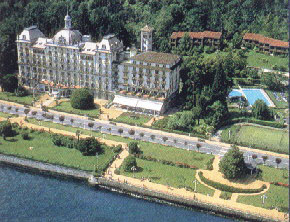 Bilderberg
conference 2004 - Stresa, Italy 3-6 June 2004 - 50th anniversary conference
Bilderberg
conference 2004 - Stresa, Italy 3-6 June 2004 - 50th anniversary conference
 Latest
Bilderbergers' news
Latest
Bilderbergers' news
 Bilderberg 2004 -
American Free
Press coverage - issue 26/04
Bilderberg 2004 -
American Free
Press coverage - issue 26/04
An encounter with Italian police on the way to Bilderberg 2004
By Daniel Estulin
http://www.onlinejournal.com/Special_Reports/062505Estulin/062505estulin.html
Online Journal Contributing Writer
Editor's Note: Daniel Estulin and his family were expelled from the Soviet Union on March 23, 1980, for anti-Soviet activity. His father, a prominent scientist and a dissident, spent 3½ years in prison for seeking freedom of speech for his fellow citizens. Fearing for his life for his daring exposes of corruption, manipulation and power grabbing, Estulin has voluntarily exiled himself to Spain. His dramatic personal stories are a rare look behind the scenes at how the most powerful secret society in the world has tried to stop one of the most determined men in the world from discovering its secrets
June 25, 2005-For the longest time, the Club and I have been seeking each other's company, for the mutual disbenefit of our detractors. Although I conduct my investigation in the strictest of privacy, once per year, I come out of my shell to confront Bilderbergers on their terrain-a five star luxury hotel, the site of the annual secret gathering. In the summer 2004, I was off to Stresa, Italy.
To get to this sleepy resort town that lives at the expense of globs of sun burned elderly German tourists who cohabitate with linguistically impaired Britons, Scots and Irishmen, one must fly to Milan's Malpensa International Airport.
I am fond of Milan; I imagine in the hollow of the vowel that splits the M and the L, a miniature replica of the famed Cathedral, the dampness of its spring sunsets, and the echoes of the feet marking a staccato-like rhythm on its cobbled squares.
So I was happy to be there again, to trudge in the opposite direction of the departing tourists, unaware of the city's elegance and hidden splendours.
As I made my way through the airport terminal, my mind dreamily wondered to something I had read in the usually soiled and leafed through in-flight magazine-a peripheral article on the Novodevichy, or "New Maidens Convent" in English, the most revered cemetery in Moscow. The article shared the page space with a scantily dressed woman in a red dress, and a helpful list of addresses to not-to-be-missed sights from the Russian tourist board to such holy shrines as Lenin's mausoleum, the KGB headquarters at Lublianka, and GUM "the world's biggest shopping centre!"
Novodevichy! Some of Russia's most venerated writers and poets are buried there. Chekhov was one of the first to be buried in the cemetery in 1904 and Googol's remains were re-interred here from Danilov Monastery not long after. The 20th century writers Mayakovsky and Bulgakov are buried here, as are the much-celebrated theatrical directors and founders of the Moscow Art Theatre, Nemirovich-Danchenko and Stanislavsky.
I thought of the utter unpredictability of the future and the past as not a rigid succession but a storehouse of remembered images and concealed patterns that contain the key to the mysterious designs of our lives.
In my imagination, I hovered over Googol's tomb that is symbolically linked with that of another famous writer, Bulgakov, author of "The Master and Margarita." When moved to Novodevichy, Googol's tomb was changed. A part of the original tomb was used in the new tomb. The remaining original stone was stored for years until Bulgakov's wife saw it and chose to incorporate it into her husband's tomb, only later discovering that it was part of Googol's first tomb.
Beauty and lightness on the one hand; philosophical meditation on the other . . .
"Buonasera. Would you please come with us, sir?" A sharp, piercing voice quickly dispersed those meretricious musings that had meandered so aimlessly, yet blissfully within the confines of my imagination.
I looked up.
He was coming towards me, garbed in a raincoat, which struck me as rather odd considering the sky was Mediterranean blue, a shiny automatic weapon slung across his shoulders.
Like a host of a freak show who surrounds himself with hunchbacks, dwarfs and singing 2m tall albinos, this insignificant man, who might well have fitted terrifically into a masquerade ball, came into my personal space, clicked his heels, put his index and middle fingers to his temple and presented himself.
"I am Detective so and o," he announced in a perfect iambic tetrameter. "Would you please come with us?"
The feeling of prearranged tragedy, or more precisely, the shadow, tragically imposed in my contra reminded me of the perilous ways in which I chose to make my living.
Detective and I, flanked by two local guards and a narcotics officer with a Doberman passed into a tiny detention room where small time hoodlums and big time criminals are whisked to by burly security guards and custom's officers in hopes of marvelous retribution from the arch-rival Nemesis; it could scarcely accommodate a rather absurdly wide desk, and next to it a little low table bearing a lamp.
Everything seemed uncannily quiet. One heard the wind against the glass, the machine-gun bursting sounds of weeping next door followed by rhythmic whimpering, the heavy footsteps across the hallway.
"You may take off your coat," said one of the guards jerking his head in the direction of a coat rack. I mechanically unzipped my windbreaker.
Looking back at what transpired, I am ashamed to recall the way I let them corner me, box me in, intimidate me initially, the anxiety I felt.
Straining to reach up, I hung my windbreaker, but it broke loose, taking down two other coats and a plaid jacket with it. The four objects hit the floor with an awkward thud.
"Lei come si chiama? [What is your name?]" I gave him my name. "What is your nationality?" I told him. Di che parte di Canada é lei? [What part of Canada are you from?] Lei dove abita? [Where do you live?] Qual é il suo numero di telefono? [What is your telephone number?] "Where are you flying from?" Éla prima volta che viene in Italia? [Is this your first visit to Italy?] Over the years of covering Bilderbergers, I learned how to nimbly avoid unnecessary confrontation with bullish border guards and trigger-happy policemen. I knew of several journalists turned back at the border for poking their fingers in the eye of the authority.
"We would like to examine your suitcase. We have reason to believe you may be transporting drugs," said the detective.
"If you have drugs, you better tell us before we open up your bag," joined in a narcotics officer.
I wasn't so much worried about the drugs, as I don't do drugs, don't smoke them, and much less transport them internationally in a suitcase.
However, I was covering Bilderberg´s annual meeting, my name was known internationally by all divisions of the secret service, from Mossad to the KGB, MI6 and the CIA. Each reporter covering these annual secret meetings is photographed, his personal details taken and the information passed through the Rockefeller-controlled Interpol to all international protection agencies.
It wouldn't be the first time that someone tried to compromise my security. In Toronto, in 1996, an undercover agent tried to sell me a stolen gun. During the 1999 meeting in Sintra, someone had sent a woman up to my hotel room, programmed through hypnosis and brainwashing techniques to undress herself in my room and to throw herself out the window, after receiving a certain telephone call, hoping to entrap me into a first degree murder conviction. Luckily for all, I refused her come ons. Don't ask me how I knew. One of the tools of the trade you develop in following Bilderbergers around is the sixth sense. Strange car sounds, repetitive noises, people's faces that somehow look familiar, friendly nobodies offering a helping hand . . . you just learn to be overly careful. There was something out of the ordinary in that woman's behaviour. Too eager, too forced. Body language that didn't coincide with the verbal language. I think that's it! What caught my attention was an apparent lack of co-ordination between her body and her speech. When I heard the knock on the door, I thought it was room service bringing up my order of chicken with cashews and apple strudel that I had ordered for dinner. Imagine my surprise, when upon opening the door I found myself standing in front of a scantly clad woman with
a perfectly sculptured body, long black curly hair and green eyes.
Could someone have snuck drugs into my suitcase? When covering Bilderberg, I take all the necessary precautions. No check ins. Only carry-on luggage. The bag never leaves my sight. Flying back from Scotland in 1998, [Translation: one of my more successful Bilderberg penetration efforts. Jim Tucker of the American Free Press and I broke the story of Bilderberg´s plans for war in Kosovo by way of first, creating hostilities between Greece and Turkey on Cyprus which they could then push back into the Balkans.] I got a nagging feeling that someone might have handled my bag. I left it at the airport with all my clothes and momentos from the Turnberry conference.
Moving over to one side of the room, I found myself at a shade end of the long desk.
The next moment, the detective who sat quite still on the edge of the bench, keenly observing my every move, his hands resting on the barrel of his gun, stood up and with the point of his boot turned back a corner of the thick doormat that was ruffled by a Doberman.
One of the guards disappeared into my bag. All I could see were the sharp angles of his elbows moving to and fro.
My heart was heavy. No matter how much I rummaged within myself, I failed to find one crumb of joy. The best I hoped for was to be put back on the plane and sent packing. "Bilderberg paradise lost" was to be the headline in P.´s next issue.
Suddenly the guard looked up, gave a cry, half turned toward me in incertitude mixed with curiosity, and pulled a thin and well-worn volume of Fet [great Russian author of the XIX century] in Russian out of the bag.
As if on queue, everybody started talking at once.
A youngish bespectacled guard, who fetched my Fet, immediately announced that he had been to Russia and knew some Russian, for instance, borsch (beet soup), raduga (rainbow) and privet (hello). At least, the guard's attitude towards me had changed dramatically.
Out of the deepest recesses of his memory, he tried (in vain) to attach the proverbial unattachable limbs into a coherent sentence. I found it impossible to understand what he was talking about. I listened dutifully, with half-opened mouth: his knowledge of Russian reminded one of the vastnesses of Russian stepa, a word, a home, that island of hope amongst the enormity of emptiness. The sheer process of trying to understand my docile language caused me pain.
The detective, having approached the guard, sat down close to me (I was still standing, leaning forlornly against a wall) that I felt his disagreeable warmth, put a peppermint into his mouth and took the book out of the guard's hands.
He passed his fingers across the spine of my book. The man opened a little volume of Fet and began to rummage through the pages. Like most people who read little, his head moved in rhythm with his lips across the page.
Taking advantage of the lull in the conversation, I made a detailed study of the man: corpulent, swarthy, none too young, sharp-tipped nose, sleekly parted hair, jutting eyelids and badly bitten fingernails.
In the next room, someone was roaring with laughter. A chair violently slid across the floor in the room across the hall. The man (with the Doberman) clad in tight, narrow trousers on his spindly legs was motioning to the guard, but the words were drowned out by the combined roar of mingling voices.
The door, whose existence I totally neglected, suddenly thrust open. A plaincloths man (with a gun) stepped in. He saw him first, uttered a cry, his hands up, all 10 fingers dancing. He and the detective (who by now got tired of leafing through my volume of Fet. It had no pictures) greeted each other lustily, trying to crowd into a handshake and backslap as much fervour as was possible.
A brief conversation ensued. By now, a detective and a plaincloths man were huddled with the two guards and an overly passive narcotics officer. The Doberman was asleep on the mat.
Out of the conversation, conducted in a hushed tone, itself a monumental success for any Italian, I could make out isolated bits of phrases: Cosa vuol dire . . . ? [¿Qué quiere decir . . . ?], Non capisco nulla. [No entiendo nada!], Che cerca [A quién busca?].
After a brief exchange, everybody got comfortable. The detective put himself in front of me, the guards took their place at the door and the narcotics cop sat himself on the desk. The plaincloths man leaned against the wall.
"Let me see, where do I know you from?" he began. The detective's velvety tone added a sense of drama to a play whose badly sketched out characters have long outlived their possible usefulness.
Dove siete alloggiati? [Where are you staying?] He asked me for my plane tickets and a hotel reservation. I produced both, crumpled beyond recognition by a habitual chaos of my handbag.
"What possible reason would you have to come to Stresa at this time of the year?" He weighed every word on the scales of the most exact common sense. I said nothing. By now, my nerves were unusually receptive after a restless hour of interrogation.
Mechanically, I reached for my Fet, presently, my only source of warmth and reassurance. I was immediately requested (by the detective) to put the book aside and to pay close attention.
The detective produced a photograph out of the red folder he was now holding in his right hand. I could hardly believe it. Staring at me was a copy of my own hideous black-and-white Spanish national identity photograph.
"What business do you have to attend to in Stresa," he repeated in perfect English. I was found out. There could be no mistake about it. Someone in the Spanish Ministry of the Interior had provided the Italian security forces with my photo. The Italians knew why I was coming and were waiting for me. What's worse, the Spanish Ministry of the Interior was cooperating with the Bilderbergers to stop my investigation. Who might it have been? How did they know where to expect me? Did the airline voluntarily offer my confidential information to the Italians? At whose request? What did they get in return?
I stared intensely at a piece of tinfoil that sparkled on the floor.
Suddenly, I understood something I had been seeing without understanding-why they stopped me, why they questioned me, why they made me lose time. They couldn't retain me, for I had done nothing. Nor could they let me go, for they were told to keep me at bay. The border guard, unwittingly, formed part of the Bilderberg invisible machinery.
I stood up. "Gentlemen, I said, "you have two choices. Either you arrest me and charge me with a crime or you let me go. The masquerade is over. You know why I am here and I know that you know that I know your game plan."
I looked at the configuration left by a shadow of a piece of tinfoil that sparkled on the floor. Sick of it all, angry at them, at me, at the world, for not knowing, not wanting to know and not caring, I tried to squeeze this entirely insignificant object into the orderly existence of the moment.
Another brief consultation followed amongst the five. But now, I knew, that within a few minutes, I'd be driven by a waiting car to the shores of Lake Maggiori, to Stresa and to Bilderberg´s annual conference; to a reunion with a group of fearless hound dogs, my friends, all of whom, against all odds had made their way to this sleepy little town, people who have put up with unimaginable hardships to expose Bilderberg´s master plan for Global Government and One World Order.
"You are free to go, Mr Estulin," said the detective. "But do remember, we know where to find you. You are in Italy. Should you get into any trouble, you will be jailed. That I promise you."
I picked up my bag. Stuffed my Fet into one of the side pockets. "Da svidania, daragoy." [Good bye, friend] The guard's face lit up momentarily. He looked askance at the detective. But I didn't see him. At last, I was free.
As I made my way through the airport terminal, I thought of the fickleness of chance and the demands of a friendship. Again and again, danger and death appeared in the margins of my life without influencing in the bit the main lines of the text.
A lanky blond young man in oriental garb with a bandaged up nose entered a café. Nearby, a waiter was wiping the slabs of tables with a wet cloth.
In a souvenir shop window, a dejected poster announced a premier of a visiting circus, one corner of its ruffled paper torn off, a dead fly on the window sill.
I stepped out on to the street. The windless air was warm, laden with a faint tang of gasoline.
A man with a local newspaper sat down on the bench in front of me. For some inexplicable reason, he took off his shoes and his socks.
Qual é il prezzo a Stresa? [How much does it cost to get to Stresa?] Possono portarmi il bagaglio? [¿Puede Ud. llevar mi maleta?]
The cab driver with a massive, strong nose obliged. He briefly rose to remove his own squashed hat from under him and loaded up my belongings into the Mercedes Benz.
I love the process of settling into viatic quarters-the comfortable leather seat, the anticipation of new discoveries, and the slow passage of the airport's receding lights.
The cab driver with a deadish little face, who as I privately noted, judging by the shape of his nose, was never one to turn down a drink, struck up a conversation. He told me about his son-in-law who had a job with some overly optimistic insurance firm in Rome. On the dashboard, I saw a soiled photograph of a corpulent, elderly woman with short red-hair, half reclined with closed eyes. The cab driver's wife. He complained of being poor, having to work too many hours and not seeing enough of his family.
This was the pattern of his life-a life that made little sense-the meagre, vapid existence of a third generation Napolitano émigré.
In some unknown compartment of my being, I could hear rambling sounds of his musings, but I, having suddenly forgotten about him, passed into another world, my private world of all that is dear to me . . .
To write, someone said, is not to be absent but to become absent; to be someone and then go away, leaving traces.
C., my love and my life. You are my heaven and hell, you could only be both. You are my happiness, my whole life, but also the clash of languages, because language, even the most brilliant language is a kind of shortfall of reason, the moan which awaits even the most perfect bliss, not because our happiness is doomed, or because fate is unkind, but because happiness is intelligible only under threat; intelligible only as its own threat.
I tried to concentrate on what was awaiting me in Stresa. Twenty-two hour working days, phone calls to check information from sources, being continuously followed by the secret service, threats, unauthorised searches, meetings and more meetings with those few valiant souls, braving the threats of Bilderbergers to give us precious details of their diabolical plans. But I simply couldn't get my mind around it. Incoherent images of moral horror ghost-danced in my head. Total Enslavement. Men-made famines that swept millions to their grave. Suffering, more suffering. Unspeakable, inhuman sacrifice. Why? Why? Is it really possible that someone might want to inflict so much pain on the world for personal gain? As I struggled to hold back tears, I kept reminding myself that my quest for the truth was a revendication of decency at the expense of cruelty.
I kept thinking of a happy ending to the yet-to-be-written tale about paradise lost-our damage-strewn world. What would it mean to lose happiness forever? Paradise and its loss are integral to each other. Not only that the true paradises are lost paradises but that there is no paradise without loss, it isn't paradise if you can't lose it.
Bilderberg, of course, is a metaphor for fear, an image of the insanity of it all. Beneath it all, there is an understanding, of course, that time and space, like love and like death, alters us and affirms us, clings to us and explores us; that it involves the irrevocable, and makes us who we are.
What is Time, if not a brutal passage and decay, and a form of awareness, a birth of consciousness that knows itself to be temporal. And still less do I understand what is the purpose of fate bringing Bilderbergers and me constantly together.
Daniel Estulin is an award-winning investigative journalist who has been researching the Bilderbergers for over 13 years. Estulin was one of only two journalists in the world who witnessed and reported (from beyond the heavily guarded perimeter) the super secret meeting at the Dorint Sofitel Seehotel in Rottach-Egern, Munich, Bavaria, Germany, on May 5–8, 2005. He can be reached at d.estulin@ctconsultoria.com.
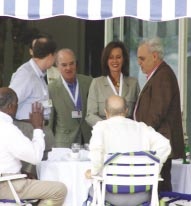 Investigation
Reveals: Bilderbergers Want Taxes Up, War in Iraq Over
Investigation
Reveals: Bilderbergers Want Taxes Up, War in Iraq Over
By James P. Tucker Jr.
Stresa, Italy-At this year's secret Bilderberg meeting, some of the world's most powerful elite focused on U.S. taxes and foreign giveaways, as well as the increasingly violent Iraq occupation and the role the United Nations should play in all future similar outbreaks of violence.
Prior to the meeting, a Bilderberg memo promised that its members would deal mainly with European-American relations and in that context, with U.S politics, Iraq, the Middle East, European geopolitics, NATO, China, energy and economic problems.
During the conference, Britain came in for harsh criticism for supporting the invasion of Iraq. It was also lambasted for failing to embrace the euro, despite Prime Minister Tony Blair's promise to do so at a Bilderberg meeting some years ago in the Scottish resort of Turnberry.
Bilderberg members also expressed frustration with the rising clamor in Britain to quit the European Union.
As expected, the United States was heavily criticized for the fact that its foreign aid was a smaller percentage of gross domestic product than that of other nations. That marked the third straight meeting at which Bilderbergers' decades of almost total congeniality was marred by hostility among the Americans, Britons and continental Europeans.
The first evidence of division in the ranks was apparent in 2002 when Bilderbergers met at Chantilly, Va., near Washington. Then, Europeans were angry that the United Sates was preparing for an invasion of Iraq. Secretary of Defense Donald Rumsfeld tried to placate them with a promise not to invade "this year." Instead, the war began in March 2003.
Bilderbergers, however, remain united in their long-term goal to strengthen the role the UN plays in regulating global relations. Aside from that objective, other matters on this year's conference agenda included the following:
• British elites are to press on with membership in the European Union despite growing domestic opposition.
• The Free Trade Area of the Americas should be enacted and include the entire Western Hemisphere except for Cuba until Fidel Castro is gone. It should then evolve into the "American Union" as a carbon copy of the European Union.
• An "Asian-Pacific Union" is to emerge as the third great superstate, neatly dividing the world into three great regions for the administrative convenience of banking and corporate elites. The United States and other international financial institutions should facilitate and administrate these global trade pacts.
Bilderbergers have, for some time, argued for three global currencies-the euro for Europe, the dollar for the American Union and another for the "Asian-Pacific Union."
One Bilderberger, Kenneth Clarke, a former chancellor of the British exchequer, saw the consolidation of currencies as an ideal strategy when he spoke to this reporter several years ago in Portugal. At that time, Clarke told me that "dollarization" would dominate the globe and "our children will laugh at all the petty currencies we have now."
Another much-discussed subject at this year's conference was the concept of imposing a direct UN tax on people worldwide. In order to achieve it, some Bilderbergers presented two proposals: a tax on oil at the wellhead and a tax on international financial transactions.
Bilderberg leaders tilted strongly toward the oil tax because everyone who drives a car, rides public transportation or flies in a plane will end up paying the tax. That will represent more people than those engaged in international financial transactions across the globe.
On the issue of Iraq, European Bilderbergers were more upset that the United States invaded without the UN's blessing than the fact that over 800 American soldiers have died and thousands of innocent Iraqi citizens have been killed.
Word reached the conference from Rumsfeld, who was unable to attend this year's meeting, that the U.S. military would assume a more defensive stance in Iraq, rather than the more provocative operations of door-to-door searches and widespread detention.
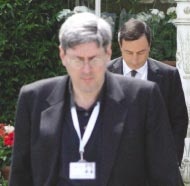 Rumsfeld was, however, represented
in Stresa by Douglas Feith, his undersecretary for policy, and William Luti,
deputy undersecretary for Near Eastern and South Asian affairs. Former Pentagon
advisor Richard Perle, one of the major architects of the war in Iraq, was
also present. It had been Perle, Feith and Paul Wolfowitz who, from the mid
1990s, had fashioned the Middle East policy later adopted by Bush, Cheney
and Rumsfeld.
Rumsfeld was, however, represented
in Stresa by Douglas Feith, his undersecretary for policy, and William Luti,
deputy undersecretary for Near Eastern and South Asian affairs. Former Pentagon
advisor Richard Perle, one of the major architects of the war in Iraq, was
also present. It had been Perle, Feith and Paul Wolfowitz who, from the mid
1990s, had fashioned the Middle East policy later adopted by Bush, Cheney
and Rumsfeld.
European Bilderbergers also protested the fact that the Pentagon was considering reducing troop levels in Germany and tried hard to convince their American counterparts to resist the move. They argued it would "undermine unity" and, irrespective of the military implications, the German economy benefited annually from the millions of dollars spent by U.S. servicemen there.
Resistance in Britain to the euro, and to membership in the European Union, caused much concern and was deemed an obstacle to the solidification of the superstate.
It was noted that many Europeans were unaware of the European Parliament elections scheduled for June 10 and should there be a low turnout, it could be attributed to a protest boycott of the elections by EU opposition groups.
Four former Conservative members of Parliament have endorsed the United Kingdom Independence Party, which demands British withdrawal from the European Union. And, if allowed to vote in a referendum, it has been reported that Britons would reject membership in the European Union by strong proportions. A YouGov survey, taken at the end of May, showed 48 percent would vote to get out of the European Union and 36 percent would vote to stay in.
As it stands, Europeans can only select members for the European Parliament but not the EU Commission, the bureaucratic powerhouse of the union.
Bilderberg participants ended their secret sessions on an upbeat note with a ferry ride to a luxury island on Lake Maggiore, where John Elkman, the latest vice president of the Fiat motor company, will marry his new bride in September.
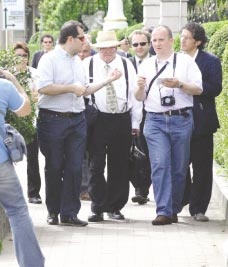 AFP's
Jim Tucker Assessed as Security Threat
AFP's
Jim Tucker Assessed as Security Threat
By the Staff of American Free Press
On Monday, May 31, AFP correspondent James P. Tucker Jr. was arrested by Italian plainclothes policemen on his first day in Stresa, Italy, to cover this year's secret Bilderberg conference.
His crime? He did what any good journalist would do. He went to the five-star Grand Hotel des Iles Borromees, where the conference was to be held, hoping to pry information from hotel staff. On his way out of the hotel, three plainclothes cops blocked his path, seized his passport and led him to an unmarked car.
"The officer in charge, Antonio Bacinelli, told me they were taking me for a five-minute ride because their commander wanted to talk to me," says Tucker, "but it was more like 40 minutes as the car whizzed through small towns to police headquarters."
At police HQ, he was led from the car and placed in an interrogation room.
"I told the cops that I was sure the State Department wasn't happy about me covering Bilderberg, but they were unlikely to approve of Italian police putting me in jail for doing my job," adds Tucker, who remembers his interrogator as a craggy-faced officer in his 60s, dressed in a business suit.
"He interviewed me through translators, including Bacinelli and a young woman, and asked me if I had any particular reason for being in Stresa. I replied: 'You know exactly who I am, but I will tell you anyway. I'm here to cover Bilderberg for the American newspaper, American Free Press'."
Tucker then handed over his American press credentials, which they examined.
The female officer read aloud, in English, what was printed on the back of Tucker's plastic-sealed press card. The wording contained the following: "The holder hereof agrees to assume all risks incident to use of this pass" but "members of the police force shall be courteous and cooperative on all occasions to the bearer of this pass."
According to Tucker, there was then "a burst of Italian chatter in which the word 'journalist' was heard several times, before the female officer smiled, returned his passport and press card and told him he would face no further harassment from the police.
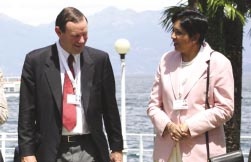 "To my surprise, Bacinelli and the commander
drove me back to the hotel," smiles Tucker, remembering every minute of his
three hours in custody. "They even followed me into the hotel and sat in
the lobby while I went into a lounge area where I could keep my eyes on them.
I had said to them: "If you chaps are so interested in Bilderberg, you are
invited to join me again in the days ahead. I will be happy to tell you what
the Bilderberg boys are doing."
"To my surprise, Bacinelli and the commander
drove me back to the hotel," smiles Tucker, remembering every minute of his
three hours in custody. "They even followed me into the hotel and sat in
the lobby while I went into a lounge area where I could keep my eyes on them.
I had said to them: "If you chaps are so interested in Bilderberg, you are
invited to join me again in the days ahead. I will be happy to tell you what
the Bilderberg boys are doing."
They had replied: "Oh no. We're regulars at this hotel."
Later, a hotel employee, who agreed to talk anonymously, told Tucker the police were not regulars.
"I think the police had been tipped off to the fact that I was going to be there. In past years of covering Bilderberg, security and police had been supplied with photographs of me and were always alerted to my arrival on the conference scene. I think they were expecting me again this time," said Tucker, wondering what will be in store for him next year.
Pro-Israel Neo-Cons Prominent at 2004 Bilderberg Meeting
By Michael Collins Piper
This year's American delegation-some 33 members strong-among the 127 acknowledged attendees at the 2004 Bilderberg meeting was populated by a heavy contingent of individuals known for their intimate ties to the powerful Israeli lobby in the United States. In full force was that faction known as the so-called "neo-conservatives"-those who have determined that Israel's security should be central to all U.S. foreign policy decisions, even those policies that focus on other parts of the world, outside the realm of U.S.-Middle East relations.
Most notable among this group is the now-infamous Richard Perle, who has attended several past Bilderberg meetings, when Republican administrations have been ensconced in Washington.
A former member and chairman of the "Dubya" Bush-administrated created Defense Policy Board (DPB), Perle was once a lobbyist for an Israeli arms manufacturer and, in the 1970s-while serving as a top aide to then-Sen. Henry M. Jackson (D-Wash.)-was investigated by the FBI for espionage on behalf of Israel. After a stint as an undersecretary of defense in the Reagan administration, Perle went on to become a major player in the burgeoning neo-conservative network that played the critical role in pushing the United States into the war against Iraq.
Considering the fact that Perle was forced to resign from the DPB after it was learned that he had been advising Goldman Sachs International on how it might profit from the war in Iraq, it is not surprising that Goldman Sachs has long been represented at the Bilderberg meetings and now boasts its "international advisor" Martin Taylor as Bilderberg's honorary secretary general.
Joining Perle were two other Bush administration neo-conservative heavyweights generally known to have been major forces behind the push for war in Iraq: Douglas Feith, deputy undersecretary of defense for policy-the top lieutenant of neoconservative stalwart and longtime Perle associate, Deputy Defense Secretary Paul Wolfowitz-and his colleague, William J. Luti, deputy undersecretary of defense for Near Eastern and South Asian Affairs.
The neo-conservatives were also represented at Bilderberg by Max Boot, a top editor for The Wall Street Journal, who has been known for his advocacy of American imperialism in the pages of both the Journal and in The Weekly Standard, which is published by European-based Rothschild family satellite Rupert Murdoch and edited by neoconservative theoretician William Kristol.
Also in attendance at this year's Bilderberg was Kristol's close colleague, Robert Kagan-a contributing editor of The Weekly Standard and a director of Kristol's Project for the New American Century, which once declared that "a new Pearl Harbor" was necessary in order for the United States to begin waging imperial ventures around the globe.
The neo-conservative Hudson Institute was represented at Bilderberg by Marie Josee Kravis, who is both the wife of billionaire Henry Kravis (also in attendance, representing his financial empire) and a business colleague of Perle, having served with Perle as a director of the neo-conservative (and Rothschild family affiliated) Hollinger publishing empire, which includes The Jerusalem Post among its holdings.
Another neo-conservative figure on hand was Bruce Kovner, one of America's richest men, who has helped finance The New York Sun newspaper, a small circulation-but highly influential-neo-conservative journal. Kovner also serves as chairman of the American Enterprise Institute, with which the aforementioned Perle has long been associated.
These neo-conservatives were also joined this year at Bilderberg by a handful of other top former Washington policy makers and publicists known for their sympathies for Israel, including Dennis Ross of the pro-Israel Washington Institute for Near East Policy, effectively an offshoot of the America Israel Public Affairs Committee, former State Department official Richard N. Haas, president of the CFR, and former Assistant Secretary of State Richard Holbrooke.
Call 1-888-699-NEWS (6397) toll free and charge a subscription to Visa or MasterCard or write: American Free Press, 645 Pennsylvania Ave. SE, Suite 100, Washington, D.C. 20003.
$59 for one year, $99 for two years, $17.76 for a 16-week "Get Acquainted" subscription-one time only. Outside the U.S. by surface mail $89 for one year, $160 for two years. First class to U.S. $92 for one year, $165 for two years. Airmail first class to Canada and Mexico $134 for one year, $232 for two years; Western Hemisphere $169 for one year, $272 for two years; Europe $172 for one year, $276 for two years; Asia and Africa $169 for one year, $272 for two years; Pacific Rim $179 for one year, $288 for two years. AFP On-Line edition: $39 per year; $10 extra per year with print subscription.
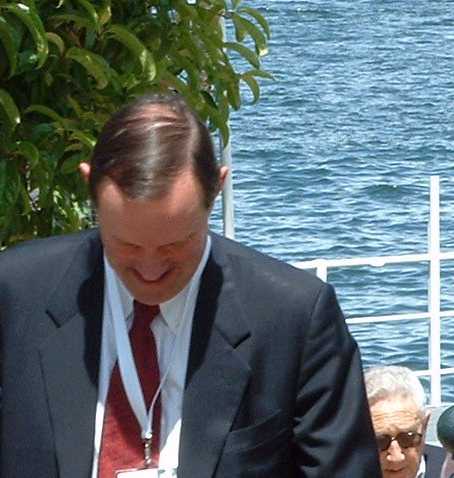 Participants 2004
The 52nd Bilderberg Meeting will be held in Stresa, Italy, 3-6 June 2004. The Conference will deal mainly with European American relations and in this context US Politics, Iraq, The Middle East., European Geopolitics, NATO, China, Economoic Problems and Energy......
Honorary Chairman - Davignon, Etienne - Vice-Chairman, Suez-Tractebel
Honorary Secretary General - Taylor, Martin - International Adviser, Goldman Sachs International
N - Auser, Svein - CEO, DnB NOR ASA
D - Ackermann, Josef - Chairman, Group Executive Committee, Deutsche Bank AG; Member of supervisory boards Siemens AG. & Bayer AG; Director, World Trade Center Memorial Foundation (court case against - see below) - [actually Ackermann is Swiss so why is he listed here as German?]
I - Ambrosetti, Alfredo - Chairman, Abbrosetti Group
TR - Babacan, Ali - Minister of Economic Affairs
P - Balsemao, Francisco Pinto - Chairman and CEO, IMPRESA, SGPS, Former Prime Minister
ISR - Barnavie, Elie - Department of General History, Tel-Aviv University
I - Benedetti, Rodolfo De - CEO, CIR
I - Bernabe, Franco - Vice Chairman, Rothschild Europe
F - Beytout, Nicolas - Editor In Chief, Les Echos
INT - Bolkestein, Frits - Commissioner for the Internal Market, European Commission, former leader of Dutch right wing Liberal Party VVD.
USA - Boot, Max - Neoconservative, Council on foreign Relations, Features Editor, Wall Street Journal
CH - Borel, Daniel - Chairman, Logitech International S.A.
I - Bortoli, Ferrucio de - CEO, RCS Libri
S - Brock, Gunnar - CEO, Atlas Copco AB
GB - Browne, John - Group Chief Executive, BP plc
NL - Burgmans, Antony - Chairman, Unilever NV
F - Camus, Phillipe - CEO, European Aeronautic Defence and Space NV
I - Caracciolo, Lucio - Director, Limes Geopolitical Review
F - Castries, Henri de - Chairman, AXA Insurance
E - Cebrian, Juan Luis - CEO, PRISA (Spanish language media company), former Chairman, International Press Institute
TR - Cemal, Hasan - Senior Columnist, Milliyet Newspaper
GB - Clarke, Kenneth - Member of Parliament (Con.), Deputy Chairman, British American Tobacco
USA - Collins, Timothy C - MD and CEO, Ripplewood Holdings LLC, Yale School of Management, Trilateral Commission
USA - Corzine, Jon S. - Senator (D, New Jersey), Chairman and CEO, Goldman Sachs
CH - Couchepin, Pascal - Former Swiss President, Head of Home affairs Dept.
GR - David, George A. - Chairman, Coca-Cola Hellenic Bottling Company SA
B - Dehaene, Jean-Luc - Former Prime Minister, Mayor of Vilvoorde
TR - Dervis, Kemal - Member of Parliament, former senior World bank official
GR - Diamantopoulou, Anna - Member of Parliament, former European Commissioner for Social Affairs
USA - Donilon, Thomas L - Vice-President, Fannie Mae, Council on Foreign Relations
I - Draghi, Mario - Vice Chairman and Managing Director, Goldman Sachs
USA - Edwards, John - Senator (D. North Carolina), Democratic Presidential Candidate
DK - Eldrup, Anders - Chairman, DONG gas company (becoming privatised) A/S
DK - Federspiel, Ulrik - Ambassador to the USA
USA - Feith, Douglas J. - Undersecretary for Policy, Department of Defense
I - Galateri, Gabriele - Chairman, Mediobanca
USA - Gates, Melinda F. - Co-Founder, Gates Foundation, wife of Bill Gates
USA - Geithner, Timothy F. - President, Federal Reserve Bank of New York
I - Giavazzi, Francesco - Professor of Economics, Bocconi University; adviser, world bank and European Central bank
IRL - Gleeson, Dermot - Chairman Allied Irish Bank Group (currently being investigated for personal and corporate tax evasion)
USA - Graham, Donald E. - Chairman and CEO, Washington Post Company
USA - Haas, Richard N. - President, Council on Foreign Relations, former Director of Policy and Planning staff, State Department
NL - Halberstadt, Victor - Professor of Economics, Leiden University
B - Hansen, Jean-Pierre - Chairman, Suez Tractabel SA
S - Heikensten, Lars - Governor, Swedish Central Bank
USA - Holbrooke, Richard C - Vice Chairman, Perseus, former Director, Council on Foreign Relations, former Assistant Secretary of State
USA - Hubbard, Allen B - President E&A Industries
USA - Issacson, Walter - President and CEO, Aspen Institute
USA - Janow, Merit L. - Professor, International Economic Law and International Affairs, Columbia University, member of apellate body, WTO
USA - Jordan, Vernon E. Senior Managing Director, Lazard Freres & Co LLC
USA - Kagan, Robert - Senior Associate, Carnegie Endowment for International Peace
GB - Kerr, John - Director, Shell, Rio Tinto and Scottish American Investment Trust, former secretary of European Constitution Commission
USA - Kissinger Henry A. - Chairman, Kissinger Associates Inc.
TR - Koc, Mustafa V. - Chairman, Koc Holdings AS
NL - Koenders, Bert (AG) - Member of Parliament, president, Parliamentary Network of the World Bank
USA - Kovner, Bruce - Chairman Caxton Associates LLC, Chairman, American Enterprise Institute
USA - Kravis, Henry R. - Founding Partner, Kohlberg Kravis Roberts & Co., acquisitions financier
USA - Kravis, Marie Josee - Senoir Fellow, Hudson Institute Inc.
FIN - Lehtomaki, Paula - Minister of Foreigh Trade and Development
FIN - Lipponen, Paavo - Speaker of Parliament; former Prime Minister
CHN - Long, Yongtu - Secretary General, Boao forum for Asia - [actually his name shouiuld read "Tu, Yonglong" the Bilderberg secretariat mistyped it]
P - Lopes, Pedro M. Santana - Mayor of Lisbon
USA - Luti, William J. - Deputy Under Secretary of Defense for Near Eastern and South Asian Affairs
CDN - Lynch, Kevin G. - Deputy Minister, Department of Finance
USA - Mathews, Jessica T. - President, Carnegie Endowment for International
War Peace
USA - McDonough, William J. - Cahirman and CEO, Public Company Accounting Oversight Board, former president, Federal Reserve Bank of New York
CDN - McKenna, Frank - Counsel, McInnes Cooper, former premier of New Brunswick
I - Merlini, Cesare - Executive Vice Chairman, Council for the United States and Italy, Council on Foreign Relations, former director, Italian Institute for International Affairs
F - Montbrial, Thierry de - President, French Institute of International Relations
INT - Monti, Mario - Competition/Antitrust Commissioner, European Commission
USA - Mundie, Craig J. - Chief Technical Officer, Advanced Strategies and Policies, Microsoft Corporation
N - Myklebust, Egil - Chairman, Scandinavian Airline System (SAS)
D - Naas, Matthias - Deputy Editor, Die Zeit
NL - Netherlands, Beatrix HM Queen of The - Lady Shell, nuff said
GB - Neville-Jones, Pauline - Chairman, QuinetiQ (UK privatised military research/services company), governor of the BBC, Chairman Information Assurance Advisory Council, formar Chairman Joint Intelligence Committee, former Managing Director NatWest Markets
USA - Nooyi, Indra K. - President and CEO, PepsiCo Inc.
PL - Olechowski, Andrzej - Leader, Civic Platform
FIN - Ollila, Jorma - Chairman, Nokia Corporation
INT - Padoa-Schioppa, Tommaso - Director, European Central Bank
CY - Pantelides, Leonidas - Ambassoador to Greece
I - Passera, Corrado - CEO, Banca Intesa SpA
USA - Perle, Richard N. - Resident Fellow, American Enterprise Institute for Public Policy Research, former Likud policy adviser, former chair Defence Policy Board, former co-chairman, Hollinger Digital
B - Phillipe, HRH Prince
USA - Reed, Ralph E. - President, Century Strategies
CDN - Reisman, Heather - President and CEO, Indigo Books and Music Inc.
I - Riotta, Gianni - Editorialist, Corriere della Serra
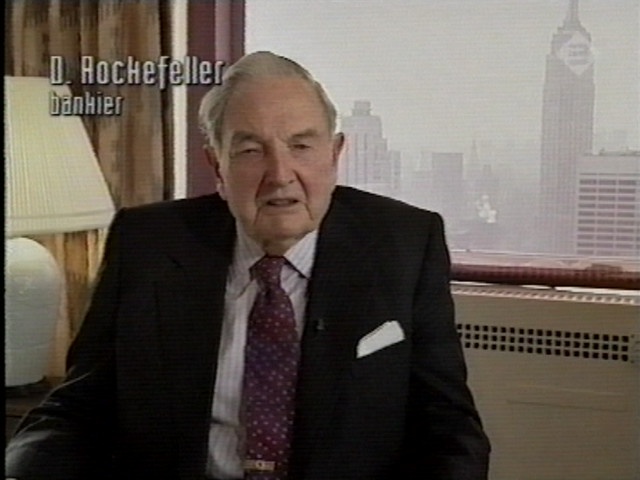
USA - Rockefeller, David - Member JP Morgan International Council, Chairman, Council of the Americas
E - Riodriguez Inearte, Matias - Vice Chairman, Grupo Santander
USA - Ross, Dennis B - Director, The Washington Institute for Near East Policy
D - Sandschneider, Eberhard - Director, Research Institute, German Society for Foreign Policy
I - Scaroni, Paolo - CEO, Enel SpA
D - Schilly, Otto - Minister of the Interior
USA - Schnabel, Rockwell A. - Ambassador to the EU
A - Scholten, Rudolf - Director, Oesterreichische Kontrollbank AG
D - Schrempp, Jurgen E. - Chairman, DaimlerChrysler AG
E - Serra Rexach, Eduardo - Head, Real Institute Elcano
RUS - Shevtsova, Lilia - Senior Associate. Carnegie Endowment for International Peace
PL - Sikora, Slawomir - President and CEO, Citibank Handlowy
I - Siniscalo, Domenico - Director General Ministry of the Economy
P - Socrates, Jose - Member of Parliament
USA - Strmecki, Marin J. - Smith Richardson Foundation
B - Struye de Swielande, Dominique - Permanant repressentative of Belguim, NATO
IRL - Sutherland, Peter D. - Chairman, Goldman Sachs International, Chairman, BP plc
USA - Thornton, John L. - Chairman, Brookings Institution, Professor, Tsinghua University
I - Tremonti, Giulio - Minister of Economy and Finance
INT - Trichet, Jean-Claude - President, European Central Bank
I - Tronchetti Provera, Marco - Chairman and CEO, Pirelli SpA
N - Underdal, Arild - Rector, University of Oslo
CH - Vasella, Daniel L. - Chairman and CEO, Novartis AG
NL - Veer, Jeroen van der - Chairman, Committee of Managing Directors, Royal Dutch/Shell
GB - Verwaayen, Ben J. M. - CEO, British Telecom; former director, Lucent Technologies
I - Visco, Ignazio - Foriegn Affairs Manager, Banca D'Italia
INT - Vitorino, Antonio M. - Justice and Home Affairs Commissioner, European Union
INT - Vries, Gijs M. de - EU Counter Terrorism Co-ordinator
S - Wallenberg, Jacob - Chairman, SEB investments (including biotech); Chairman, W Capital Management AB
D - Weber, Jurgen - Chairman of the Supervisory Board, Deutche Lufthansa AG
GB/USA - Weinberg, Peter - CEO, Goldman Sachs International
NL - Wijers, Hans - Chairman, AkzoNobel NV
D - Wissmann, Matthias - Member of Parliament
GB - Wolf, Martin H. - Associate Editor/Economic Commentator, The Financial Times
INT/USA - Wolfenson, James D. - President, The World Bank
RUS - Yavlinsky, Grigory A. - Member of Parliament
USA - Yergin, Daniel - Chairman, Cambridge Energy Research Associates
D - Zumwinkel, Klaus - Chairman, Deutche Post Worldnet AG; Chairman, Deutche Telekom
GB - Rachman, Gideon - Brussels Correspondent, The Economist
GB - Wooldridge, Adrian D. - Foreign Correspondant, The Economist
Thanks to Michael Haupt - www.threeworldwars.com - for that
Where
is this year's Bilderberg meeting taking place?
Hotel des Iles Borromees - Corso Umberto I, 67 - 28838 Stresa - ITALY
tel. +39 0323 938 938 / fax. +39 0323 324 05
e-mail: borromees@borromees.it
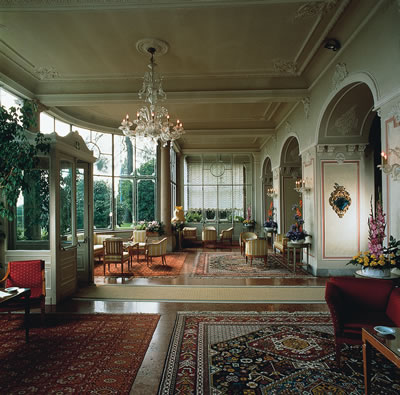
The Borromeo Islands are 'verdant jewels' floating 'idyllically' in Lake Maggiore, and the finest place from which to observe their beauty is the equally stunning Grand Hotel des Iles Borromees, located on the lakefront in Stresa. The hotel's beautiful Belle Epoque architecture has been faithfully preserved both outside and inside. Lavish decor faultlessly recreates a grand era of days gone by, while recent refurbishments ensure the ultimate in comfort for the most modern of travellers. Built in 1861, the hotel has been host to many prominent guests, including Hemingway, Mussolini, Rothschild and Clark Gable. Today, its guests still enjoy the unrivalled beauty, unprecedented luxury and world- class facilities for which the Grand Hotel is famed.
174 stunning rooms faithfully recreate the Belle Epoque era; Impero or Maggiolini style, lavish drapes, warm, rich colours, fabrics and Murano chandeliers enhance the authenticity. Most lake-facing rooms enjoy a private balcony, and all bathrooms are tiled in Italian marble and have a whirlpool. Suites are magnificent, boasting fine art, inlaid ceilings, statues, vast whirlpool baths and separate showers in imperial suites.
http://www.borromees.it/inglese/index2.html - flashy flash site
 Latest Bilderberg news
 NATO’s secret armies linked to terrorism
Nato=Nazi trail - link one - click for next
http://globalresearch.ca/articles/GAN412A.html
by Daniele Ganser
ISN Security Watch, 15 December 2004
www.globalresearch.ca 17 December 2004
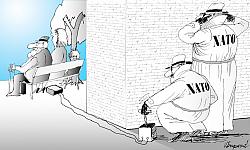 NATO’s secret armies linked to terrorism
click here for more on Operation Gladio
by Daniele Ganser
In Italy, on 3 August 1990, then-prime minister Giulio Andreotti confirmed the existence of a secret army code-named “Gladio” - the Latin word for “sword” - within the state. His testimony before the Senate subcommittee investigating terrorism in Italy sent shockwaves through the Italian parliament and the public, as speculation arose that the secret army had possibly manipulated Italian politics through acts of terrorism.
Andreotti revealed that the secret Gladio army had been hidden within the Defense Ministry as a subsection of the military secret service, SISMI. General Vito Miceli, a former director of the Italian military secret service, could hardly believe that Andreotti had lifted the secret, and protested:
"I have gone to prison because I did not want to reveal the existence of this super secret organization. And now Andreotti comes along and tells it to parliament!"
According to a document compiled by the Italian military secret service in 1959, the secret armies had a two-fold strategic purpose: firstly, to operate as a so-called “stay-behind” group in the case of a Soviet invasion and to carry out a guerrilla war in occupied territories; secondly, to carry out domestic operations in case of “emergency situations”.
The military secret services’ perceptions of what constituted an “emergency” was well defined in Cold War Italy and focused on the increasing strength of the Italian Communist and the Socialist parties, both of which were tasked with weakening NATO “from within”. Felice Casson, an Italian judge who during his investigations into right-wing terrorism had first discovered the secret Gladio army and had forced Andreotti to take a stand, found that the secret army had linked up with right-wing terrorists in order to confront “emergency situations”. The terrorists, supplied by the secret army, carried out bomb attacks in public places, blamed them on the Italian left, and were thereafter protected from prosecution by the military secret service. "You had to attack civilians, the people, women, children, innocent people, unknown people far removed from any political game,” right-wing terrorist Vincezo Vinciguerra explained the so-called “strategy of tension” to Casson.
“The reason was quite simple. They were supposed to force these people, the Italian public, to turn to the state to ask for greater security. This is the political logic that lies behind all the massacres and the bombings which remain unpunished, because the state cannot convict itself or declare itself responsible for what happened."
How strongly NATO and US intelligence backed and supported the use of terror in Italy in order to discredit the political left during the Cold War remains subject of ongoing research. General Gerardo Serravalle, who had commanded the Italian Gladio secret army from 1971 to 1974, confirmed that the secret army “could pass from a defensive, post-invasion logic, to one of attack, of civil war”.
The Italian Senate chose to be more explicit and concluded in its investigation in 2000: "Those massacres, those bombs, those military actions had been organized or promoted or supported by men inside Italian state institutions and, as has been discovered more recently, by men linked to the structures of United States intelligence." Ever since the discovery of the secret NATO armies in 1990, research into stay-behind armies has progressed only very slowly, due to very limited access to primary documents and the refusal of both NATO and the CIA to comment. On 5 November 1990, a NATO spokesman told an inquisitive press: "NATO has never contemplated guerrilla war or clandestine operations”.
The next day, NATO officials admitted that the previous day’s denial had been false, adding that the alliance would not comment on matters of military secrecy. On 7 November, NATO’s highest military official in Europe, Supreme Allied Commander Europe (SACEUR) US General John Galvin, together with NATO’s highest civilian official, Secretary-General Manfred Wörner, briefed NATO ambassadors behind closed doors.
"Since this is a secret organization, I wouldn't expect too many questions to be answered,” reasoned a senior NATO diplomat, who wished to remain unnamed. “If there were any links to terrorist organizations, that sort of information would be buried very deep indeed.” Former CIA director William Colby confirmed in his memoirs that setting up the secret armies in Western Europe had been “a major program” for the CIA. The project started after World War II in total secrecy, and access to information was limited “to the smallest possible coterie of the most reliable people, in Washington, in NATO” and in the countries concerned.
Yet when in Italy in 1990 former CIA director Admiral Stansfield Turner was questioned on television on Gladio, he strictly refused to answer any questions on the sensitive issue, and as the interviewer insisted with respect for the terror victims, Stansfield angrily ripped off his microphone and shouted: "I said, no questions about Gladio!", whereafter the interview was over.
If there had been a Soviet invasion, the secret anti-communist soldiers would have operated behind enemy lines, strengthening and setting up local resistance movements in enemy-held territory, evacuating shot down pilots, and sabotaging the supply lines and production centers of occupation forces. Upon discovery of the secret armies, the European Parliament responded with harsh criticism, suspecting it to have been involved in manipulation and terror operations. “This Europe will have no future,” Italian representative Falqui opened the debate, “if it is not founded on truth, on the full transparency of its institutions in regard to the dark plots against democracy that have turned upside down the history, even in recent times, of many European states.” Falqui insisted that “there will be no future, ladies and gentlemen, if we do not remove the idea of having lived in a kind of double state - one open and democratic, the other clandestine and reactionary. That is why we want to know what and how many "Gladio" networks there have been in recent years in the Member States of the European Community." The majority of EU parliamentarians followed Falqui, and in a special resolution on 22 November 1990 made it clear that the EU “protests vigorously at the assumption by certain US military personnel at SHAPE and in NATO of the right to encourage the establishment in Europe of a clandestine intelligence and operation network”, calling for a “a full investigation into the nature, structure, aims, and all other aspects of these clandestine organizations or any splinter groups, their use for illegal interference in the internal political affairs of the countries concerned, and the problem of terrorism in Europe”.
Only the parliaments in Italy, Switzerland, and Belgium had formed a special commission to investigate the national secret army, and after months or even years of research, presented a public report. Building on this data and secondary sources from numerous European countries, “NATO’s Secret Armies” confirms for the first time that the secret networks spread across Western Europe, with great details on networks in Germany, France, Spain, Portugal, Holland, Luxemburg, Belgium, Denmark, Norway, Italy, Greece, and Turkey, as well as the strategic planning of Britain and the US. The stay-behind armies were coordinated on an international level by the so-called Allied Clandestine Committee (ACC) and the Clandestine Planning Committee (CPC), linked to NATO’s Supreme Headquarters Allied Powers Europe (SHAPE). And they used cover names such as “Absalon” in Denmark, “P26” in Switzerland, “ROC” in Norway or “SDRA8” in Belgium. Interestingly, large differences existed from country to country. In some nations the secret armies became a source of terror, while in others they remained a prudent precaution.
In Turkey, the “Counter-Guerrilla” was involved in domestic terror and torture operations against the Kurds, while in Greece, the “LOK” took part in the 1967 military coup d’état to prevent a Socialist government. In Spain, the secret army was used to prop up the fascist dictatorship of Franco, and in Germany, right-wing terrorists used the explosives of the secret army in the 1980 terror attack in Munich. In other countries, including Denmark, Norway, and Luxemburg, the secret soldiers prepared for the eventual occupation of their home country and never engaged in domestic terror or manipulation.
In the context of the ongoing so-called war on terror, the Gladio data promotes the sobering insight that governments in the West have sacrificed the life of innocent citizens and covered up acts of terrorism in order to manipulate the population.
Allegations that NATO, the Pentagon, MI6, the CIA, and European intelligence services were linked to terror, coups d’état, and torture in Europe are obviously of an extremely sensitive nature, and future research is needed in the field. In the absence of an official investigation by NATO or the EU, ongoing international research into terrorism is about to tackle this difficult task, the first step of which I hope to have promisingly taken with “NATO’s Secret Armies”. Dr Daniele Ganser is a Senior Researcher at the Center for Security Studies at the ETH in Zurich. For more information on the topic, compare the research of the Center of Security Studies (CSS) at ETH Zurich.
http://globalresearch.ca/articles/GAN412A.html
Prince Bernhard was not renowned for his subtlety, yet he made up for this by his unstoppable urge to enjoy life to the full.
But that will to live finally succumbed to years of mounting health problems on 1 December 2004. Cancerous tumours eventually got him at the age of 93.
His death heralds the end of the old royal regime which saw the Netherlands through the turmoil of the German occupation during World War II.
The war years and the post-war reconstruction were in many ways Bernhard's finest. But some of his many critics continue to insist the prince wasn't even sure which side he was on during the Netherlands' darkest hours.
Others claimed Bernhard was at the centre of a right-wing conspiracy by industrialists and politicians to dominate the world.
Such was his ability to win friends and offend in equal measure; it will probably take some time for history to give its final judgement on Bernhard's legacy.
To begin with, he was German — a twist of fate that helped colour people's views of him.
He was born in Jena, Germany, in 1911 with a very definite royal spoon in his mouth. The eldest son of Prince Bernhard von Lippe and Baroness Armgard von Sierstorpff-Cramm, his full name was Bernhard Leopold Friedrich Eberhard Julius Kurt Karl Gottfried Peter zu Lippe-Biesterfeld.
At an early age, he learned that few might have been of blue blood, but the ravages of war and revolution can take away some of the privileges of being high-born. His father lost his municipality and the revenues it accorded the family after World War I.
But times were nowhere as bad for his family as they were for millions of other Germans who lived through the hunger, revolution and inflation caused by their country's defeat in 1918.
The young Bernhard was raised on the family's new estates in Eastern Prussia and he was educated at home until the age of 12. Later, he went to a gymnasium school in Berlin before studying law in Switzerland and Berlin.
Although the family had lost its principality, Bernhard enjoyed the life of a jet setting prince to the full. He loved horseback riding, flying, big-game hunting and fast cars. (On his 87th birthday, Bernhard gave himself the latest model of Ferrari.)
He nearly killed himself twice in his youth — once in a boating accident and later in an airplane crash.
Despite his joie de vivre and constant striving for new physical challenges, the young Bernhard also saw himself as a real entrepreneur and a member of the elite.
He was appointed secretary of the Board of Directors of German chemical giant IG Farben. It was a prestigious name at the time, but given the company's association with the Nazis and the Holocaust, his choice of career continued to cloud Bernhard's reputation for years to come.
Several obituary writers have noted that Bernhard's political antenna was often his undoing. As a student in the early days of the Nazi regime, he and some of his fellow students joined the SS.
Bernhard claimed years later that he was totally opposed to the Nazi ideology, but joining the SS enabled them to continue their education. In the months before his death, evidence that Bernhard had also been a member of Hitler's National Socialist NSDAP party hit the newspapers.
In the mid-1930s, fears were brewing of a new war in Europe. The announcement of the engagement between Bernhard and Crown Princess Juliana of the Netherlands wasn't greeted with overwhelming enthusiasm among the Dutch public.
Bernhard didn't help when he visited Adolf Hitler, who suggested the marriage was a sign of an alliance between the two countries.
Although he was bestowed with Dutch citizenship for the wedding, the prince insensitively briefed an SS officer about the political situation in the Netherlands, including the Dutch Nazi party, just days before the nuptials.
But some of his critics insist to this day that Bernhard knew exactly what he was doing.
Bernhard appears to have sorted out his priorities by 10 May 1940 when the Germans invaded. Armed with a machine gun, Bernhard helped lead the royal family to safety in England.
Once there, he asked to work for British Intelligence, but lingering doubts about his loyalties deprived the prince of the James Bond role he would so dearly have loved.
Instead, he flew for the RAF and helped his wife run the government-in-exile and was allowed to work on war planning councils. But when Operation Market Garden proved a bridge too far at Arnhem, there were dark mutterings that Bernhard — now commander of the Dutch forces — had betrayed the plans to the Germans.
Present at the German surrender at Wageningen in the Netherlands on 5 May 1945, Bernhard showed his sincere, but insensitive side when he said he felt sorry for the general who signed on behalf of the German forces. The officer was charged with war crimes.
If the war provided Bernhard with a chance to escape the confines of being a prince-consort, the early post-war years were heaven for him.
Although the Dutch Constitution did not provide him with any official role, he was appointed Chairman of the Joint Chiefs of State and served on councils of all branches of the military.
He renewed his jet setting lifestyle as an unofficial ambassador and general Mr Fix It for the Netherlands. He was never shy of accepting 17-gun salutes to mark his arrival in a foreign country and it is said he also used the time abroad to indulge in extramarital affairs.
He served on the boards of dozens of companies, including Dutch plane maker Fokker and Dutch carrier KLM.
He truly earned a place in the history books — and on the pages of numerous websites that cater in conspiracy theories — when he helped organise an all-male meeting of key business and intellectual figures at a Bilderberg Hotel in the Netherlands.
Officially, the annual meeting was a forum to discuss economic issues in Western Europe and the threat of communism. Unofficially, the Bilderberg Group, say some amateur theorists, is a right-wing conspiracy to dominate the world.
Ironically, Bernhard, the big-game hunter, also found time to set up the conservation organisation World Wildlife Fund.
His high-flying career came crashing down in 1976, when it emerged that Bernhard — in typical cavalier style — seemed to think it was okay to accept "commissions" from US plane manufacturer Lockheed for his help to influence the purchase of a new fighter jet for the Netherlands.
It was hardly Bernhard's finest hour. The scandal allowed the media to take another look at his SS links as well as his extramarital affairs and his links to several dodgy business personalities.
The government was forced to tone down the final report of the inquiry into the Lockheed scandal as the then Queen Juliana threatened to abdicate if Bernhard was carpeted.
The final report could not find evidence he accepted a USD 1.5 million bribe from Lockheed, but it did say he had acted in such a way as to create the impression he was open to "doing favours".
The findings were damning enough to strip Bernhard of his business positions. He also lost his military titles and was prevented from wearing a Dutch military uniform ever again.
This punishment — though mild compared to a lengthy jail sentence — hurt Bernhard deeply.
He constantly harked back to the camaraderie he experienced during the war years and made a point of attending Liberation Day ceremonies and other events for veterans. He seemed happiest when taking a salute from old soldiers at the annual 5 May Wageningen Liberation Day celebrations.
When his daughter Beatrix became Queen in 1980, Bernhard was firmly relegated to the sidelines. This didn't stop him writing letters to the media or even ringing up editors to outline his view on the big story of the day.
In the last few years, Bernhard fought a constant battle against ill health. Though slowed, he still managed to make headlines — and find himself on the right side of public opinion — when he offered to pay any fine imposed on two have-a-go supermarket workers charged with roughing up a knife-wielding robber.
Some critics in the gossip press suggested he had less time for his wife, Juliana, who had Alzheimer's in the last few years before her death in March 2004.
Yet her death seemed to mark a serious decline in Bernhard's health. There were concerns he was too ill to attend the funeral, but true to form, he was there — looking frail and ill — but he was there.
In mid-October, the Government Information Service RVD announced Bernhard had an inoperable tumour. For once, Bernhard seemed to accept that this was one battle he wasn't going to win. His declared wish was to die in Soestdijk Palace, the home he had shared with his late wife of 67 years.
But life doesn't always have a fairy-tale ending.
In a no doubt well-meaning act, the prince was rushed to hospital when his doctors decided he could no longer be treated at home. When he got there, the prince took control of his life for one last time.
He told his doctors not to treat him any further. Prince Bernhard — an important part of Dutch history — passed away at 6.50pm on 1 December 2004.
His body was brought back to Soestdijk at 10pm.
http://news.bbc.co.uk/2/hi/europe/749465.stm
Prince Bernhard of Lippe Biesterfeld was German by birth, but became a naturalised Dutchman shortly before his marriage, in 1937, to the heir to the Dutch throne.
The young German was introduced to his future wife during 1935, before the romance reportedly developed on skiing jaunts to Switzerland.
When the Nazis tried to make political capital from the wedding, Queen Wilhelmina asserted, "This is the marriage of my daughter to the man she loves...not the marriage of the Netherlands to Germany."
When the Germans invaded the Low Countries in 1940, Prince Bernhard escorted the Royal Family to safety in England, but returned himself to serve with what remained of the Dutch army.
And during the closing phase of the war, the prince returned to Europe to organise the Dutch forces of resistance and prepare the way for the Canadian liberators.
When Princess Juliana succeeded to the throne in 1948, Bernhard played his part in the public life of his adopted nation, promoting Dutch trade and industry, especially abroad.
As inspector-general to the Dutch armed forces, he was a member of various services advisory councils.
Early in 1976, this side of his activities came under scrutiny after evidence was given to a United States Senate sub-committee that a "high Dutch official" had received bribes from the Lockheed Aircraft Corporation in connection with the sale of military aircraft to Holland 15 years earlier.
A subsequent Dutch government inquiry found that the Prince had acted "in a completely unacceptable manner" in his relations with Lockheed.
He had shown himself to be open to dishonourable requests and offers, and had allowed himself to be tempted to take initiatives which were bound to place him and Dutch policy in a dubious light.
To avoid a constitutional crisis after Queen Juliana had threatened to abdicate as a result of the findings, Prince Bernhard faced no criminal proceedings.
In the wake of the scandal, Prince Bernhard resigned from all his armed forces functions, and also gave up most of his business activities. Even so, Dutch exporters selected him for their 1977 man-of-the-year award.
In the meantime, the Prince had established a reputation as an accomplished horseman, and often competed in riding and jumping events at international shows.
Best known outside his country for his becoming the first president of the World Wildlife Fund in 1961, Bernhard raised $10m in two years by running a club subscription scheme among his friends.
His work for the organisation continued, after the Lockheed scandal forced his resignation from the presidency.
The prince was also instrumental in setting up the annual Bilderberg conference, named after the Bilderberg Hotel in Oosterbeek, Holland.
The conference was designed for high-powered policy makers to have "regular discussions to help create a better understanding of the complex forces affecting western nations".
It is credited with prompting the establishment of the European Community.
A lifelong fan of fast cars, for his 88th birthday, Prince Bernhard bought himself a present of a 200 mph Ferrari, despite the fact that his age and infirmity precluded him from driving it himself.
http://news.bbc.co.uk/2/hi/europe/749465.stm
Is now the unelected (appointed by Republic President) Prime Minister.
Durão Barroso, former Prime Minister, now president of European Comission, officially resigned in 29 June.
A political crisis begun on 10th June, day of European Elections, ending at the end of the month.
Lope's name first rumored as future PM around 28 June. That day he stated it was not true he was invited.
Former Environment Minister, hated by most, popular because he had a prime-time talkshow with Pedro Santana Lopes, where both discussed national politic.
Is, since Sunday 26th September 2004, the leader of the principal opposition party. Probably next Prime Minister, just a matter of how far this government will last.
Now president of European Commission, replaced by Santana Lopes.
Resigned in a social/political crisis envolving paedophilie, is place was took by José Socrates.
Washington Dispatch - September 10, 2004
http://www.washingtondispatch.com/article_10029.shtml
Downward and downward spiral the fortunes of Conrad Black, the deposed CEO of Hollinger International, the only tycoon in history brought low by his wife’s taste in shoes. Last week, the sometime Sun King of the Sun-Times received a mortal blow in the form of an internal report into his alleged malfeasance called ‘The Hollinger Chronicles’ authored by a personage no less prominent than Richard Breeden, former chairman of the SEC.
It is damning stuff. According to Dominic Rushe in the September 5 Sunday Times, Breeden has found that throughout the period of 1997-2003, the amount of money taken by Black and his cohort David Radler in a policy of ‘aggressive looting’ amounted to $400m, a staggering 95.2% of Hollinger’s net income for that period. Although there might not be much to substantiate the investigations by the SEC and the Illinois authorities, if he is found to have breached any SEC rules Black is automatically guilty of violating a consent decree requiring him to comply with securities laws, which was passed with his consent in 1982 and which remains in force, following litigation against sometime target Hanna Mining. Such violation is a criminal offence, and he goes straight to the hole.
However, it’s not only King Conrad who should be quaking in his boots with this report’s release. As a result of his failure to perform the duties incumbent upon him as a member of Hollinger’s executive committee, uber-neoconservative Richard Perle, ‘The Prince of Darkness’, sometime Chairman of the Pentagon Defence Policy Board, may soon find himself out of pocket to the tune of – wait for it, I’m savouring this – 5 MILLION DOLLARS!
Perle is not just a neoconservative – he is the personification of that philosophy. Along with David Frum, he is the co-author of An End to Evil, neoconservatism’s vision for the Middle East. Frum, like Black a Canadian by birth, was a columnist for Blacks’s National Post before being hired as a Bush speechwriter. Fired after his wife’s Internet boast that he coined the phrase ‘Axis of Evil’, Frum then penned the Bush hagiography The Right Man, before finding his true level as resident ideologue of the National Review Online. Frum is a hatchet man with a strong tendency towards self-promoting buy-the-book conservatism. In March 2003, he published a scandalous article in the National Review called ‘Unpatriotic Conservatives’ accusing Pat Buchanan, Robert Novak, Samuel Francis and others of, amongst other things, disloyalty, anti-Semitism and racism as payback for their refusal to support the Iraq War. Buchanan returned the compliment to Perle in a classic article, ‘Whose War?’ published in the March 24 2003 American Conservative.
Perle started his career in public life as an aide to Scoop Jackson. In 1983, the New York Times reported that he had been paid by Israeli weapons manufacturers. In 1996, he co-authored a report for Likud Prime Minister Benjamin Netanyahu called ‘A Clean Break: A New Strategy for Securing the Realm’ along with arch-neoconservative Douglas Feith. Buchanan quoted directly from the paper:
“Israel can shape its strategic environment, in co-operation with Turkey and Jordan, by weakening, containing and even rolling back Syria. This effort can focus on removing Saddam Hussein from power in Iraq – an important Israeli strategic objective in its own right – as a means of foiling Syria’s regional ambitions”
Four years after writing that, Perle was back at The Pentagon. It was in the office of Feith, now the number three civilian at The Pentagon, that the suspected Israeli agent Lawrence Franklin worked.
However, Breeden blasts Perle for the lack of care he exhibited towards the interests of the wider shareholder democracy forming Hollinger International. Perle was not just a main board director; he was a member of the corporation’s executive committee. He should have been scrutinising the web of interlocking companies, the non-compete fees, the management fees and the asset sales and purchases that seem to have enabled Black and Radler get their hands on so much for so long. Either Perle wasn’t doing his job properly or he was looking the other way. Breeden proposes that the ultimate penalty be imposed on Perle for his consistent failure to perform. Black’s biographer Richard Siklos, writing in Hollinger’s former title The Sunday Telegraph of September 5, quotes Breeden thus –
“As a faithless fiduciary, Perle should be required to disgorge all compensation he received from the company”.
Over the course of his involvement with the company, Perle was paid a total of 5 million dollars. If Perle is called upon to repay this sum, it will be very interesting to see who is backing him up.
‘A faithless fiduciary’. Man, that must really hurt. However, Conrad Black liked his company. Under Conrad Black, both the Daily and Sunday Telegraphs faithfully parroted the neoconservative line. According to Dominic Rushe, Hollinger International’s board meetings were civilised affairs, where, after a brief chat about the operations and tribulations of a global media empire, Black, Perle and Henry Kissinger would chew the fat about politics. It’s a pity that more time wasn’t spent on discussing corporate affairs; otherwise the Louisiana Teachers’ Pension Fund might not now be suing Hollinger. It just goes to show that, in business as in politics, don’t ever ask a neocon to mind the store.
http://www.washingtondispatch.com/article_10029.shtml
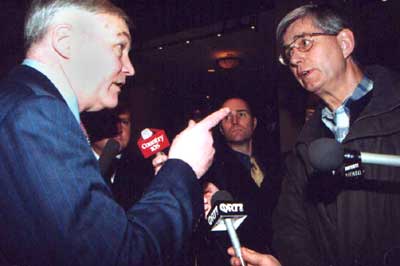 A black future
September 05, 2004 - The Times
http://business.timesonline.co.uk/article/0,,8209-1246866,00.html
After last week's damning report into Hollinger International accused Lord Black of Crossharbour of looting the company of $400m, the former Telegraph owner faces a welter of lawsuits and the prospect of a criminal inquiry that could lead to jail. Dominic Rushe reports from New York
AS a top bodyguard, James Hyslop saw some of the world’s most powerful people at their most vulnerable. Working in security for the Bilderberg Group, Hyslop came into close contact with the statesmen and leading businessmen that make up the right-wing think-tank’s membership.
Conrad Black, peer, former Telegraph boss and Bilderberg member, always impressed him, said Hyslop. “He didn’t need someone around the way other people on the world stage do — the bodyguard as a status symbol.”
Hyslop acted as Black’s bodyguard, accompanying him on his private jet and attending functions. He has nothing but fond memories of a man he describes as generous, warm, witty and intelligent.
Last week Lord Black’s former colleagues painted a very different picture of the disgraced peer — one that could land him in jail. In a phrase reminiscent of Black’s own famously florid oratory, he was accused of running “a corporate kleptocracy”. A 500-page internal report commissioned by his former company, Hollinger International, alleged that Black and others siphoned off $400m in an “aggressive looting” of the publishing company’s assets.
The cash taken by Black, his former deputy David Radler and their associates including Black’s wife Lady Barbara Amiel-Black, represents 95.2% of Hollinger’s entire adjusted net income during the period 1997-2003, claimed the report. Alongside the big numbers, the report is studded with a glittering trail of outrageous expense claims. Between 2001 and 2003, Black and co spent $23.7m on private jets. “Black’s corporate expense reports charge the company for items such as ‘handbags for Mrs BB’ ($2,463), ‘jogging attire for Mrs BB’ ($140), ‘exercise equipment’ ($2,083), ‘T Anthony Ltd leather briefcase’ ($2,057), ‘opera tickets for C&BB’ ($2,785), ‘stereo equipment for the New York apartment’ ($828), ‘silverware for Blacks’ corporate jet’ ($3,530) ‘summer drinks’ ($24,950), a ‘happy birthday, Barbara’ dinner party at New York’s La Grenouille restaurant ($42,870),” claimed the report.
Shareholders and Hollinger want the money back and are pursuing Black for more than $1 billion in the American courts. Also at risk are his former friends and directors, including Henry Kissinger, American defence adviser Richard Perle and Marie-Josée Kravis, wife of billionaire Henry Kravis. They stand accused of standing idly by as Black raided the piggy bank. Their bill for failing to stop Black’s excesses could run to hundreds of millions of dollars.
As the report makes clear, the claims against Black may well bankrupt the peer, but money could be the least of his worries. The Securities and Exchange Commission (SEC), America’s top financial watchdog, the state authorities and the FBI are investigating various aspects of the Hollinger case. A criminal lawsuit is a strong possibility and, in the current environment, conviction would almost certainly mean jail.
Black and Radler are strongly protesting their innocence. A statement from Ravelston, a company controlled by Black, dismissed the report as “exaggerated claims laced with outright lies”. Radler described it as: “a highly inaccurate and defamatory diatribe written more like a novel than a serious report.” He said KPMG, Hollinger’s auditors, repeatedly reviewed and approved the now controversial payments.
Hyslop said that Black should be treated as innocent until proven otherwise. But if the worst came to the worst and Black was sent to jail, “I think he would thrive. He can adapt to any situation. At least we’d have a far more intelligent prison class.”
WHATEVER the final outcome for Black, he and his former colleagues now look set for years of legal skirmishes. To date Black faces:
The legal fallout from the debacle will have a wide impact and take years to settle, said Columbia University professor John Coffee, an authority on white-collar crime.
Black’s case, he said, reminds him of the trial of Dennis Kozlowski. The former boss of Tyco is awaiting a retrial on charges that he looted $600m from the conglomerate. Like Black he enjoyed a lavish, company-funded lifestyle, spending $1m on his wife’s birthday bash and $6,000 on a shower curtain for his Manhattan flat.
The Kozlowski case began with an investigation by the SEC. It then passed its findings to Manhattan’s district attorney Robert Morgenthau, who brought criminal proceedings against Kozlowski and other former Tyco executives.
Black is already being investigated by the SEC and by authorities in Chicago, the city Hollinger lists as its headquarters. The two will work in tandem and the SEC is “almost bound” to bring legal action against Black, said Coffee.
The Hollinger Chronicles, as the report is known, was compiled by Richard Breeden, a former chairman of the SEC, and contains such damning accusations that “the SEC, I am sure, will proceed against him”, said Coffee.
Should Black be found guilty, the SEC can fine him, demand he repay money and ban him for life from holding office in an American company. But the watchdog’s powers are civil, not criminal.
It will ultimately be up to Illinois’s attorney-general, Lisa Madigan, to decide whether criminal charges will be brought against the peer. Kozlowski’s trial will weigh heavily on the mind of any prosecutor. “In almost all respects this is a case that is similar to Tyco,” said Coffee. “And that one started unravelling all over the place the minute it got to court.”
Kozlowski’s trial was heralded by headline-grabbing examples of his excess and gross spending sprees. The trial proved far less spectacular, with the jury worn down by mindnumbing and complex arguments.
“I think this report could well result in indictments, but it’s not a slam dunk,” said Coffee. He expects prosecutors to begin working on former Hollinger directors to turn against Black and act as witnesses for the prosecution. “Flipping” witnesses, as its known, has been particularly successful in securing convictions against executives of Enron, the energy firm that imploded in one of America’s biggest scandals.
James Cox, law professor at Duke University, said Breeden’s report looks too damning for Black to escape criminal prosecution. “If Breeden is right, then it seems that this was not a question of poor judgment, but of scheming and design,” he said. He reckoned that prosecutors would identify one or two areas where they believe the evidence is strongest and attack Black on those charges rather than going to trial with a long list of accusations, as happened in the first Tyco case.
Last April, that case ended in mistrial after six months in court and two weeks of jury deliberation. Prosecutors are to bring the case back to court and are expected to trim down their charges after the successful prosecution of two other fallen business stars.
Complexity was a potential problem in the trial of Frank Quattrone, a former star banker at Credit Suisse First Boston. Quattrone was the biggest banker of the dotcom era and made millions for his clients from share sales in companies that subsequently collapsed, costing the investing public and pensioners billions in lost savings. Prosecutors side-stepped getting involved in a complex securities case and instead pursued Quattrone, successfully, for obstruction of justice. Martha Stewart, the media queen, was also convicted on obstruction charges after an investigation of insider-dealing charges — something that is very hard to prove.
Hollinger and Black’s affairs are about as tangled as they come. The peer controlled the Telegraph empire through a network of holding companies, had significant operations in Britain and Canada as well as the United States, and banked many of his most controversial payments in Bermuda.
With the successful prosecution of Stewart and Quattrone on simpler charges, Chicago’s prosecutors may be tempted to follow a similar solution, say legal experts. They say Black’s past behaviour has left him vulnerable to such an attack — one that could avoid the complexities involved in Breeden’s report, but could still land the peer in jail.
IN the early 1980s, Black was feeling socially and politically stifled in his native Canada. A lifelong Amerophile, he set his sights on making his debut in business across the border. An ideal candidate was found in Hanna Mining, a company whose largest shareholders were some of America’s most well-connected families, including the Humphrey family — George Humphrey was President Eisenhower’s secretary of the Treasury.
The foray ended in legal action between Black and Hanna. Court documents relate that the Humphreys were assured that Black’s intentions were friendly and in 1981 the Humphreys approved the sale of 4.9% of Hanna to Norcen, a company Black chaired.
In filings with the SEC this stake was described by Norcen as “an investment position” and “purchased for investment”. But minutes from a board meeting described a more aggressive scenario: the “ultimate purpose” of the investment was a takeover. Months later, Black launched a hostile bid. Hanna hit back hard, accusing Black and Norcen of fraud and racketeering.
Black spent 20 hours in the witness box over four days, but despite impressing both judge and prosecutor with his oratory, he lost the case. The judge called Black’s reading of events “strained and unpersuasive”.
After an SEC investigation of the case, Black signed a “consent decree” in 1982 in which he pledged not to break any of the rules and regulations surrounding publicly traded companies. A consent decree is a court order, and breaching it is a criminal offence.
Breeden’s report alleged that Black filed documents with the SEC that contained false statements, or “omitted to include material information” on numerous occasions.
Breeden claimed the SEC was not informed about tens of millions of dollars paid to Black, Radler and others “regarding fees and other forms of compensation or related party transactions ... For example, the compensation table in Hollinger’s proxy statements does not show Black and Radler as receiving any compensation from Hollinger as their share of $226m in management fees between 1996 and 2003. In an average year, Hollinger failed to disclose in its proxy statement as much as 96% of the compensation the committee believes was received by its top five officers,” reported Breeden.
Piling on the detail, Breeden reported that “Black and Radler caused Hollinger to make $15.6m in ‘non-competition’ styled payments in 2000 and 2001 to themselves and two associates without any review by or approval from the Audit Committee or the Board.” The Special Committee accuses Black and others of creating “sham transactions, the deliberate backdating of checks and concealment of the unauthorised payments” and says the payments were not fully disclosed to the SEC.
If the hotly disputed allegations were proven true, Black would be in clear breach of the consent decree.
FOR Black and his former colleagues the party is over, and the headaches have only just begun.
Under Black, board meetings operated more like “a social club or public-policy association than as the board of a major corporation”, according to Breeden’s report.
Black talked world affairs with Henry Kissinger and Richard Perle, the former Pentagon defence adviser. A good lunch followed the short meetings and never did the board query Black or his spending. Black and Radler bought newspaper titles from Hollinger, sometimes for as little as $1, and added them to their own private companies. The board appears to have failed to ask if this was as good a deal for Hollinger as it appeared to be for Black.
According to Breeden’s report, Black contributed to his board members’ charities and invested in businesses they were tied to. In the case of Perle, who at one point sat on Hollinger’s compensation committee, Hollinger awarded him millions in bonuses and even picked up his grocery bills — at least until Black started querying Perle’s expenses.
Those close ties and the board’s silence will come at a price, said Laura Jereski, analyst at Tweedy Browne, a Hollinger shareholder and the first to blow the whistle on Black. The company is threatening a lawsuit unless Hollinger pursues its present and former directors for allegedly allowing Black to allegedly loot the company.
Cardinal, another shareholder, is already demanding $300m in restitution from this rich and powerful board. Both Tweedy and Cardinal are likely to press for a settlement — if they don’t get one then Black’s former friends face embarrassing days in court.
Jereski said she was impressed with the Breeden report, before adding: “It’s one thing writing about what happened. But for me the finger wagging is less interesting than what gets done about it.”
http://business.timesonline.co.uk/article/0,,8209-1246866,00.html
http://www.canada.com/windsor/windsorstar/features/onlineextras/story.html?id=b6adcb4d-3ce6-4046-81bc-9bf47080fe5f
http://www.canada.com/montreal/montrealgazette/news/story.html?id=ea12c9eb-630c-438d-a0ca-4332a0dd8a5e
September 2, 2004
Conrad Black, by 1985, was a master at hobnobbing with the rich and famous and the politically powerful. He was an accomplished insider at the secretive Bilderberg conferences and the Trilateral Commission.
But he did not feel involved in world events. His business interests - with the exception of his newspaper interests - bored him. His involvement with grocery stores, mining, petroleum, farm machinery and the like served only one purpose. "I was in those solely for the reason of making some money out of them," he says. "Restructuring them, or managing them up and selling or trading them, or doing something financially 'preferably a bit innovative' with them."
Ever since Black had run the Eastern Townships Advertiser and the Sherbrooke Record in the 1960s, newspapers had appealed to him, and he had picked up a few in provincial Canadian backwaters. But his dream of becoming a press baron on a grand scale had been thwarted.
In 1979, he had been blocked by Kenneth Thomson in his quest to gain control of FP Publications, an important Canadian newspaper group.
Over the years, at Bilderberg conferences, Black occasionally discussed the prospect of investing in a British newspaper with Andrew Knight, editor of The Economist and a member of the Bilderberg steering committee. Black had always admired Canadian press barons who made it in London.
Lord Beaverbrook, from New Brunswick, had made a fortune through newspapers. He'd served as a minister in British cabinets in both world wars and vigorously promoted the Empire Crusade - an attempt to increase trade within the Commonwealth. He was even mentioned in the newsreel sequence of Citizen Kane as a newspaper power to be reckoned with.
Black had closely studied Kenneth Thomson's father Roy, admiring the way this astute but modest man from northern Ontario watched the balance sheet. But there was an obvious difference in style between Beaverbrook, the hands-on propagandist, and Thomson, the cool operator who had made a fortune in broadcasting and North Sea oil, then used it to subsidize The Times. Thomson considered the take-over to have been "the summit of a lifetime's work."
Even to this day, long after Thomson's death, Brian MacArthur, associate editor of The Times says: "I bless Roy Thomson's name. He hired excellent editors, spent money, didn't interfere, and let us journalists get on with it-something like the New York Times, the Washington Post or the Toronto Globe and Mail. All Thomson cared about was the number of classified ads, and giving journalists the resources to do their job."
Beaverbrook and Thomson Sr. had been Fleet Street giants, sending journalists around the world to report on events that mattered, setting a high standard for eye-witness news-gathering as much as for writing. They dominated the world's most competitive newspaper market and that commanding position gave them access to highest royalty and to politicians from mayors to prime ministers. They were sometimes asked to quietly smother stories, but also often had a hand in choosing the country's political leadership. Britain is a country with no written constitution, where the chain of command within the government - even in the planning of nuclear war - was subject to interpretation, based on historical precedents, and there was usually an informal, gentlemanly character to political decision-making. The press barons were a formidable, articulate alternative to the government.
Moreover, a strong majority in the British parliament could result in democratic tyranny. "Particularly in our constitution," said Lord Carrington, "press barons play an important role in Britain where if you have a very big majority in the House of Commons, there are no checks and balances. The House of Lords doesn't matter, and the House of Commons really doesn't matter, because if you have a big majority, the followers always go with the premiers - well, nearly always."
"Newspapers influence the outcomes of elections," said Lord Hattersley, a former minister in the Labour governments of Harold Wilson and James Callaghan, and a noted journalist. "In a free society, it just happens. Journalists have to be accepted as part of the democratic process. People in political office complaining about journalists are like sailors complaining about the sea."
The British government draws press lords into the circle of power by using the honours system, the often cynical award of noble titles-one of "the most potent pieces of patronage in a premier's hands," according to constitutional authority Peter Hennessy. A peerage transforms newspaper proprietors into legislators, with the power to debate and vote on bills sent up to the House of Lords from the House of Commons. This fudges their role, from the observation of events and the shaping of public opinion to participation in decision-making. They are proprietors, marketing facts and ideas on a grand scale. But they are statesmen too - with a political platform of their own in and outside of Parliament.
In May 1985 came an opportunity that would change Black's life.
At the Bilderberg meeting at Arrowwood, outside New York, Andrew Knight told Black that The Daily Telegraph was undergoing severe financial and managerial strain. The paper was the English-speaking world's largest-circulation conservative broadsheet. It dated from 1855, the time of the Crimean War. Black's great-grandfather Robert Thomas Riley was the son of one of the founding shareholders. Since the late 1920s, the Telegraph had been controlled by the Berry family, industrious Welsh entrepreneurs with a history of coming to the rescue of faltering companies and then building up durable value. Bill Berry, the first Lord Camrose and one of the pre-war giants of Fleet Street, had promoted high standards of reporting at The Telegraph. He had the good sense to oppose fascism throughout the 1930s (unlike his competitor Lord Rothermere at The Daily Mail) and had even employed Winston Churchill as a freelance contributor before the Second World War. The Telegraph broke the one million circulation barrier in April 1947 - a net daily sale of 108,000 more copies than The New York Times and The New York Herald Tribune combined. But Camrose's son Michael - Lord Hartwell - a deaf and extremely shy man prone to mumbling, did not have much entrepreneurial flair.
His mission was to preserve the value and style of his late father in the newspaper's executive offices on the fifth floor of 135 Fleet St. "Just as he kept his own offices unchanged, with their 1930s panelling and their ancient Telegraph contents bills for decoration, so he maintained his father's routines to the letter," wrote Duff Hart-Davis, the Telegraph historian. "A butler dressed in black still guarded the entrance to the fifth floor." Staff members of the old school snapped to attention when they spoke to Hartwell on the telephone.
Hart-Davis explained that Hartwell maintained an antiquated system of management, surrounding himself with venerable gentlemen like himself, and had done little to prepare the next generation - his sons Adrian and Nicholas Berry - for administrative roles. Adrian was more interested in science than administration. Nicholas had shown a keen business sense, but had not been prepared for succession.
Besides, in the midst of rapid technological change on Fleet Street, and an ongoing war of attrition between newspaper proprietors and print unions, Hartwell had made a catastrophic mistake - committing to costly new printing installations in the East London's Docklands on the basis of overly optimistic projections without properly evaluating the financial risks. The new presses would offer financial benefits to the paper, but the Telegraph did not have the financial depth needed to pull it off without new capital. After lengthy negotiations with several banks during 1984, "a consortium led by Security Pacific, and including the National Westminster County Bank, the Hong Kong and Shanghai Bank and Wardley London, agreed to put up £75 million on condition that the Telegraph raised £29 million from the sale of shares." Given the precarious financial position of the company, N.M. Rothschild & Sons was having trouble raising the £29 million.
"The Telegraph was bankrupt effectively," says Knight, "and it couldn't raise the money it needed to finance its new presses, let alone survive. Rothschild could not raise all the money needed, so I contacted Black with a view to having him invest in the paper. I had two candidates in mind, Conrad or Kay Graham. I went to Conrad because he was more ideologically attuned to the Telegraph and, unlike Kay, was not a friend of the Berry family, so future muddles would be avoided if and when he got control."
The Telegraph was the Crown Jewel of the British press. As Black later wrote, "the key to the Daily Telegraph's immense success was a formula devised by Lord Camrose and faithfully continued by his son, Lord Hartwell, consisting of an excellent, fair, concise, informative newspaper; good sports coverage; a page three in which the kinkiest, gamiest, most salacious and most scatalogical stories in Britain were set out in the most apparently sober manner, but with sadistically explicit quotations from court transcripts; and extreme veneration of the Royal Family."
Beyond the quality and prestige of the title, Black was also interested in the political platform that ownership, even partial ownership, would offer ?? a platform in a world capital, more than just a cut above Toronto. There was a charming, faded elegance to London, with its palaces and hotels, the bulky black Carbodies cabs and double-deckers lumbering by, the trotting procession of the Horse Guards and richly liveried staff in the clubs. London was a layered city, a visual feast for a history buff like Black.
There was also the impressive literary tradition of British journalism.
Bill Deedes (now Lord Deedes), a former editor of The Daily Telegraph, had been a war correspondent during the Italian invasion of Ethiopia in the 1930s (and a character in Evelyn Waugh's Scoop), a parliamentary secretary in Sir Winston Churchill's post-war government and a cabinet minister under Harold MacMillan. In the 1970s and 1980s, following in the footsteps of Waugh and George Orwell, came a series of adventurers and unusually gifted men - Reuters correspondent Anthony Grey, who was held hostage for two years during the Chinese Cultural Revolution as a symbol of the paper tigers of capitalism; war correspondent Max Hastings who sometimes scooped the opposition by taking a taxi to the front; John Pilger, a rugged Australian whose life mission was to denounce every abuse of power (he attacked the manufacturers of thalidomide as willingly as he blasted Henry Kissinger for the indiscriminate American bombing of civilian Cambodia during the 1970s); Robert Fisk who risked his life time and again reporting from Lebanon and throughout the Middle East; and Reuters man Andrew Tarnowski who became a temporary captive of the Amal militia in Beirut so he could interview hostages from the 1985 TWA hijacking and scoop the world's media.
Black relished the negotiating process; the opportunity of gaining The Telegraph at a bargain price and releasing the locked-up value."You have all the different elements there," said Black."You have possible economic gain, you have human drama, you sometimes haveâ?¦the abrupt and almost cruel end of long-standing incumbency, and the rise of new interests, which I suppose I myself represented. You have the unfolding drama, and you are conscious at all times of being in the midst of the drama, whose outcome is hoped-for, but there is a great deal of suspense as you get into these things. A lot of nervous energy is put into it." But Black recognized the risks as well.
Excerpted from Lord Black: The Biography by George Tombs.
Copyright 2004 by City Publishing Inc. www.optimumpublishing.com all rights
reserved.
This book will be available across Canada Sept. 13.
http://www.canada.com/windsor/windsorstar/features/onlineextras/story.html?id=b6adcb4d-3ce6-4046-81bc-9bf47080fe5f
http://www.canada.com/montreal/montrealgazette/news/story.html?id=ea12c9eb-630c-438d-a0ca-4332a0dd8a5e
After having announced the attributes and the names of the new European Commissioners on 12 August 2004, José Manuel Barroso met his team on the 20 August 2004 in Brussels for the first time. The new commissioners will then be submitted to hearings on September 27, by the European Parliament, who shall vote at the end October on the new Commission, before it officially takes over on November 1st 2004.
The "European popular group" showed its satisfaction the day after the announcement of the nominations. Its president Potterin commented positively on the Lisbon strategy, in other words the strenghtening of European competitiveness. This will be the central aim of Günter Verheugen. [Bilderberg], who will report directly to Barroso, himself presiding over the group in charge of this strategy.
Verheugen declared that he will be in charge of the group of commissioners responsible for European economic coordination and this will give him a strong position. The subject is essentially depending on the individual member states.
Between the nations in Europe and the EEC, we will find M. Verheugen. The president of the "democrat group", M. Graham Watson greeted the 'inspired' choices and the 'imaginative' thoughts of the future president of the commission. He was delighted at the presence of one third women in the commission and the absence of super commissioners.
The actual commissioners refuse to give their public ideas about the decision of Mr Barroso. One of them observed privately, that the former Portuguese prime minister rewarded his friends, who were with him on the side of the American intervention in Iraq. So, M. Mandelson (trade/commerce), Italy with Rocco Bottiglione (justice liberty security), Denmark with Marianne Fisher Boel (agriculture), Poland with Hubner (regional policy), Spain with Joaquin Almounia (economical and financial affairs) have got more powerful commission posts than France ad even Germany, if we judge limited the powers of M.Verheugen.
The preeminence of the liberals is also underlined with Peter Mendelson, says a senior civil servant of the commission. Trade policy runs a risk of being more liberal and Atlantic. The British commissioner, he added, can attempt to try again to suggest the idea of a free trade zone upon the Atlantic, against the which Pascal Lamy [Bilderberg] fought.
The Irish Charlie McCreevy and her collegue in charge of the concurrence, the Dutch Kroes Smit, are two ultra liberals in charge of two key posts, should provoke reservations from our point of view in regard with their past performance.
McCreevy, Irish finances secretary from 1997 to 2004 is considered as the artisan in company of First Minister Bertie Ahern of the 'Celtic miracle'. His policy towards Foreign Investments turned the island into an El Dorado of American Multinationals. Firms are paying 12,5 % of taxes (in France the rate is 35 % ). The minimum wages are under what is required to live with some respect of oneself. McCreevy promoted the recovery of the National Airways company, Air Lingus, which was near of the bankruptcy by cutting the number of employees.The result of this policy gave some undesired effects: public services running down, increased poverty, inflation, and strikes for higher pay in the public sector.
Sometime nicknamed the Iron Lady in the Netherlands, Mrs Kroes Smit, who was secretary of State then secretary of Transportation, is known by the Dutch Trade Unions as having been behind the privatisation of the old postal service. Her arrogance and bad temper brought her a lot of enemies. Her nomination may well be down to Jacques Chirac, President of France, because, is it told in The Hague, he asked the Dutch government to name Christian Democrat Veerman agriculture commissioner. Mrs Kroes says her policy is Popular/Liberal but no-one is quite sure why she thinks she is popular.
These beginnings are not reassuring, so the French socialist MP, Arnaud Montebourg, denounced the attribution of all the key posts in economical and financial fields to personalities who have a systematic orientation towards liberalism. This European commission, he concluded, is an enemy to every member of our party. Another French socialist MP underlined the decline of France which can only receive a little second order nomination.
The position of President Chirac is not comfortable. The partial nominations in the EEC Commission is showing a spirit of vengeance on the French and the German rebels who weren't on the American side in the Iraq war.
The strange Blairite creature the British press have christened the 'Prince of Darkness' for his twice being forced out of ministerial positions for illegal activities but ability to 'ressurect' his politiacal carreer. Peter Mandelson, we see that he is a member of the Ditchley Foundation, which aims to develop Transatlantic links between Great Britain and the USA. With more than 15 conferences every year in the castle of Ditchley Park, near Chipping Norton in Oxfordshire
Ditchley is certainly one of the most important places of meeting for the International Elite, along with the Trilateral Commission and the Bilderberg Group. Ditchley has focused on International problems, as the expansion of Europe (mister Verheugen was just Commissary at the broadening of Europe during the commission Prodi, is this not curious ?), Global Arms Control, the Euro currency, Defense Industry, conflict of Kosovo. It is a very select club, the members are industrialists, financiers, ministers, secretaries of State, journalists, intellectuals and leaders of armed forces, including NATO.
President of Ditchley, we find as we look closer, is ex-British Prime Minister John Major. A member of Bilderberg and the European President of the Carlyle Group. John M is also credit adviser for Suisse First Boston, President of the council of European Advisers of Emerson Electric and boss of Atlantic Partnership. We find as well as members Lord Leon Brittan, vice-president UBS Warburg, director of Unilever, former vice-president of the European Commission. Giulanio Amato, former first secretary of Italy and Bilderberger. Etienne Davignon, that all know in Bilderberg affairs as President, dame Pauline Neville Jones who was Governor of the BBC, president NatWest Markets, member of Bilderberg Stresa 2004, and who sollicited a few month ago to become director in Eurotunnel, whose Lord Tugendhat, member of Ditschley, former vice-president of the European Commission to the budget is director as in Rio Tinto. All these friends awarding jobs to each other over lots of plush surroundings and good food which nobody seems to know who pays for.
A lot of commissioners of the new Commission are not well known because originating from the new members of Europe countries, but in any case there is no doubts about the fact that their hearts all beat in favour of extreme liberalism. We are coming to a more hard stage of liberalism tending to be restored in full power of its belief in its credo.
Let us remember that Liberalism is claiming three liberties:
The first wave of liberalism died in the years 1920-1930 after it did a lot of harmful work on the European and American Societies.
Their system is saying that if everything is free and companies making no cartels and monopolies, with no workers belonging to Trade Unions, the system will enrich everybody. In a way this is the counterpart of the dream of Karl Marx. This is perfectly utopia but based on the works of Nobel prize economists, and mathematic developments, this seems in their eyes to be true.
The system 'requires' every country in the world to be included, and every individual to be effected. That is why Liberalism and Globalism work closely together.
Some French socialists are reproaching to M. Chirac not to have presented M. Lamy at the Presidency of the Commission. Chirac is not mad. He remembered all the worst that Mr Lamy [ Bilderberg] has done to the interests of France. Mr Lamy proclaims to the world that he is a French Socialist as was Mr Strauss Kahn, and Mr Fabius. All of the three are from the 'Champagne Left' and all three are Bilderbergers who like to live in luxury.
The works of Mr Lamy in collaboration of M. Zoellick [Bilderberg USA] have given a conclusion going along with the end of farming subsidies to help European and American agriculture compete in export fields. This will create a strong crisis in the rural world of USA as well in Eastern Europe (standards of living are not the same in Poland and other new member countries as Western Europe).
Undoubtly, this signature will help the products from countries of the South to invade the American and European markets meanwhile a lot of indebted farmers will stop exploiting their fields. This will meet he wishest of the EEC Commission which has decided to reduce the subsides to agriculture in the next four years.
This is an application of the principles of Liberalism. Mr Chirac is the worst enemy of Liberalism in Europe. He is deliberately promoting the French Industry and French Groups. He has been denounced as practising "Colbertism" (after the name of the commerce minister of king Louis XIV). Chirac helped the alliance of Adventis - Sanofi, the merging of these two companies rendered this French group the third in pharmaceutical field. But Novartis and M. Vasella [Bilderberg] was on the side expecting to merge with his own group.
The intervention of M. Chirac made him sour although he declared the opposite. Mr Chirac continues to work with a nation idea of capitalism, opposed by the Global vision of Liberalism.
The power of France is coming from the fact that the European "Council of Ministers" has more power than the commission. They are not both supposed to quarrel, and up the moment of the adoption of the Constitution of Europe and its application, it will be so.Only then will the Commission take power above the Council of Ministers. The constitution, if accepted by the members states will be in full power in 2009.Until then the current system will prevail.
Let 's imagine that one nation rejects the constitution. It will delay the process. Thus the special links between France and Germany are working in the field of economical cooperation as well than in politics, enraging the opinionated liberals.
Now to demonstrate the power of international capitalism , I will show you the list of the commissioners since 1994 and their outside activities:
Vice-président : Sir Léon Brittan, vice-président UBS Warburg, administrator Unilever, adviser of Morgan Stanley Dean Witter.
Industrial Affairs, technological informations & telecommunications, Martin Bangemann : member of gestion council of Telefonica
Concurrence : Karel Van Miert, administrator Agfa Gevaert, de pers group , member surveillance comite of Philips, Wolters Klowers, Goldman sachs international, Rabobank, Swissair, DHV, GUIDANT , Eli Lilly, British American Tobacco, member of consultance comite RWE.
Foreign Relations, Foreign Security Policy : Hans Vandenbroeck : secretary of board of directors and commercial director of (division of chemical group Akzo Nobel)
Relations with the European Parliament. Culture & audiovisuel : Marcelino Oreja : former director of Banco Guipuzcoana, Cementos Portland Valderribas , Acerinox, Vidrieras Guardian Llodio, papeles Scott Iberica, Agroman Empresa Constructora
Regional policy : Monica Wulf Mathies :former director of Veba (division of chemical group EON), Deutsche lufthansa,BGAG Beteiligungsgesellschaf der Gewerkschaften , Bund Verlag
Interior market, financial services : Mario Monti, former member de l'Aspen Institute Italia, executive comite of the Trilateral commission , of the direction of meetings of Bilderberg group,former director of Gilardini (1979 -- 1983), Fidis (1982 1988), Fiat (1988 1993), Banco commerciale italiana (1983 1994,), Rizzoli editore (1984 1985), IBM italia (1981 1990) , assurances Generali (1986 1993).
Economical affairs, finances and money : Yves Thibault de Silguy : presently director of Suez and member of Internation Medef, director ofUgine and Unimetal (divisions of Usinor-Sacilor)
Budget, personnel & administration : Erkki Liikanen : président 1983 à 1989 of the surveillance council Outokumpu inc, former director of the Firm televa oy
Président : Romano Prodi, former member of the orientation comittee of the review If (revue of the IBM foundation Italia), member of the 'association for the protection and promotion of investments of Private Foreign Investments (AAPPI, in Zurich), comite of direction of the review " moneto e credito of the BNL (Banco nazionale de Lavoro). When he declared his personnel professional and private interests, romano Prodi declared having 50 % of the firm ASE , then in phase of liquidation since end 1997.
Concurrence : Mario Monti, cfr Commission Santer
Interior Market, taxation & custom union : Frédéric Bolkenstein, président of International libérals, président of the Atlantic Commission atlantique (Netherlands), member of the Society Mont - Pelerin, former member of the surveillance comite of the firm Merck Sharp & Dohme. Frits Bolkenstein stayed during 16 years near Royal Shell Dutsch before becoming General director of Chemical Shell . Economical & Money Affairs : Pedro Solbes Mira : member of the Spanish section of the Trilateral Commission.
Enterprise- Information Society : Erkki Liikanen cfr commission Santer
Foreign Relations : Chris Patten : precise at the moment of the declaration of his personnal interests & Professional interests havingr 4660 shares of the company Heavitree Brewery (leisures, ho tels)
Commerce : Pascal Lamy : former director general of the Crédit Lyonnais, former member of the direction comite of the Socialist party, former président of the prospective commission of the Medef ( french patrons !!!!), former member of the consultative council of Rand Corporation Europe.
Health & Consumers protection : David Byrne, precise in his declaration having 625 shares of Lough Inagh & Derryclare Fishery and 8000 shares of Agua Deck
Employment & Social Affairs ( !) : Anna Diamantopulou, former president of EOMMEX, Greek organisation for little and Middle enterprises and artisans (1993 1994), precise in her declaration, having shares in different Greek firms for about 88.000. Member of Bilderberg since Stresa 2004.
Development & Human help : Paul Nielson, former president LD -Energy, Water Group, former director Denerco (petroleum), tarco (chemical industry), Vestas D. W. T (world leader in manufacturing wind turbines) .
Justices & Interior affairs : Antonio Victorino, former vice-president Portugal télécom international (1998 --1 999), former president of the General Assembly of auctionneers Banco Santander central (1998 -- 1999).
Next door to the commissioners' offices in Brussels we find a lot of workforces existing by the political will of the European leaders, and more particuliarly, members of the Commission, the contacts with the business world are so important that hey could fill a book.
Under the Santer Commission for instance, we have two instances about the future of telecoms and Society of Information on one side, on the other about the European competitiveness in Europe. It is in February 1994 that Martin Bangemann then commissioner in charge of industrial affairs, Information technologies and telecommunications set up a workforce including (no Trade Unions) the following chiefs of enterprises: carlo de Benedetti, président of Olivetti, Gyllenhammar president of Volvo, Pierre Lescure president of Canal+, Gaston Thorne, president CLT, Peter Bonfield, president of British telecoms; Etienne Davignon, president Société Générale de Belgique, Hans Olaf Henkel, président Henkel, Heinrich von Pierer, president of Siemens, Jan Timmer, president of Philips, Candido Velasquez, president of Telefonica whom Martin Bangemann will be little after member of the direction.
These different experts were nearly all present to the ERT ( European Industrial Round Table) which is - it appears - the sole policy making body for new Eurppean law and directives. With plenty of direct contacts with the Private sector of telecommunications and new technologies.
The conclusions they had in these years were in favour of their own private interests. They asked the EEC to install the following reforms, as urgently as possible:
In a word, to do more with less. One year after, in February 1995, President Jacques Santer himself created a consultative group on European competitiveness. Made up of of 13 members : president of Unilever, Percy BARNEVIK (president of ABB et member of Bilderberg) , David Simon (president of BP) or Orja Ollila (president of Nokia and Bilderberger ).
This year they invited some Trade Unions. It is true that the European Confederation of Unions (CES) has accepted since a few years all the reforms of the EEC and the requests of the European patrons.
For instance, the General Secretary of the CES, Emilio Gabaglio, was taking part in the year 2000 to the European summit under the auspices of UNICE and the European Commission. He agrees with the ERT that workers must become more flexible. He spoke in the frame of a task force devoted to reinforce the flexibility of the work markets.
Today the boss of the European Syndicates is himself a member of the European Policy Center, a think thank based in Brussels and which has as director the former vice president of the Commission , Peter Sutherland, [Bilderberg] who became president of BP Amoco and of the American Bank Goldmann Sachs .
http://www.nytimes.com/2004/07/11/weekinreview/11cowe.html
Published: July 11, 2004
SINCE its first meeting 50 years ago, the Bilderberg conference, a secretive gathering of global power brokers, has inspired layer upon layer of conspiracy theories, which it has done little to dispute. Over the years, the deeds laid at the conference's devious door have included the creation of the European Union, the invasion of Iraq and the bombing of Serbia - all to service its most cherished goal: the creation of a world government.
The conspiracy theories bubbled to the surface anew last week, after it was reported that a well-received speech by Senator John Edwards at the conference last month in Stresa, Italy, was one reason for his selection as John Kerry's vice-presidential running mate.
Is the Bilderberg confab now molding domestic American policy?
Roughly 130 delegates attend the invitation-only annual gatherings, named for the Dutch hotel where the first Bilderberg conference was held in May 1954, to debate issues surrounding the cold war.
The meetings are hardly a monument to transparency. The hotels involved are usually closed off to other guests.
Unlike the World Economic Forum in Davos, Switzerland, journalists are not invited to cover it - although a few attend as participants - and all delegates promise to keep quiet about what they hear and say.
"They do not have to sign anything, but they understand that they do not talk," said Maja Banck-Polderman, the organization's executive secretary. In a telephone interview, she said she was the only employee at the Bilderberg administrative office in Leiden, the Netherlands.
Secrecy understandings aside, prying details loose about Mr. Edwards's appearance was not difficult so long as the chattering chieftains were not identified.
Mr. Edwards, several said, joined Ralph Reed, the Republican strategist, in giving a presentation on the American election. After Mr. Reed spoke about how Mr. Kerry was vulnerable on "values," Mr. Edwards presented a characteristically positive case for Mr. Kerry's election, focusing on the insecurity of American workers that persists even when economic statistics turn north.
Two Democrats in the room said Mr. Edwards sparked a rule-breaking round of applause when he finished, though a nonpartisan witness did not recall such an ovation.
"He spoke with great passion, in a meeting that is usually rather dry," said the nonpartisan veteran attendee. "He was able to make it a cross between his stump speech and an intimate conversation in a small room."
The group's meetings, Ms. Banck-Polderman said, are financed by corporate sponsors in the host countries and are regularly attended by tycoons, politicians and diplomats in Europe and the United States, including Henry A. Kissinger, the former secretary of state, and Richard N. Perle, the former head of the Defense Policy Board. This year's list also included Richard C. Holbrooke, the former United States ambassador to the United Nations, and, of course, Senator Edwards.
The guest list and membership would more or less overlap with the "Wanted" posters of anti-globalization protesters. Indeed, one former participant, Will Hutton, a British journalist and economist, has been widely quoted calling the Bilderberg set the "high priests of globalization."
Former participants have generally played down the conspiracy theories, saying the secrecy is merely designed to foster a climate of open debate, allowing participants to speak their minds freely.
But critics of the Bilderberg conference argue that while it may not make formal decisions, it sets a consensus that spreads among business and political elites, molding the global agenda.
Some argue, for instance, that the first intimations of American determination to wage war in Iraq came from a Bilderberg gathering in 2002.
"What I call for is more openness in what they do," said Tony Gosling, a British researcher and former journalist who has followed the Bilderberg meetings and believes they are designed to unite opinion around major, global ideas.
"I don't think the participants should be sworn to secrecy," he said in a telephone interview from Bristol, England. "I think that a forum where so many rich and powerful people meet should be open to public scrutiny."
Whatever else, the selection of Mr. Edwards as Mr. Kerry's running mate seems to show that the Bilderberg delegates have an eye for a contender.
But Democrats please note: they do not always back the winner. This year's delegates list showed that Giulio Tremonti attended as Italy's minister of economy and finance: four weeks later, he resigned in a political dispute - perhaps not the best of omens for Senator Edwards.
http://www.nytimes.com/2004/07/11/weekinreview/11cowe.html
http://www.worldnetdaily.com/news/article.asp?ARTICLE_ID=39333
Posted: July 8, 2004 - 2:49 a.m. Eastern
Sen. John Edwards' standout "performance" at the super-secret Bilderberg meeting in Italy last month may have been a key reason for his selection as John Kerry's vice presidential running mate, according to the New York Times.
The 50th anniversary conference of the elite group – which many believe conspires semi-annually to foster global government – met June 3 through June 6 in Stresa, Italy, at the Grand Hotel des Iles Borromees.
Among the attendees from the U.S., according to a list obtained by WND, were Senators John Edwards, D-N.C. and Jon Corzine, D-N.J., Henry Kissinger, Richard Perle, Melinda Gates (wife of Bill Gates), David Rockefeller, Timothy F. Geithner, president of the Federal Reserve Bank of New York, Donald Graham, chairman and CEO of the Washington Post Company, and even Ralph Reed, former head of the Christian Coalition.
According to a report in yesterday's New York Times by Jody Wilgoren, analyzing why Kerry chose Edwards over the other 24 serious contenders for the No. 2 spot:
Several people pointed to the secretive and exclusive Bilderberg conference of some 120 people that this year drew the likes of Henry A. Kissinger, Melinda Gates and Richard A. Perle to Stresa, Italy, in early June, as helping win Mr. Kerry's heart. Mr. Edwards spoke so well in a debate on American politics with the Republican Ralph Reed that participants broke Bilderberg rules to clap before the end of the session. Beforehand, Mr. Edwards traveled to Brussels to meet with NATO officials, brandishing his foreign-policy credentials."His performance at Bilderberg was important," said a friend of Mr. Kerry who was there. "He reported back directly to Kerry. There were other reports on his performance. Whether they reported directly or indirectly, I have no doubt the word got back to Mr. Kerry about how well he did."
Since 1953, the Bilderberg group has convened government, business, academic and journalistic representatives from the U.S., Canada and Europe with the express purpose of exploring the future of the North Atlantic community.
According to sources that have penetrated the high-security meetings in the past, the Bilderberg meetings emphasize a globalist agenda and promote the idea that the notion of national sovereignty is antiquated and regressive.
"It's officially described as a private gathering," noted a BBC report last year, "but with a guest list including the heads of European and American corporations, political leaders and a few intellectuals, it's one of the most influential organizations on the planet."
And according to a BBC report on June's conference in Stresa: "Not a word of what is said at Bilderberg meetings can be breathed outside. No reporters are invited in and while confidential minutes of meetings are taken, names are not noted. The shadowy aura extends further – the anonymous answerphone message, for example; the fact that conference venues are kept secret. The group, which includes luminaries such as Henry Kissinger and former UK chancellor Kenneth Clarke, does not even have a website."
But, counter participants, the secrecy is not evidence of a grand conspiracy, but only an opportunity to speak frankly with other world leaders out of the limelight of press coverage and its inevitable repercussions.
"There's absolutely nothing in it," argues the UK's Lord Denis Healey, one of the four founders of Bilderberg. "We never sought to reach a consensus on the big issues at Bilderberg," he told the BBC. "It's simply a place for discussion."
http://www.worldnetdaily.com/news/article.asp?ARTICLE_ID=39333
Bret Burquest
In 1954, a group of powerful men and women met in the Bilderberg Hotel in Holland to form an alliance whose purpose was to organize the world in a manner suitable to their liking. This alliance, known as the Bilderberg Group, has held annual meetings ever since to influence the fate of the world. This year is the 50th anniversary of the organization, made up of 120 prominent businessmen, politicians and European royalty.
The annual meetings are held in total secrecy in posh locations in Europe or North America. This year, the meeting will be held in Stresa, Italy, during June. Reporters and other outsiders are prevented from attending, or even entering the premises, by armed security forces, and not a word of what is said in a Bilderberg meeting can be breathed outside. Meetings are held behind closed doors and the minutes are not published.
According to former Bilderberg delegate Will Hutton, a British economist, the meetings are the “backdrop against which policy is made worldwide.” Prince Bernhard of Denmark, a Bilderberg Group founder, stated, “It’s difficult to reeducate the people who have been brought up on nationalism to the idea of relinquishing part of their sovereignty to a supernatural body.” The primary goal of the Bilderberg Group is a one-world government. And to no one’s surprise, the Bilderbergers would like very much to be in charge of that government.
Bilderberger George McGhee, former U.S. Ambassador to Germany, contends, “The Treaty of Rome, which brought the European Market into being, was nurtured at Bilderberg meetings.” In the 1998 Bilderberg meeting, one of the decisions was to encourage British Prime Minister Tony Blair to press harder for Britain’s entry into the European Union, another step toward one-world government. British journalist Tony Gosling claimed, “I first heard about the determination of U.S. forces to attack Iraq from leaks that came out of the 2002 Bilderberg meeting.”
Critics of the Bilderberg Group claim that they coercively manipulate global finances and establish rigid, binding monetary rates around the world. The Group selects political figures they believe will further their cause and targets those who oppose their goals. This strategy guarantees the propagation of their own power and the enrichment of its members, often at the expense of human rights and environmental concerns.
Like it or not, powerful people in high places are meeting regularly and secretly to manipulate world affairs.
Samuel Berger, formerly Bill Clinton’s national security advisor, speaking recently at the Brookings Institute, observed, “Globalization – economic, technological, cultural and political integration – is not a choice. It’s a growing fact. It’s a fact that will proceed inexorably, with or without our approval. It’s a fact we ignore to our peril.”
It’s not too farfetched to believe that powerful people meet to discuss a common agenda. The problem is the secrecy. Any activity that is honorable should be available for public scrutiny. Our currency says it all: Novus Ordo Seclorum – New World Order. Perhaps a one-world government has been in the works for a long time.
I once belonged to a similar secret organization that operated on a slightly smaller scale. In 1996, we held a meeting at a Motel Six near the airport in Hackensack, New Jersey. We were much like the Bilderbergers – full of ambition and avarice, yearning for power. Thereafter, we were referred to as the Hackensack Group.
Our goal was to acquire acreage by homesteading the median strip of the New Jersey Turnpike, from Bayonne to Perth Amboy, and grow asparagus. We spent two days surveying the area and formulating strategy.
Unfortunately, one of the Hackensackers discovered that the Homestead Act of 1862 was repealed in 1977, bringing our operation to a grinding halt. Rather than come up with another plan, we met for breakfast at a waffle house and disbanded the group. After 48 hours in New Jersey, we figured it just wasn’t worth it.
Sometimes it’s better to go with the flow and let the greed-heads who want to control the world flounder in their own ambitions. Anyone who wants to be in charge of this planet is either a masochist or an idiot. Or both.
By Jean Christou
11June 2004
http://www.cyprus-mail.com/news/main.php?id=14704&cat_id=1
CYPRUS was represented for the first time ever at the 50th anniversary conference of the top-secret prestigious Bilderberg group in Italy last weekend, it was confirmed yesterday.
The island’s ambassador to Greece, Leondios Pantelides, confirmed that he had joined the likes of Henry Kissenger, who is a regular Bilderberger, Richard Perle, Richard Holbrooke, the heads of the Rothschild and Rockefeller dynasties, European royalty, select media barons and world bankers.
Speaking to the Cyprus Mail from Athens yesterday, Pantelides said he could not discuss the content of the three-day meeting, which had been held in Stresa in Italy. “But I have no problem confirming that I was there,” he said.
For the best part of 50 years, the annual Bilderberg meeting, named after the Dutch hotel in which it was first held in 1954, has been something of a myth, which with the advent of the Internet has developed into a full-blown conspiracy theory.
It’s only in the past three years that its existence has become a topic in the mainstream media, following the Swedish-held meeting two years ago. Last year’s meeting was held in Versailles.
When the list of participants is viewed, and taking into account the strict media ban and hush-hush agenda, it’s not hard to see why Bilderberg is shrouded in mystery, or why conspiracy theorists suspect a big-moneyed elite are shaping world policy behind the scenes to further their own interests.
This year’s list of 126 invitees (33 of them Americans) from 25 countries, included BP boss John Browne, US senator John Edwards, Mrs Bill Gates, former British Chancellor Kenneth Clarke, Queen Beatrix of The Netherlands and Jean-Claude Trichet, President of European Central Bank, as well as a host of other big-name financiers, industrialists, politicians and opinion formers.
Regulars and those who have popped in to previous meetings include Prince Charles, Bill Clinton, Tony Blair, Donald Rumsfeld, Peter Mandelson, King Juan Carlos of Spain, and Lord Black. There was also a suggestion that George Bush might have dropped in to the Stresa meeting as he was in Italy late last week.
Pantelides said this was the first year that Cyprus had been invited to the Bilderberg meeting, although he said the Cyprus issue was not on the official agenda, which needless to say is a “secret”.
Alternative Internet media reports suggested this year’s conference dealt mainly with European-American relations, US Politics, Iraq, The Middle East, European Geopolitics, NATO, China, Economic Problems and Energy.
Pantelides said Cyprus may have been invited this year due to the fact that the island has now joined the EU, “although not all new members were invited,” he said. Cyprus has also been on the world stage in recent months.
Cyprus and Poland were the only two of the 10 new EU member states invited, compared to 14 of the 15 pre-enlargement countries. No one from Luxembourg attended.
“All I can say is that it was interesting,” said Pantelides.
According to a BBC report, "privacy, rather than secrecy", is key to such a meeting. Financial Times journalist Martin Wolf, who has been invited several times in a non-reporting role, told the BBC: "The idea that such meetings cannot be held in private is fundamentally totalitarian," he says.
"It’s not an executive body; no decisions are taken there."
However, left-wing activist Tony Gosling, a former journalist, said: "My main problem is the secrecy. When so many people with so much power get together in one place I think we are owed an explanation of what is going on.”
Former Observer editor Will Hutton, who has been invited in the past, has called the group the "high priests of globalisation".
http://www.cyprus-mail.com/news/main.php?id=14704&cat_id=1
http://washingtontimes.com/upi-breaking/20040606-103603-4126r.htm
Milan, Italy, Jun. 6 (UPI) --
Among the 100 or so invitees to the annual Bilderberg conference under way Sunday in a northern Italy resort is potential U.S. vice president John Edwards.
Reporters generally are not invited and those who are observe the conference group's general pledge of secrecy, reinforcing the view of conspiracy theorists that the elite gathering is up to no good, London's The Guardian newspaper reported.
Sen. Edwards is regarded in Democratic circles as a good performer in his battle with Sen. John Kerry for the nomination to be presidential candidate and so is expected to be a finalist when Kerry chooses a running mate.
Other invitees are Mrs. Bill Gates and likely are regulars Bill Clinton, Henry Kissinger and U.S. Defense Secretary Don Rumsfeld.
The Bilderberg tradition began in 1954 as a transatlantic post-war sounding board.
http://washingtontimes.com/upi-breaking/20040606-103603-4126r.htm
Italy hosts 50th-anniversary confab of mysterious society of world leaders
Posted: June 4, 2004 1:00 a.m. Eastern
http://worldnetdaily.com/news/article.asp?ARTICLE_ID=38783
The conference, which began yesterday and will run through Sunday, is being hosted at the Grand Hotel des Iles Borromees.
Since 1953, the Bilderberg group has convened government, business, academic and journalistic representatives from the U.S., Canada and Europe with the express purpose of exploring the future of the North Atlantic community.
According to sources that have penetrated the high-security meetings in the past, the Bilderberg meetings emphasize a globalist agenda and promote the idea that the notion of national sovereignty is antiquated and regressive.
"It's officially described as a private gathering," noted a BBC report last year, "but with a guest list including the heads of European and American corporations, political leaders and a few intellectuals, it's one of the most influential organizations on the planet."
And according to a current BBC report on the conference in Stresa: "Not a word of what is said at Bilderberg meetings can be breathed outside. No reporters are invited in and while confidential minutes of meetings are taken, names are not noted. The shadowy aura extends further – the anonymous answerphone message, for example; the fact that conference venues are kept secret. The group, which includes luminaries such as Henry Kissinger and former UK chancellor Kenneth Clarke, does not even have a website."
But, counter participants, the secrecy is not evidence of a grand conspiracy, but only an opportunity to speak frankly with other world leaders out of the limelight of press coverage and its inevitable repercussions.
"There's absolutely nothing in it," argues the UK's Lord Denis Healey, one of the four founders of Bilderberg. "We never sought to reach a consensus on the big issues at Bilderberg," he told the BBC. "It's simply a place for discussion."
Here is the partial guest list of the current meeting obtained by WorldNetDaily – which includes Senators John Edwards, D-N.C. and Jon Corzine, D-N.J., Henry Kissinger, Richard Perle, Melinda Gates (wife of Bill Gates), David Rockefeller, Timothy F. Geithner, president of the Federal Reserve Bank of New York, Donald Graham, chairman and CEO of the Washington Post Company, and even Ralph Reed, former head of the Christian Coalition:
In addition, according to the Bilderberg.org website, two reporters ("rapporteurs") from the British publication The Economist will also be attending: Gideon Rachman, Brussels correspondent, and Adrian D. Wooldridge, the magazine's foreign correspondent.
That may afford slightly more transparency than in the past. In 1998, British free-lance journalist Campbell Thomas attempted to cover the conference in Turnberry, Scotland, for the Daily Mail. Thomas began by seeking the opinions of neighbors to the secret meeting being held nearby. One of those was a young woman who told him he was in the hotel's staff quarters and should leave immediately, which he did. A short while later, two local police officers arrested Thomas, who reportedly remained in custody for eight hours.
British journalist Jon Ronson, who is the author of a book on Bilderberg, had this to say: "I'm a sort of semi-conspiracy theorist when it comes to Bilderberg because I think they wouldn't go to that much trouble of having this incredibly expensive international conference every year and they'd go to all this trouble to keep themselves out of the press and be really secret and invite the world's most powerful people if it was just a chat and a game of golf, which is basically what they say it is. So I do think they have some impact on world affairs."
Some observers are even speculating that President Bush will make an appearance at this year's event, just as Bill Clinton did at the group's 2000 meeting. By coincidence, it just happens that Bush will be in Italy over the weekend …
http://worldnetdaily.com/news/article.asp?ARTICLE_ID=38783
By Jonathan Duffy BBC News Online
http://news.bbc.co.uk/1/hi/magazine/3773019.stm
The Bilderberg group, an elite coterie of Western thinkers and power-brokers, has been accused of fixing the fate of the world behind closed doors. As the organisation marks its 50th anniversary, rumours are more rife than ever.
Given its reputation as perhaps the most powerful organisation in the world, the Bilderberg group doesn't go a bundle on its switchboard operations.
Telephone inquiries are met with an impersonal female voice - the Dutch equivalent of the BT Callminder woman - reciting back the number and inviting callers to "leave a message after the tone".
Anyone who accidentally dialled the number would probably think they had stumbled on just another residential answer machine.
But behind this ultra-modest façade lies one of the most controversial and hotly-debated alliances of our times.
On Thursday the Bilderberg group marks its 50th anniversary with the start of its yearly meeting.
For four days some of the West's chief political movers, business leaders, bankers, industrialists and strategic thinkers will hunker down in a five-star hotel in northern Italy to talk about global issues.
What sets Bilderberg apart from other high-powered get-togethers, such as the annual World Economic Forum (WEF), is its mystique.
Not a word of what is said at Bilderberg meetings can be breathed outside. No reporters are invited in and while confidential minutes of meetings are taken, names are not noted.
The shadowy aura extends further - the anonymous answerphone message, for example; the fact that conference venues are kept secret. The group, which includes luminaries such as Henry Kissinger and former UK chancellor Kenneth Clarke, does not even have a website.
In the void created by such aloofness, an extraordinary conspiracy theory has grown up around the group that alleges the fate of the world is decided by Bilderberg.
In Yugoslavia, leading Serbs have blamed Bilderberg for triggering the war which led to the downfall of Slobodan Milosevic. The Oklahoma City bomber Timothy McVeigh, the London nail-bomber David Copeland and Osama Bin Laden are all said to have bought into the theory that Bilderberg pulls the strings with which national governments dance.
And while hardline right-wingers and libertarians accuse Bilderberg of being a liberal Zionist plot, leftists such as activist Tony Gosling are equally critical.
A former journalist, Mr Gosling runs a campaign against the group from his home in Bristol, UK.
"My main problem is the secrecy. When so many people with so much power get together in one place I think we are owed an explanation of what is going on.
Mr Gosling seizes on a quote from Will Hutton, the British economist and a former Bilderberg delegate, who likened it to the annual WEF gathering where "the consensus established is the backdrop against which policy is made worldwide".
"One of the first places I heard about the determination of US forces to attack Iraq was from leaks that came out of the 2002 Bilderberg meeting," says Mr Gosling.
But "privacy, rather than secrecy", is key to such a meeting says Financial Times journalist Martin Wolf, who has been invited several times in a non-reporting role.
"The idea that such meetings cannot be held in private is fundamentally totalitarian," he says. "It's not an executive body; no decisions are taken there."
As an up-and-coming statesmen in the 1950s, Denis Healey, who went on to become a Labour chancellor, was one of the four founding members of Bilderberg (which was named after the hotel in Holland where the first meeting was held in 1954).
His response to claims that Bilderberg exerts a shadowy hand on the global tiller is met with characteristic bluntness. "Crap!"
"There's absolutely nothing in it. We never sought to reach a consensus on the big issues at Bilderberg. It's simply a place for discussion," says Lord Healey.
Formed in the spirit of post-war trans-Atlantic co-operation, the idea behind Bilderberg was that future wars could be prevented by bringing power-brokers together in an informal setting away from prying eyes.
"Bilderberg is the most useful international group I ever attended. The confidentiality enabled people to speak honestly without fear of repercussions.
"In my experience the most useful meetings are those when one is free to speak openly and honestly. It's not unusual at all. Cabinet meetings in all countries are held behind closed doors and the minutes are not published."
That activists have seized on Bilderberg is no suprise to Alasdair Spark, an expert in conspiracy theories.
"The idea that a shadowy clique is running the world is nothing new. For hundreds of years people have believed the world is governed by a cabal of Jews.
"Shouldn't we expect that the rich and powerful organise things in their own interests. It's called capitalism."
http://news.bbc.co.uk/1/hi/magazine/3773019.stm
http://www.telegraaf.nl/binnenland/11044231/PvdA_ers_bij_52e_Bilderbergconferentie.html
STRESA - In the Italian city Stresa 130 European and North American topbussinesmen -diplomats and politicians meet during the 52e (buttock of the mount= fun translation) Bilderberg Conference. They discuss European-American relations, but nobody know´s what the exact topics will be during this ´informal´ meeting. The participants solemnly promise that they will not talk about the result with the press.
On behalf of the Netherlands some top business men will join this secret meeting: Antony Burgmans (Unilever), Jeroen van de Veer(Shell) and Hans Wijers (Akzo Nobel). Euro commissioner Frits Bolkestein, the Professor Economy Victor Halberstadt, PvdA-government man Bert Koenders, Eu-coordinator for terrorism Gijs de Vries and Queen Beatrix are also on the guest list.
From the United States amongst others are former vice minister of foreign affairs Richard Holbrooke, top banker David Rockefeller and former-minister of foreign affairs Henry Kissinger. Also the president of the European central bank Jean-Claude Trichet, former prime minister of Belgium Jean-Luc Dehaene and the German minister of home affairs Otto Schily are present.
According to the organizers, the conferences are held as a forum for the elite to be able to discuss world issues without interference from the media. The participants are selected on the basis of their experience, knowledge and points of view.
This year, according to the organizers, the American foreign policy, Iraq, the Middle East, NATO, China and the worldwide economic discomfort are on the agenda. The meeting is concluded Sunday, without Final Declaration, without press conference, and bound to silence for all attendees.
The Bilderberg Conference was first held in 1954, and has been named to the Dutch Hotel where that first meeting took place. The first meeting was held on initiative of prince Bernhard, who was a regular attendee for many years.
http://www.telegraaf.nl/binnenland/11044231/PvdA_ers_bij_52e_Bilderbergconferentie.html
American Free Press May 10, 2004
http://www.amricanfreepress.net
By James P. Tucker Jr.
http://www.denverspiritualcommunity.org/AmericanFreePress/AFPNewsMay04.htm#anchor106037
Bilderbergers say they do not know where their secret meeting will be held this year, so, in the spirit of brotherhood, American Free Press will help them. Go to Stresa, Italy, and chick into the five-star Grand Hotel des Iles Borromees June 3 to June 6.
Until the moment AFP positively identified where the international banksters would hold their annual secret session, Bilderberg luminaries insisted they did not know where they would meet but were waiting for the word.
Stresa is 30 miles from Milan, in northern Italy, on the western shore of Lake Maggiore. It is a luxury resort town with a population of 4,684. The town has been the scene of major international conferences over the decades, although this is believed to be Bilderberg's first meeting in the tiny town.
Small as it is, Stresa has six major hotels. Five are four-star resorts, and one, where Bilderberg will set up shop, is five-star, with rooms costing about $500 a day. It is one of the most expensive and popular resorts in the Italian lake country.
By high noon on Wednesday, June 2, the Grand Hotel des Iles Bborromers (pictured) will be cleared of all guests except Bilderberg's advance staff. For months, people seeking reservations have been told the hotel is all booked up June 3 to June 6.
In the past, Bilderberg's private plainclothes guards have given photos and information to hotel security about this AFP reporter and of European reporters who have been increasingly pursuing Bilderberg in recent years.
On one occasion when I made reservations at a Bilderberg resort in the days preceding a meeting my room had been bugged - one bug in a couch and another embedded in a wall near the phone.
Uniformed police sealed off the grounds around the resort. Those admitted wore photo badges - one color for Bilderberg participants another for Bilderberg staff, another for hotel staff. But despite the high security, AFP has still been able to report in detail on the meetings.
This is Bilderberg's 50th anniversary, having held its first meeting under that name at the Bilderberg Hotel in Oosterbeck, Holland in 1954.
Of numerous major meetings in STresa the most impressive was in 1932, when a conference of 15 European nations was held on economic collaboration, In 1935, leaders from Britain, France and Italy met in Stresa to discuss a common posture toward Germany.
Insiders believe, that high on, the Bilderberg agenda will be the war in Iraq. Many European Bilderberg luminaries strongly opposed the U.S. invasion; but now other issues emerge: What new role for the United Nations? How to divide the oil and gas interests? Who will be embarrassed by having fraudulently profited from the UN's "oil-for-peace" program in which Saddam Hussein's Iraq was to be allowed to trade oil for food and medicine?
Traditional issues are sure to be on the table. What steps can be taken to advance the ultimate goal of establishing a world government under the UN? Will Americans be so eager to lighten the burden in Iraq and Afghanistan that one of several versions of a global tax imposed directly by the UN will be achievable? Proposals include a small tax on oil at the barrel head, which would be reflected at the pump when you buy gas and a levy on international financial transactions.
http://www.denverspiritualcommunity.org/AmericanFreePress/AFPNewsMay04.htm#anchor106037
http://www.ctv.ca/servlet/ArticleNews/story/CTVNews/1083970296895_71/?hub=CTVNewsAt11
Canadian Press
Updated: Fri. May. 7 2004 11:36 PM ET
In a radical escalation of its war against founder Conrad Black, Hollinger International Inc. has increased its court claim against him and other executives of the newspaper group to $1.25 billion US and accused them of corruption.
Black fired back that the company's latest action "is tabloid journalism masquerading as law."
The operating company of Black's newspaper empire said Friday evening that it has amended its complaint in a Chicago court and now is seeking $484.5 million US -- $380.6 million in damages and $103.9 million in prejudgment interest.
The company is also asserting that the defendants "engaged in a pattern of racketeering activities" and is demanding that the damages be tripled, as provided for in the U.S. Racketeer Influenced and Corrupt Organizations Act.
The RICO claim is based on "alleged fraudulent diversion of company funds through improperly obtained non-competition and other payments of fees, transfers of certain newspaper assets at less than fair value, and other acts."
The total claim including treble damages comes to $1.25 billion, plus legal fees.
A statement issued Friday night through Ravelston Corp., a Black private company through which he controls Hollinger International via Toronto holding company Hollinger Inc., commented that "overreaching use of the Racketeer Influenced and Corrupt Organizations Act has been frowned upon in virtually every circuit court in the United States. When this complaint is heard in a court of law, the poverty of this case will be plainly demonstrated."
Hollinger International alleged previously that Black and his associates took money improperly from the company -- whose holdings include the Telegraph of London, the Chicago Sun-Times and the Jerusalem Post -- through excessive management fees and unjustified non-competition payments.
The amended filing adds accusations of breaches of fiduciary duty "in connection with the sale of certain newspaper assets at less than fair value to companies controlled by certain of the defendants."
There have been persistent reports that Black and longtime associate David Radler arranged to buy small-town papers from Hollinger International at below market value.
The new filing also seeks to recover bonuses previously paid in connection with subsidiary Hollinger Digital.
The Ravelston response insisted that "the vast majority of the agreements and transactions to which Hollinger International is apparently objecting were reviewed and approved by its independent directors."
Black, who was forced to resign as Hollinger International's chief executive officer in November and as chairman in January, is engaged in a complex web of litigation with the operating company, whose previous claim in January was for $200 million US.
He in turn filed an Ontario action in February demanding $850 million in damages from Hollinger International directors, including $200 million for defamation, and last month sued Hollinger International for refusing to exercise his stock options.
The situation has snowballed since November, when a Hollinger International board committee uncovered $32.2 million US in alleged unauthorized or unreported payments to Black and three other executives.
In a development earlier Friday, the Toronto Stock Exchange said it is reviewing the status of the Hollinger Canadian Newspapers Limited Partnership -- the remnant of Hollinger's Canadian holdings which briefly made Black the country's dominant newspaper proprietor.
The partnership, whose unitholders receive income from 13 small-market dailies and assorted trade publications and community papers, has not complied with a TSX requirement that listed companies have at least two independent directors. The partnership has been given 30 days to meet that rule.
The big-city Canadian newspapers Hollinger had owned, including the former Southam dailies and the National Post, were sold to CanWest Global Communications for $3.2 billion in 2000. Hollinger's dailies in smaller markets in Ontario were sold to Osprey Media Media Group for $220 million in 2001.
Beset by financial and legal troubles, Black arranged to sell his controlling interest in Hollinger Inc. to British tycoons David and Frederick Barclay in a $605-million deal which fell apart in March.
Hollinger International is now entertaining bids for some or all of its assets.
http://www.ctv.ca/servlet/ArticleNews/story/CTVNews/1083970296895_71/?hub=CTVNewsAt11
http://www.freepressinternational.com/bildercanada.html
The Gateway Canada
4.6.2004
The most orgiastic display of coordinated corporate capitalism/state cronyism happens at the annual Bilderberg meetings, but since our monolithic Canwest-Corus-Shaw-Quebecor-Bell media entity and even the venerable CBC refuse to cover them in-depth, all I can say is, thank God for the Internet.
The annual Bilderberg meetings were initiated in 1954 by the Nazi-sympathizing Prince Bernhard of the Netherlands at the Hotel de Bilderberg in Oosterbeek, Holland. Even though the meetings take place annually all over the world, they still retain their original name. The purpose of the meetings is to foster dialogue among world leaders in a private setting and enable leaders to be more candid than they would otherwise be in public.
Outsiders regard the meetings as “secret,” whereas attendees defend them as “private.” While they are exercising their rights to free assembly, I doubt that industry and state leaders of this calibre get together to engage in idle banter, scotch-drinking and a round of golf. The purpose of the meetings is to reach an informal consensus and then work towards that consensus through their more formal governmental bodies such as the G8.
Last year’s meeting took place near Versailles, France while most of us were enjoying our annual May-long holiday, and barely was a peep heard of it in the Canadian press. Some headline guests included, as always, Henry Kissinger and Conrad Black (who sits on the steering committee that chooses invitees) as well as big-name Canadians like Heather Reisman of Chapters-Indigo, Anthony Fell, Chairman of RBC Dominion Securities, Mark Steyn, writer for Conrad Black’s paper group, and Stephen Harper.
Maybe the corporate media is just stupid, or perhaps they’re in on it, too. Only the 15 May, 2003 issue of the Toronto Sun and the 6 June, 2003 issue of Edmonton’s See Magazine mentioned Stephen Harper’s attendance, but both failed to provide the coverage that others such as Pepe Escobar’s “Masters of the Universe” article did for the Asia Times. The only other coverage available was on blogs and Independent Media Collective (Indymedia) websites across Canada.
A 1987 issue of the Economist magazine once declared: “when you have scaled the Bilderberg, you have arrived.” This is why Stephen Harper’s recent attendance at the 2003 Bilderberg meeting has such significance, as it indicates that the global ruling class has placed its long-term bets on Harper. This is important for the Conservative leadership race, as Belinda Stronach has only captured the hearts of the World Economic Forum crowd, who rank lower in the global-ruling food chain. However, the real leadership race is amongst the partisan plebeians, and in all likelihood, the globalists can only hope for a positive outcome.
The Bilderberg group is said, though, to have made kings of Bill Clinton and Tony Blair, who were unknowns until after they had done their rounds at the annual meetings. Uncle Ralph did it the other way, as he was whisked away in 1995 to a Bilderberg meeting a few years after becoming King of the Kleinocratic Ralph- ublic of Oilbertastan, 51st State in the Union. Some say it reflected Black’s admiration for the “privatize and tell lots of lies” strategy that plunged Alberta into the Kleinocracy it is today. Klein is not unique, though, as other Canadian politicians like Paul Martin and Mike Harris have attended. Is this why Klein appears closer to Martin and Harris? I asked Uncle Ralph this very question recently, and he responded with a “no.”
To Canada’s media conglomerates, I say do your job to inform us as to how these meetings shape Canada’s future and how the Bilderberg consensus affects our policies and lives. The next one might be in Florida or Georgia—get your asses down there and cover it. Because after all, we have a right to know.
http://www.freepressinternational.com/bildercanada.html
by Richard Greaves
Everywhere you look - government, big business and any other institution seeking to exercise power - the key is secrecy. Meetings such as those of the Organisation for Economic Co-operation and Development (OECD), the G-8, World Trade Organisation, World Economic Forum, Central Banks, the European Union Council of Ministers and the EU Commission, EU summits, government cabinet meetings, numerous think tanks etc. are always conducted behind closed doors. The only possible reason for this is that they don't want you and I to know what they are really up to. That well worn excuse for keeping things under wraps -"it is not in the public interest" really means that it is not in the interest of the powers that be that the public should know. However there is, in addition, a network of private forums and meetings that take place where the secrecy principle extends to the forums and meetings themselves - by and large, we don't even know that they are taking place, let alone what is being planned and discussed….
Did you know, for example, that some of the biggest names in world politics, media, banking and business met at Turnberry South Ayrshire from 14th. to 17th. May 1998 under the chairmanship of Lord Peter Carrington? If you didn't, this is your introduction to the Bilderberg Group - a private forum where powerful and influential figures from Europe and North America meet in great secrecy amid very tight security to plan and discuss global strategy and reach consensus on a wide range of issues. What then seems to happen is that ensuing consensus on various issues are then promoted by powerful commercial and business interests in the media at the same time becoming the policy of governments of supposedly different political persuasions.
Bilderberg was formed in 1954, named after the hotel in Oosterbeek, Holland where the first meeting took place. It has a main meeting annually in a heavily guarded location in Europe or North America. It brings together top people from a variety of spheres of influence and power on both sides of the Atlantic. Participants include Heads of State, prime ministers, other leading political figures, top corporate executives, industrialists, bankers, financiers, and an assortment of intellectuals, diplomats, influential representatives of the media and even the occasional trade unionist with demonstrated sympathy for establishment views. One insider apparently has observed that "..today, there are very few figures among governments on both sides of the Atlantic who have not attended at least one of these meetings."
What sets this private forum, (and others mentioned later) apart from other gatherings of the politically and economically powerful such as the G-8 meetings, European Union summits etc. is that they are little or almost unknown to the public and they escape media attention. Much of the centralisation of power that is taking place in the world today - a process that has been going on for many years, but is now accelerating into top gear - can very likely be attributed to the agreements and consensus reached at these meetings. Human nature being what it is, there are people in power who would seek to bring about some form of centralised all powerful global government. Much of what we see happening around us today is bringing that prospect ever closer. There is the increasing power of multi-national corporations, the surrender of national sovereignty in the EU, governments handing over complete control of money supply and monetary policy to unaccountable central banks, the rules and regulations of the World Trade Organisation, the ability of the International Monetary Fund to dictate to national governments etc. Power is being concentrated in the hands of ever fewer people operating through more remote unaccountable institutions. This is O.K. if you happen to trust the top people in power.. However remember the saying "all power tends to corrupt…and absolute power corrupts absolutely".
Few journalists, reporters and news people in the mainstream media, until very recently, had even heard of Bilderberg, yet these are the people who claim to give us informed in-depth reporting of what is going on in the world. Even many M.Ps. in the House of Commons appear not to have heard of it, and those that have do not speak publicly about it. However some of the more prominent and "promising" ones will have actually attended its meetings.
It is claimed by the organisers to be an "informal" gathering. Attendance is by invitation from the steering committee - an inner circle of permanent members, who meet regularly, setting the aims and agenda of the group, and reviewing progress. Everyone is invited to "speak freely" - which suggests they can say what they really think and believe rather than what they tell the public they think and believe! And it is all off the record.
If you question anyone who has attended, about the group, the answers you get are either that it is just an informal airing of views in relaxed surroundings with no votes or formal resolutions. (However, one can build up consensus quite adequately without formal resolutions.) Alternatively it is claimed to be a gathering of political "has beens" who no longer wield any real power. An examination of the annual attendance lists reveals nothing could be further from the truth. Many a rising star has attended and the so called "has beens" who do attend are in fact still active and influential behind the scenes. Former Observer Editor Will Hutton attended the 1997 meeting. He did not disclose the content of any discussions, but he expressed the view, privately, that it is Bilderberg that sets the agenda for the forums and summits that follow, such as the G-8, Council of Europe and World Trade Organisation meetings.
Lord Carrington was chairman of the steering group until 2000, Lord Home was a former chairman. Kenneth Clarke and Henry Kissinger are current steering group members. Early steering group members included Denis Healey and Reginald Maudling, followed more recently by EU Commission President Romano Prodi, EU Commissioner Mario Monti and former Labour leader John Smith. In the past Wilson, Heath, Callaghan, Thatcher, Roy Jenkins, Jeremy Thorpe, David Steele, the Duke of Edinburgh, Cyrus Vance, George Shultz, Helmut Kohl, Francois Mitterand have all attended. More recently it has been Bill and Hilary Clinton, Blair, Brown, Mandelson, Paddy Ashdown, Norman Lamont, William Waldegrave, Malcolm Rifkind, Alan Greenspan (Head of the U.S. Federal Reserve Bank), numerous EU Commissioners, Lord Roll of Ipsden (Labour Peer and former President of merchant bank Warburg, Dillon Read), Conrad - now Lord -Black (Chairman Hollinger Group which owns the Daily Telegraph and the Spectator), Andrew Knight (chief executive of Rupert Murdoch's News International media empire), Umberto Agnelli (President of Fiat SpA). Senior editors at the Financial Times, the Washington Post and the Wall Street Journal attend regularly. In 1996, T.U.C. General Secretary John Monks attended. Monks has establishment approval because, since then he's been in favour of Britain scrapping the Pound and adopting the Euro. Since ceasing to be TUC general Secretary, Monks has become Secretary of the European Trades Union Council. In 1998 at Turnberry, George (now Lord) Robertson attended - he was subsequently appointed Secretary General to NATO. In 1999 former Friends of the Earth Director and current Forum of the Future Director Jonathan Porrit attended. Ed Balls, senior economic advisor to Gordon Brown, attended in 2001, 2002 and 2003. Also in 2003, Philip Gould, described as Public Relations Advisor to Tony Blair, attended. Ever since its inception, members of the Rothschild and Rockefeller families have always attended.
What exactly has been going on here? There's certainly a wide range of prominent people attending these meetings, and, when hearing about Bilderberg for the first time, some people say isn't it great that so many different people come together to discuss global issues. Another perhaps more realistic interpretation is that it is the rich and powerful planning our future behind our backs without our knowledge and permission. Previous meetings in Britain have taken place in Buxton, Cambridge, Torquay, and Gleneagles, right under our noses only we didn't know about them. Only in very recent years has the veil of secrecy surrounding the event begun to break, with limited mention in the local press of the host country. Several Scottish newspapers made quite a splash that the 1998 meeting took place at Turnberry, but since then silence has returned. Nothing about the meetings in 1999 at Sintra, Portugal, in 2000 at Chateau du Lac near Brussels, in 2001 at a secluded island resort near Gothenberg, Sweden, in 2002 at Chantilly, Virginia, USA. Finally nothing on 2003's meeting at Versailles outside Paris.[1]
Bilderberg is reckoned to be the most influential of the private forums, but there are other little known organisations such as the Trilateral Commission, the Pinay Circle, the Royal Institute of International Affairs- (RIIA is said to be responsible for British foreign policy) and its United States counterpart, the Council on Foreign Relations. Except occasionally the RIIA, these organisations are almost never mentioned in the mainstream media, all meet behind the usual closed doors, yet they are almost certainly closely linked. Some of them are strongly Anglo-American in membership. Indeed it appears that the RIIA and the CFR may be essentially one and the same organisation, born at the same time in the early '20's, out of an earlier grouping known as the Round Table, set up by those advocates of global domination, Cecil Rhodes and Lord Alfred Milner. Perhaps this gives true meaning to the "special relationship" between Britain and the U.S.A.
http://news.independent.co.uk/uk/media/story.jsp?story=492816
By David Usborne in Wilmington, Delaware
19 February 2004
Contacts between Conrad Black and the Barclay brothers regarding their possible acquisition of The Daily Telegraph were taking place at the same time that Lord Black was promising the board of its owner, Hollinger International, not to interfere with its plans for a disposal of its assets, it was claimed yesterday.
The allegation was made at the start of a highly charged trial in Wilmington, Delaware, which will determine whether Lord Black's proposed sale of a majority voting stake in Hollinger to David and Frederick Barclay should be allowed. The Hollinger board is trying to block the sale. Lord Black is expected to take the stand on Friday. A ruling is expected within about ten days.
Lawyers for Chicago-based Hollinger submitted into evidence two letters written by Lord Black to David Barclay in early November last year. They were written at the time that a special committee at Hollinger was laying bare allegations that Lord Black and three other executives at Hollinger had received unauthorised payments of $32m. The revelations sparked the crisis at Hollinger.
The surfacing in court of the letters suggested that the Barclays brothers and Lord Black were at least entertaining the notion of a deal between them far earlier than has previously been suggested. Last month Lord Black stunned Hollinger by announcing that he had, as the controlling shareholder of Hollinger, unilaterally agreed to sell his stake to the Barclays in a $466m deal.
Hollinger says Lord Black agreed in mid-November to a broad restructuring strategy under which, among other things, the company would hire the Lazard brokerage firm to canvass for a buyer of its assets. It also says that Lord Black expressly agreed not to undercut that process.
Gordon Paris, who replaced Lord Black as the chief executive officer of Hollinger in November and who became chairman last month, was asked by a lawyer for the company if he had previously seen the letters to the Barclays. "Absolutely not," he replied twice.
On 3 November last year, the court was told, Lord Black wrote a letter to David Barclay apparently replying to an expression of interest in taking control of The Daily Telegraph and sister publications. "You have made your desire to buy the Telegraph abundantly clear," Lord Black wrote, before suggesting that Mr Barclay desist from writing to him on the subject.
But in a second letter, dated 11 November, Lord Black, who has denied wrongdoing, apparently changed tack and expressly asked Mr Barclay for help in how he might contact him by telephone, saying that since his previous communication he had had more time to "think of a suitable subject for a talk".
It was between those two dates that the special committee at Hollinger came out with its findings regarding the alleged unauthorised payments and confronted Lord Black. And it was several days after the second letter that Lord Black allegedly agreed to the terms of the restructuring agreement leaving the job of disposing assets to Lazard.
The court action in Delaware is part of a growing web of legal manoeuvres in a bitter struggle that will determine the fate not just of the Telegraph Group but of Hollinger's other newspaper holdings, including The Jerusalem Post and the Chicago Sun-Times.
A raft of alternative suitors has reportedly presented themselves to Lazard with offers. They include Richard Desmond, owner of Britain's Express newspapers, and rival newspaper publisher Daily Mail and General Trust, which both submitted bids for the Telegraph titles last week. Also in line are the private equity firms 3i, advised by the former Mirror Group chief David Montgomery, Candover and Apax.
The Barclay brothers, the famously reclusive owners of The Scotsman and The Business, are not participating in the Delaware case. Under their deal with Lord Black, they would buy his 73 per cent voting stake in Hollinger International held through its holding company, Hollinger Inc of Toronto.
Hollinger International is arguing that the Barclay deal should be blocked because it does not maximise possible returns for its minority shareholders. Also at issue at court are plans by Hollinger to use a "poison pill" defence to repel the Barclay advance. In a statement before the trial, Hollinger said it was acting to "prevent a disloyal director and controlling shareholder ... from manipulating the company's corporate machinery for his own selfish financial purpose".
Lord Black is countersuing to block the board's action against him. In his suit, he accuses some of the directors of "illegal manoeuvring and blatant thievery" of his rights. In addition, Lord Black last Friday filed a defamation lawsuit in Toronto against the same directors saying that with their attacks on him through the press they had attempted to turn him into a "loathsome laughing stock".
Mr Paris testified repeatedly that none of the payments to the executives uncovered by the Hollinger committee had been disclosed to the board or properly authorised. "We did not find any authorisation of those payments," he told the lawyer for Hollinger, Martin Flumenbaum.
When he takes the stand, Lord Black, who is also under investigation by the Securities and Exchange Commission in the US, is expected to say the board misled him when it presented the evidence of alleged wrongdoing to him in November and that, for that reason, he is no longer bound by any agreements reached at that time.
Presiding over the Delaware trial is vice chancellor Leo Stern, who has a reputation for defending the rights of minority shareholders, a fact which may not augur well for Lord Black. He is expected to wrap up testimony on Friday and issue a ruling before 3 March, when the Barclays deal is due to close.
Canadian newspaper tycoon who hit the big time in 1986 when he bought The Daily Telegraph. He builds global media empire in Hollinger International but he stands accused of using it as his "personal piggy bank". Unusually for a businessman, he has written an acclaimed history book, a biography of F D Roosevelt, the former US president.
Born in Watford but brought up in Canada, she became romantically involved with Conrad Black 14 years ago, making him her fourth husband. She ensured that the couple moved in the right social circles and was later given a column in the Telegraph. Since 1995, she has been vice-president of Hollinger International.
In May 2003, Hollinger needed to add a non-executive director. It chose Mr Paris - one of its bankers. Shortly after, Hollinger started to implode. Mr Paris was picked to head a committee to look into allegations of impropriety. When Lord Black was forced to step down as chairman in November, Mr Paris was made chief executive.
The Barclay twins are self-made multi-millionaires, having made their fortune in property; they live on their ownisland in the English Channel. Known for taking big risks, as they did with the Hollinger deal. They already own The Scotsman and The Business.
Saeed Shah
http://news.independent.co.uk/uk/media/story.jsp?story=492816
http://www.timesonline.co.uk/article/0,,2095-1001366,00.html
14Feb04 - Prufrock in the Times
MORE bad news for Conrad Black, the ousted chairman of Hollinger, which owns the Telegraph newspapers. The disgraced Canadian press baron faces being pushed out of Bilderberg, the elite club that conspiracy theorists think really runs the world.
As befits somone fascinated by powerful historical figures, Black has long been a dedicated member of the secretive group of businessmen and diplomats. But his financial woes, including the small matter of a dispute over $300m of payments at Hollinger, have left the inner circle at Bilderberg increasingly uncomfortable.
The final straw came this month when Black said he would sue Henry Kissinger and Richard Perle, both directors of Hollinger and fellow Bilderbergers. Now he is going to be pressed to leave the group. Meetings of its steering committee have become awkward affairs since Black had his little spot of bother, said one insider. His exile from the rich and powerful will be particularly painful, but perhaps he will be comforted by the words of one of his heroes, Napoleon, who said it was “better to have a known enemy than a forced ally”.
The deadline for bids for the papers passed last week, but there is one outstanding bid still to come: from the Berrys, the aristocratic press barons from whom Black wrestled the Telegraph in 1985. Three weeks after Prufrock first revealed the Berrys’ determination to win back the papers, their bid is still alive. Watch this space.
http://www.timesonline.co.uk/article/0,,2095-1001366,00.html
http://quote.bloomberg.com/apps/news?pid=10000082&sid=aTpQsbSD3KWI&refer=canada
Feb. 3 (Bloomberg) -- Conrad Black, the former chief executive of Hollinger International Inc., said he's being forced to sell control of the Chicago-based newspaper publisher because it slashed payments he was using to finance his majority stake.
In a counterclaim against Hollinger International directors suing to stop the sale, Black said they reduced the payments by 95 percent to $100,000 a month since he resigned in November -- not enough to keep Hollinger Inc., the company he uses to control Hollinger International, from defaulting on its debt.
The claim contradicts earlier statements by Black, a British lord who took Hollinger International public to raise capital for papers such as London's Daily Telegraph and the Chicago Sun-Times. Investors accused him at the annual meeting in May of funneling more than $200 million from the company to help support a complex network of holding companies including Hollinger Inc.
``The inference has been incited that there's some connection between the debt-servicing needs of that company and the size of the management fee,'' Black said at the time in a telephone interview with Bloomberg News. ``We will completely atomize and reduce to dust any such suggestion. Obviously, there's no such connection and no conscientious or honest person would ever countenance any such thing.''
Black's claim filed in Delaware Chancery Court took a different position.
Cutting the fee ``to a pittance of its level in 2003 severely jeopardizes Hollinger's ability to satisfy ongoing obligations and hence its ability to continue as a going concern,'' Black said in the claim, which also names Hollinger Inc. and 504468 N.B. Inc. as plaintiffs.
Toronto-based Hollinger Inc. holds 30 percent of the equity and 73 percent of the votes in Hollinger International. Hollinger Inc. in turn is 78 percent owned by Black's investment vehicle, Ravelston Corp. Ravelston agreed last month to sell Hollinger Inc. to U.K. entrepreneurs David and Frederick Barclay for C$423.8 million ($317 million).
Regulatory filings had hinted at Hollinger Inc.'s dependence on payments from Ravelston, which until November was getting at least $22 million a year from Hollinger International for management services such as mergers advice.
Since March, Black had been steering at least $14 million of that to Hollinger Inc. to help pay the interest on $120 million of bonds, according to the filings.
A December filing said the payments from Ravelston had to total at least $4 million a quarter or Hollinger Inc. might have to sell assets. The company's only other publicly disclosed source of income is C$6 million in annual consulting payments from CanWest Global Communications Corp.
Hollinger International last month filed a lawsuit in Delaware, where the company is incorporated, seeking to block the sale to the Barclays and contending it wouldn't benefit investors other than Black. A trial is scheduled for Feb. 18 to Feb. 20.
Black's counterclaim accuses Hollinger International's interim chief executive, Gordon Paris, and members of the company's board of deceiving him, breaking agreements and violating his rights as controlling shareholder. The company's directors include former U.S. Secretary of State Henry Kissinger and former Illinois Governor James Thompson.
The claim asks a judge to dismiss Hollinger International's suit, invalidate its adoption of a ``poison pill'' takeover defense, uphold changes to Hollinger Inc.'s bylaws and award damages and costs.
``International and its board have no legal right to affect transactions in the shares of Hollinger -- another corporation -- or to demand that a purchaser of such shares negotiate with them as to the terms and conditions of its purchase,'' Black said in the counterclaim.
Molly Morse, a spokeswoman for Hollinger International, declined to comment.
The suit marks a rupture of relationships that Black developed over decades as he built his newspaper empire and filled his board with political figures who shared his conservative views. Black became friendly with Kissinger during meetings of the Bilderberg, an organization of European and North American political leaders and businessmen, according to his 1993 autobiography.
Now he is accusing Kissinger, U.S. defense adviser Richard Perle, former U.S. ambassador to Germany Richard Burt and other board members of breaching their fiduciary duty. Their actions to block the sale of his controlling stake caused ``irreparable injury,'' according to the suit.
The dispute with Black was sparked by investors such as New York-based Tweedy Browne Co., which pressed for a company investigation of payments to Ravelston.
The probe, led by former U.S. Securities and Exchange Commission Chairman Richard Breeden, in November disclosed $32.2 million in unauthorized payments to Black, Hollinger Inc. and his business associates. The company later sued Black for more than $200 million, alleging he participated in a scheme to fabricate deals, falsify documents and mislead the company's board.
Black has said any payments were approved by the board.
Breeden is also a defendant in Black's counterclaim.
Separately, the Teachers' Retirement System of Louisiana, a pension fund that owns Hollinger International stock, sued the company and Black in U.S. District Court in Chicago, alleging securities fraud and breach of fiduciary duty.
James Badenhausen, a spokesman for Black, didn't return calls seeking comment. Jeremy Fielding, a spokesman for Hollinger International, declined comment on the suit.
http://quote.bloomberg.com/apps/news?pid=10000082&sid=aTpQsbSD3KWI&refer=canada
Deutsche Bank chief in court over €57m payoffs
By Dan Sabbagh
http://www.timesonline.co.uk/newspaper/0,,2712-969094,00.html
DEUTSCHE BANK will come under unprecedented strain this week when Josef Ackermann, its chief executive, goes on trial for his part in agreeing a $15 million (£10.3 million) bonus to Klaus Esser, the former boss of Mannesmann.
Herr Ackermann will have to appear in a Düsseldorf court every day for several weeks until he learns his fate. A guilty verdict could lead to ten years in prison and will cost him his job at the helm of Germany’s biggest bank.
In interviews Herr Ackermann has done his best to be philosophical. “We have to fight it through. We are obliged to fight it for the benefit of Germany and for the financial system in Europe.”
Deutsche has set up a corporate office in Düsseldorf for use by Herr Ackermann and key officials as they try to maintain a grip on the bank’s operations. However the court is near enough to the bank’s Frankfurt headquarters for the new office to be required only in urgent situations.
At issue is the role played by Herr Ackermann and other lesser-known Mannesmann supervisory board members in the last days of Vodafone’s successful £101 billion takeover bid. They are charged with “breach of trust” because of the sheer size of the payments to Herr Esser and other former Mannesmann executives, which total €57 million.
The trial has infruriated Deutsche, which has, at various times, threatened to move its headquarters out of Germany. The German bank believes that the case should not go ahead, arguing that the size of the bonuses were not unreasonable given the size of the deal. It has drawn in German politicians, with Chancellor Schröder praising Herr Ackermann for “doing a good job” in a November interview, although the Chancellor rejects the bank’s suggestion that the trial will drive out foreign investment in Europe’s biggest economy.
However, the scale of Herr Esser’s payoff is unprecedented in Germany and remains unpopular, even though Mannesmann’s market value rose €150 billion while he was chief executive, and chief financial officer before that. Herr Esser has failed to secure an executive job since he left Mannesmann in the summer of 2000.
Sir Christopher Gent, the Vodafone chief executive at the time of the takeover, will also give evidence. He could do this in writing, although it is understood he is “minded” to attend in person. Julian Horn-Smith, another Vodafone director, is also expected to be a witness.
Canning Fok, group managing director of Hutchison Whampoa, will also be a crucial witness, although he is not expected to attend in person. Mr Fok was the Mannesmann supervisory board member who proposed the payments to Herr Esser but he has not been charged.
The case began when Mark Binz and Martin Sorg, partners at a four-man Düsseldorf law firm, asked the city’s public prosecutor to examine the payments to Herr Esser and his colleagues. Mr Binz has been an adviser to the country’s Christian Democrat opposition and both men were Mannesmann shareholders.
Originally the prosecutor was also examining whether the payments — agreed in February 2000, the day after Mannesmann capitulated to an increased offer from Vodafone — had acted as an inducement for the bosses to accept the takeover. No evidence for this was substantiated.
http://www.timesonline.co.uk/newspaper/0,,2712-969094,00.html
For date and copies see Bilderberg page
http://www.vpro.nl/geschiedenis/anderetijden/index.shtml?4158511+2899536+13916757+15738492
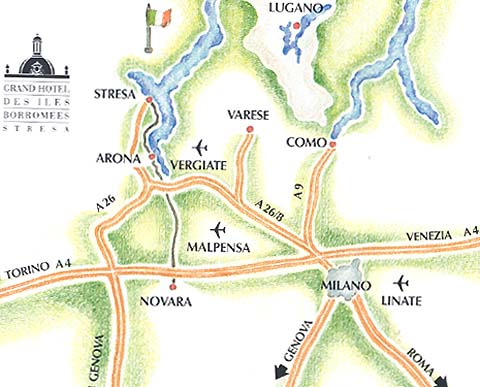 Press
and Bilderberg observation venue
Press
and Bilderberg observation venue
tel. 0323 31178 / 31190 fax 0323 32729
e-mail: info@milansperanza.it
http://www.emmeti.it/Welcome/Piemonte/ProvVerbania/Stresa/Alberghi/Milan/index.uk.html
http://www.voyagenow.com/hotels/stresa/milan_speranza_(lake_view).html
http://www.usembassy-israel.org.il/publish/press/2004/may/051103.html
http://www.cicero-project.com/nato/china.3.html
from:
http://www.telegraaf.nl/binnenland/11044231/PvdA_ers_bij_52e_Bilderbergconferentie.html
List of Dutch participants in the Bilderberg conferences since it's foundation
in 1954. Thanks HD|2N A!
http://www.nos.nl/radio1journaal/uitzendingen/specials/bilderberg_conferenties.html
As an alternative to the above link you can see all Dutch participants
since 1954 here
Taylan Bilgic from the foreign news desk of the Turkish Socialist Daily Evrensel in Istanbul notes that in the Wednesday June 2nd edition of Milliyet has a verified list of names of Turkish attendees at Bilderberg 2004.
According to Spanish political adviser Daniel Estulin the Spanish political class look set to be present in force at Bilderberg 2004.
Michel David-Weill - US and French president of the board of Lazard Freres is due to be there. There is no other information about who will be there yet - apart from the usual royalty and Bilderberg Steering Group attendees - a list of which has been made available in previous years from Maja Banck at the Bilderberg office in Leiden
Here, is a report interviewing a participant http://italy.indymedia.org/news/2004/06/573958.php here on Edwards, a story covered also by the New York Times and Boston Globe.
http://italy.indymedia.org/news/2004/07/586514.php Picture too.
http://italy.indymedia.org/news/2004/06/562510.php glad to be considered as a photgrapher :) More interesting, the new Italian Economy Minister was at Bilderberg (he took over from Mr. Tremonti a few weeks after Stresa) http://italy.indymedia.org/news/2004/07/588994.php
Sorry it's mostly in Italian, but we did do a pretty extensive investigation :)
Thanks to Italian Franco Bernabe, the president (between others) of Petrochina for his help :)
Mazzetta (Italian Indymedia)
Pedro Santana Lopes was one of the three Portuguese present at the Bilderberg reunion of 2004, and I have some information on him. But before I proceed, I must explain our current political situation here in Portugal.
Our Prime Minister, José Durão Barroso - who also participated in one the meetings of the Bilderberg Group, has been invited to be the next President of the European Commission and he accepted this nomination.
He has, at the moment, the support of the main politicians in Europe. But, and in the terms of our Constitution, the resignation of the Prime Minister dictates the resignation of all the executive government. Thus a major political crisis here In Portugal.
Now, our Republic's President has to decide if he calls for new elections - the only democratic solution possible - or if he accepts the nomination of Pedro Santana Lopes to Prime Minister (with no election). Jorge Sampaio, our President, has earlier attended one of the Bilderberg Meetings, and he is inclined to choose Pedro Santana Lopes for Prime Minister, without elections.
Who is Santana Lopes? Well, he is the son of Maria Ivone and Aníbal Lopes, in 1956. He has a degree in Law, but was low graded student. From 1976, he was a member of the PSD Social-Democrat Party (Conservative party), Chief of staff on culture, he once said he loved "Chopin's compositions for the violin" - this shows the kind of man he is. Low culture, he only likes to show himself in social events. He is a right wing man, pro-globalisation, loves soccer, and he is the Mayor of Lisbon, but he got in by a very strange elections (much like Bush in Florida).
However, we are talking of a megalomaniac that sees himself as "a man of politics, and a man of victory" - on his biographic web site. He does not hesitate to create conflicts inside PSD to try to ascend to power positions, opening crisis among its peers, generating plots inside national politics, to ascend. But he failed to get the support of the members of his party, so he has lost the elections inside PSD. However, he won the Mayor of a town called Figueira da Foz, and he made a fair job, so, the next step was Lisbon. But in Lisbon, he only won with strange elections.
He wants to change Portugese Constitution, in order to create a new institution of power, called the Senate, and he presents himself, with others, as one of the the necessary names to be senators - notice that this senate would not be like USA Senate; he proposed a life time nomination as a senator. There would be no election for the Senate, but the Government would simply nominate life time senators. This is his concept of State.
As I write this lines, here in Portugal there are manifestations all over the contry demanding election and against the nomination of Pedro Santana Lopes without elections, for Prime Minister.
José Socrates, other of the three participants in 2004 meeting, is a important leader os PS (Socialist Party); he is pointed as a strong menace for the leadership of Ferro Rodrigues. At the moment Rodrigues is leader of PS, but in the middle of an internal war inside PS, which nobody knows the genesis of this war, because he has taken PS to great results on statistics.
http://english.pravda.ru/mailbox/22/101/399/13245_Barroso.html
Jose Manuel Durao Barroso was born in Lisbon on 23rd March, 1956. He soon became involved in political activity, joining the MRPP (Reorganising Movement of the Proletarian Party), a Maoist organization, before the Revolution of 25th April 1974, which brought an end to the Fascist regime of Marcelo Caetano (who had succeeded Dr. Antonio Salazar in 1970).
His passage through Lisbon University's faculty of Law was marked by the now-famous fights between left-and right-wing political groups, in which Jose Barroso was a central figure. He abandoned his party in 1977 after it changed its name to PCTP-MRPP, adding "Portuguese Communist Workers" Party), one year before he graduated and went to Geneva to take a Master"s Degree in Political and Social Sciences and later, specialization courses in Georgetown University, Washington. Returning to Portugal, he became a Teacher at his Law Faculty in Lisbon.
He joined the PSD (Social Democratic Party), centre-right, in 1980, becoming associated with the right-wing spectrum of the party, led by Anibal Cavaco Silva, who became leader of the PSD in May, 1985. In the general election held in October of that year, Jose Barroso was elected a Member of Parliament at 29 years of age, becoming Sub-Secretary of State in the Internal Affairs Ministry.
In 1987, alter a new election and the PSD gaining an absolute majority, Barroso was appointed Secretary of State for Cooperation in the Portuguese Foreign Ministry, involving himself in the beginning of the peace process in Angola (where the MPLA and UNITA had fought a civil war since 1975.
In 1992, after Cavaco Silva"s PSD was reelected with another absolute majority, Jose Barroso became the Minister of Foreign Affairs. He continued to work on the Angolan peace process, his work being rewarded with the signing of the Bicesse Agreement (1991) which temporarily halted the conflict. His period in government finished in 1995, when the PSD lost the election to the PS (Socialist Party), led by Antonio Guterres.
In opposition, Barroso continued to work in his chosen area, leading the Parliamentary Commission on Foreign Affairs and working as Director of the International Relations department at the Lusiada University, Lisbon, contributing towards the East Timor independence process.
In 1999, Barroso took advantage of an internal power struggle in his party (after the previous leader Marcelo Rebelo de Sousa was forced to resign after a disastrous alliance with the Popular Party of Paulo Portas). Candidate for the party leadership for the second time (after having lost the first battle to Fernando Nogueira in 1995), Jose Barroso was elected leader of the PSD.
As leader of the party, Jose Barroso was unable to make any inroads, due to his weak oratorical skills and lackluster personality. The PSD lost the European Parliament elections in 1999 (31.1%, against the Socialists" 43%), the legislative elections in Portugal the same year (32,3%) and the Presidential Election in 2001, where his candidate Joaquim Amaral was beaten by Dr. Jorge Sampaio (Socialist Party). However, Barroso was re-elected as party leader in 2000.
In December 2001, the Socialist party lost the main municipalities in the local elections (Lisbon, Coimbra, Oporto, Cascais and Sintra), although the party still had more votes than any other. Antonio Guterres, tired of the in-fighting in domestic politics, took this as a sign of his unpopularity and walked out of the government, leaving Eduardo Rodrigues as his substitute as leader of the party and calling for a parliamentary election.
During the election campaign, Barroso adopted a discourse of catastrophe, saying phrases like "The country is stripped naked" "Portugal is in chaos" "The country cannot continue like this", which just about won him the election in 2002 (slightly ahead of the PS with 40.1% against 37.8% but needing to form an alliance with the former pariah, Paulo Portas (Popular Party, Conservative).
However, he failed to communicate with the people in his brief tenure of office, making him arguably the worst Prime Minister in recent political history, due to the fact that in two years, the unemployment rate doubled and unemployed people had to wait up to seven months for their state payments. He and his team, seen as inhumane and uncaring by the majority of the Portuguese, were extremely unpopular, a feeling reflected in the recent European Parliament elections, in which the government coalition was crushed by the Socialists.
As usual, Barroso acts as a protagonist and not as a man of integrity, accepting the European Commission as the third or fourth choice, just because there was nobody else. As a young man, he abandoned the left because he saw a chance with the right, allied himself to the man he thought would bring him the best chance of public office in his party, allied himself to the man (Portas, PP) who had attacked his party so vigorously in opposition in the 1990s (as Director of a national newspaper), criticized Antonio Guterres for abandoning the government half-way through his programme and then did exactly the same because he saw how unpopular he was.
It is a question of time before Jose Barroso commits an enormous gaffe in Europe, making as much a spectacle of himself (for the wrong reasons) abroad as he has done at home for the last two years, having arrived at his level of incompetence under Peter"s Principle.
Weak, uncharismatic, with zero communication skills, Jose Barroso would be better and happier working as a grey Eurocrat behind the scenes in the External Affairs area.
Timothy Bancroft-Hinchey
FRONT PAGE STORY - 03Jul04
Portuguese Prime Minister Durão Barroso was on Tuesday named as the next head of the European Commission. Following weeks of speculation as to who would replace Romandi Prodi, it became evident that Barroso would resign as Prime Minister on Sunday when he received an official invitation from Irish Prime Minister Bertie Ahern, whose country had been leading the European presidency.
Durão Barroso is expected to stand down as Portugal's Prime Minister next Monday. However, Barroso's resignation is presenting the Portuguese state with an unexpected and immediate crisis.
In the meantime, and while Durão Barroso has gone to great lengths to ensure internal stability, it seems that he will leave national problems behind him next week to start preparing a new European Commission.
Durão Barroso will also need time to prepare his programme for presentation to the European Parliament, which has to approve his nomination on July 22.
But Barroso's departure for the EU's top job has prompted fierce debate between Lisbon's centre-right coalition government and left opposition parties on how he should be replaced.
Senior figures in Durão Barroso's two-party executive have insisted President Sampaio allows them to form a new cabinet.
The main Socialist opposition, boosted by victory over the prime minister's Social Democratic Party (PSD) in recent European elections, wants early general elections.
"I consider the best solution for the political crisis created by the prime minister's resignation is early elections", Socialist chief Eduardo Ferro Rodrigues was quoted as saying by the Lusa News Agency on Wednesday, adding that this call had been unanimously approved by his party's National Commission.
Meanwhile, an opinion poll published on Wednesday reveals that over half of Portuguese want fresh elections.
The survey, published by Público, showed that 51 percent of Portuguese want President Sampaio to call an early vote. However, 54 percent said they supported Durão Barroso's decision to assume the role of EC President.
But Durão Barroso has fought back at opposition criticism.
Until last week, Durão Barroso had backed the candidacy of Socialist Antonio Vitorino, Portugal's European Justice Commissioner to take over the reigns in Brussels.
Durão Barroso called for the same "opposition consensus" over his departure for Brussels, "as exists among the Portuguese people".
"As prime minister, I backed the candidacy of an opposition politician. I think that I'm now in a position to ask the opposition to congratulate me on my election to the presidency of the Commission".
While no certainties exist as to who will now replace Durão Barroso as Portuguese prime minister, Lisbon Mayor Pedro Santana Lopes (as revealed in last week's edition of The Portugal News) is currently the hot favourite.
However, Finance Minister Manuela Ferreira Leite has already said she would not accept the former culture minister as prime minister, leading for calls from within the ruling party's ranks to make her interim prime minister. But this still appears highly unlikely, especially when it is borne in mind that Ferreira Leite is probably the most unpopular member of Durão Barroso's cabinet.
The final decision over elections will rest with President Jorge Sampaio, and should he opt for elections, the centre- right coallition, on current levels of popularity and the recent hammering they received in the European elections, should be removed from office and replaced by the Socialists.
However, the Socialists do not currently enjoy acceptable levels of stability within party ranks, and Ferro Rodrigues' leadership has come under increasing fire from within. The two strongest candidates to replace Rodrigues are former Lisbon Mayor João Soares (son of former President Mário Soares) and José Socrates, with the latter set to receive the most support and many are tipping him to become the next Prime Minister.
With Pedro Santana Lopes as chief of the PSD and José Socrates leader of the PS, the spectrum of Portuguese politics will have undergone a dramatic and unexpected surprise. But others may believe their rise to power was a foregone conclusion after the two attended the Bilderberg conference at the beginning of June (see The Portugal News, June 5).
http://www.aovk16.dsl.pipex.com/Bilderberg-BohemianGrove-JonRonson20040610.mp3
Thanks to Ben Phillimore for this - please contact Ben - email: aovk16(at)dsl.pipex.com
Ben also reccomends the newsgroup alt.binaries.sounds.radio.misc
From Pauli Ojanpera <pasaojan@cc.jyu.fi>
Dear Mr. Gosling - The speaker of Finnish parliament attended the latest Bilderberg meeting. I wonder if you knew that the organizer pays at least some attendee's expenses for participating. When I contacted our Parliament Information Office for information on the trip Lipponen took to Italy, I was told that the organizer took care of all organising and paid all the expenses his trip. Regards, Pauli
---------- Forwarded message ----------
Date: 8 Jun 2004 13:07:00 +0300
From: Kivinen Merja <merja.kivinen@eduskunta.fi>
To: Pauli Ojanpera <pasaojan@cc.jyu.fi>
Subject: Vast:Lipposen ja Lehtomäen matka Stresaan Hei!
Puhemies Lipponen oli matkalla kutsuttuna vieraana. Tilaisuuden järjestäjä vastasi kaikista järjestelyistä sekä kustannuksista.
Ystävällisin terveisin, Merja Kivinen
Eduskuntatiedotus/Parliament Information Office
00102 Eduskunta/Parliament of Finland
merja.kivinen@eduskunta.fi
p. +358 9 432 2021
fax + 358 9 432 2019
2004-06-04 - by Dr. James J. Zogby
http://www.unobserver.com/layout5.php?id=1718&blz=1
There's a story behind the story. And it is a messy tale of deceit, cronyism and corruption.
Ahmad Chalabi's apparent falling out with the U.S., and some recent reports indicating that U.S. Undersecretary of Defense, Douglas Feith may be losing influence in the Administration, represent only the latest chapter in their sordid histories and relationship.
Back in 2001, when Feith's name was first mentioned for the number three position in the Pentagon, I wrote two lengthy articles on his business dealings and his ideology. Part of the Reagan-era Defense Department neo-conservative group, Feith left government service and trading off of his political contacts, he became a lobbyist and foreign agent, representing Turkey and some Israeli interests as well. In 1996, Feith, a supporter of the Likud in Israel, co-authored a paper for the Israeli Prime Minister Benjamin Netanyahu advising him to end the Oslo peace process. When Netanyahu signed the Wye Agreement, Feith broke with him, accusing the Israeli leader of compromising away his values.
Chalabi has a long and well-known history of shady business dealings. His active courting of pro-Israel and neo-conservative groups leading to the passage by Congress of the Iraq Liberation Act of 1998 (ILA), is also quite well-known.
So much for their separate histories.
Their relationship blossomed after Feith was confirmed by the Senate and assumed his post at the Pentagon. Early on, he began, in earnest, to lay out the justification for a war with Iraq. The funds that Congress mandated in the ILA, had been frozen during the Clinton years. Early in the Bush term, they were freed up to help finance Chalabi's activities. For his part, the Iraqi and his group began to supply Feith's newly reorganized Defense Department with "intelligence" on Saddam's weapons of mass destruction progress, and later on, with "information" linking the Baghdad regime to al-Qaeda.
Both men were willing and eager accomplices of each other's missions. Both wanted a U.S. war to topple the hated dictator and would, apparently, go to any length to make that happen.
It was Chalabi, among others, who also sold Feith both on the ease with which the regime could be removed and the uprising of support for the U.S. that would immediately follow. It was assessments such as these that provided Feith's planning office with logic that justified their fatally flawed post-war calculations.
But Chalabi's fabrications didn't stop there. Even during the 1990s, it is now known, he was promising the war's supporters that his post-Saddam Iraq would establish diplomatic and trade relations with Israel and the U.S. He and his supporters were, at one point, quoted in the U.S., to the effect that after Saddam, the Russians and French would be out, replaced by U.S. companies who would be contracted to exploit Iraq's bountiful oil resources. More quietly, Chalabi was even promising both Israelis and their U.S. supporters that not only would the new Iraq trade with Israel, but it would resurrect the Iraq-Israel pipeline for oil export. This, of course, was music to their ears.
Shortly after the war began, Chalabi, despite strenuous objection from the State Department and the CIA, was airlifted with his supporters into Iraq. He immediately began plans to establish a power base in his newly liberated country.
Appointed by the U.S. to a position on the Iraqi Governing Council, Chalabi assumed the role of director of its economics and finance committee. He was able to place his close relatives and other allies in key ministries and directorships of institutions dealing with Iraq's banking, finance and oil resources.
The spoils of war were now within his reach.
One of his nephews, Salem Chalabi, chose not to hold a government position. Instead, he established the Iraq International Law Group (IILG), which describes itself as "your professional gateway to the new Iraq." Assisting Salem in setting up the IILG was a partner Marc Zell (the IILG's website has been registered in Zell's name). Zell is an Israeli settler of the Gush Emunim (Bloc of the Faithful) stripe. Here the plot thickens.
Zell had for many years been Feith's partner in their Washington-Tel Aviv law firm, Feith and Zell (FANDZ). FANDZ had been set up when Feith left government to pursue the work of a "foreign agent" representing Turkey and some Israeli interests.
Following the Baghdad opening of the IILG, Zell soon opened, in the U.S., an office for Zell, Goldberg & Co., which promises to assist "American companies in their relations with the U.S. government in connection with Iraq's reconstruction projects." It is interesting to note that Zell, Goldberg still uses the website FANDZ, the site of the old Feith and Zell firm. So when Zell boasts his connections to government, businesses know exactly what is meant.
In the relatively short period of time since the fall of the Ba`ath Party regime, IILG and Zell, Goldberg have facilitated contracts in the tens, possibly hundreds of millions of dollars.
Salem Chalabi incidentally has also been appointed by the Coalition Provisional Authority to head the Iraqi tribunal that will investigate and prosecute the crimes Saddam and his cohorts committed against the Iraqi people. His uncle is meanwhile railing against the former regime's corruption and demanding the right to investigate profiteering and kick-backs he alleges occurred in the UN's food for oil program.
Surely Saddam should be tried for his crimes and the people of Iraq have a right to have lost revenues restored. But for this effort to have credibility, surely the Iraqi people deserve to be represented by judges and investigators who themselves are credible.
In any case, for reasons unrelated to this sordid web of corruption and cronyism, it appears that Feith and his friend and co-conspirator Ahmad Chalabi have fallen on hard times.
Feith, for example, has been implicated in the Abu Ghraib debacle. It was his office that had general oversight over post-war planning (and pre-war propaganda). And it was apparently his office that dismissed the applicability of the Geneva Conventions to the detained of Iraqi prisoners. Growing displeasure with his work in this regard (Gen. Tommy Franks has been quoted as calling Feith "the. . .stupidest guy on the face of the earth.") has caused him to be sidelined. There are also hints he may soon step down from his post.
For his part, Chalabi recently caused some irritation by proudly boasting that it didn't matter that the intelligence he provided the Pentagon was faulty, because it got the job done. He has also angered his neo-con and pro-Israeli supporters by apparently turning his back on commitments he made to them. He is also now in trouble, having been accused of providing important secrets to Iranian intelligence. His home was recently raided by U.S. and Iraqi forces.
What is intriguing is that in all the recent U.S. media coverage of the changing fortunes of both Feith and Chalabi, there is very little mention made of the questionable business dealings by those closely connected to them. Only a handful of reporters have actually dug deeply into this story.
Both Feith and Chalabi may be facing some difficulties, but don't count them out quite yet. Feith may leave government, but the last time he left the Pentagon, he turned his departure into business connections and a handsome profit. And Chalabi, the wily manipulator, also has a record of rebounding from set-backs that have marked his past.
With Zell and Salem in business, both Feith and Ahmad have a place to go. The final chapter in this sordid tale has yet to be written.
http://www.unobserver.com/layout5.php?id=1718&blz=1
Marc Delcour - 31May04
Roughly translated from Metula News Agency article in French
The Middle East is soon to be moving under the impulse of a huge behind-the-scenes agreement between governments of the USA, Israël, and certain components of the Palestinian Authority as well as Egypt and Jordan. And for the first time these last two countries have accepted to play an active role on the side of Israel, coordinated by the Sharon government.
As this agreement is rolled out of the shadows into the public domain it is becoming clear that the new plan doesn't insist on an end to the Israel-Palestinian conflict but that the partners have a fixed goal now to realize the conditions of the 'road map'.
In other words, it is about the neutralization of armed resistance to Israeli occupation, cessation of violence and an in-depth reform of the Palestinian Authority.
On Israeli Side, Ariel Sharon has accepted to evacuate the Gaza Strip and to dismantle all Jewish settlements if the agreement is signed.
The most spectacular aspect of this agreement is the neutralization of Chairman of the PA.. who will obtain the honorary title of President. The Chief of Palestinian government will become his prime minister, who shall hold all the powers.
The decisive move in the application of this new agreement was, without doubt, the visit of the Egyptian intelligence chief général Omar Suleiman, last Monday (31st May) in Ramallah and Jerusalem.
On this occasion, the Egyptian général explained to Arafat the overall lines of the agreement and let him know he has to name Mohamed Dahlan as prime minister soon and to give him all power.
Arafat asked Suleiman "And if I refuse?" Mubarak's general answered him "These changes will take place with you or without you", adding "If you go against this, things will go badly for you, how can the new Palestinian state be born when we don't have the correct leader?"
The meeting was tough but to the point. At the end Arafat asked to receive the promise of Sharon, that if he accepts the terms of the diktat, he can travel where he wants and will no more be confined in the Moukata.
Arafat waited to receive a direct answer from prime minister Sharon and guaranties from President Mubarak about the implementation of the agreement.
After a discrete second conversation with Sharon and a rather long phone call between the President of the Israeli Council and the President of Egypt, Ariel Sharon sent out a communiqué : Israël guarantees Yasser Arafat full liberty of movement on the condition that the Palestinian forces are brought together under one centralised command and that violence against the Israelis stops.
Over and above the official publication of this agreement, two extra conditions have been communicated to Arafat :
1) He must keep out of the political direction and military direction of the Palestinian Authority
2) He must not contradict the action of the new prime minister and his successors from Palestine.
Last year chairman of Royal Dutch Shell group's committee of directors, Sir Phillip Watts, was sacked. As expected Jeroen Van der Veer, last year attendant to Bilderberg, has assumed the key role in RD Shell. Peter Sutherland of BP was the other attendant. Are things to occur between the both companies?
I am personally betting upon the presence in Stresa this year of Mr Jean René Fourtou, the president of the International Chamber of Commerce and president of Vivendi Universal. As President of the I.C.C. born as well in 1919 his annual congress is to be held in Marrakech from 6 to 9 June 2004. "Standing up for the global economy " is the strapline for the ICC meeting.
"We ask George W. Bush to push the Doha cycle on international commerce again to the top of the priorities, as spectacularly unexciting EU trade commissioner Pascal Lamy (last year attendant) is making the same request at the expense of the EU against the will of France. Mr Zoellick (attendant last year) is overjoyed at these new developments.
Mr Fourtou is a intelligent man and a neo-liberal in favour of the opening of the borders, exchange liberalisation, investment, technology transfers, migrations of populations. With Fourtou everything is wide open except his flies!
ICC was founded in Atlantic City in 1919 and is now present in more than 130 countries. It s presenting itself as the voice of global business. The international secretariat is in Paris.
As the reliance of the cycle of Doha is as the centre of international negotiations after the failure of Cancun, as ICC is a globalist institution working with the TABD, as JR Fourtou is a clever man with a special role in Marrakech (Morocco) at the moment Business wants the US/UK/Isreal led ‘Greater Middle East’ to work (despite the unintelligent work of GW Bush team) we may consider Fourtou as an eligible Bilderberger 2004.
The Nato Summit will be held in Istanbul on the 28 and 29 of June - main topic of conversation - improving links with the Chinese military - see also ther Turkish attendees confirmed.
One of the main agenda items on the 2004 Bilderberg Meeting will probably be a 'Greater Middle East' initiative to be imposed upon Europeans by their big brothers from USA. This initiative is aimed at a global strategy from Morocco to Afghanistan. Bush's puppeteers want to put on the table something bringing cooperation with his allies in an electoral year in order to promote a 'left-right' collaboration about the middle East.
The first to give his agreement to this plan was Joshka Fisher, German secretary then Chancellor Schroeder, but the French are more cautious about the project. Their position, quite correctly, is that before handling the region, the Israeli - Palestinian conflict has to be solved. Otherwise it will all be a waste of time/effort/money/life. Europeans understand correctly that US will ask them to finance their plan. Naturally, Javier Solana is again 100% in favour of this plan.
USA are trying to bring NATO into their plan and this is likely to be rejected by Europeans.
Hawks' CAFE is asking authorities with jurisdiction to treat the Bilderberg group (see 2004 participant list below) as a racketeering influenced and corrupt organization (RICO).
Using money stolen from the UN Oil-for-Food program and a 9/11 pump-and-dump strategy, insider trading by two Bilderberg banks, AXA/BNP Paribas (run by Henri de Castries and Power Corp of Montreal) and JP Morgan Chase (David Rockefeller and Henry Kissinger) have generated about $250 billion in illegal profits from their '90s bubble stocks, including Enron, Nortel and WorldCom.
Profits from the fraud appear to have been laundered through bogus life insurance contracts taken out by AXA/BNP Paribas on the victims of 9/11.
http://www.axa-financial.com/pressroom/2001/09172001_claims_announcement.html
Henri de Castries and fellow AXA executives have been charged with money laundering through bogus life insurance contracts, allegedly taken out on the 72 victims of the Order of the Temple of the Sun massacres in 1994/95 in France, Switzerland and Quebec.
http://www.conspiration.ca/conspir/ots_blanchiement_axa.html
David Hawkins, Foundation Scholar, Cambridge University and founder of the Citizen's Association of Forensic Economists at Hawks' CAFE Independent networking for "Clarity, Equity and One Set of Books!"
Conversations and Case Studies http://www.DavidHawkinsResearch.com
If I am correct, this is the 50th anniversary. According to Pepe Escobar's Asia Times article, in 2003, the topic of discussion was how to "avert" (read: bring about) a financial collapse of the western sphere. If this is the 50th year of the Bildies, it is a Jubilee year, meaning a liquidation is in the works, possibly. The trick is to bring about a financial collapse of debt/credit and play this off as a failure of capitalism. This will make communism/socialism/fascist collectivism more appealing which is, of course what all the current chaos in the Middle East is really all about.
http://www.gateway.ualberta.ca/view.php?aid=2632
http://vancouver.indymedia.org/news/2003/08/63985.php
http://www.vancouver.indymedia.org/news/2003/11/86676.php
http://www.vancouver.indymedia.org/news/2003/11/89008.php
Finally, some stuff that may be of general interest - cheers - Aaron
http://www.idaho.indymedia.org/news/2004/03/7235.php
http://www.vancouver.indymedia.org/news/2004/03/115115.php
One correspondant has heard that Bilderberg 2005 will be held at Waddesdon Manor in the UK?????